

“PMI improves not when AI is built, but when AI spreads, and we’re moving from brain builders to economy-wide beneficiaries.”
Executive Summary
This paper presents a 2026 AI outlook calling for an inflection: artificial intelligence is transitioning from a cloud-based software phenomenon into a physical-world infrastructure cycle with broad economic consequences. The first phase of AI investment (2022–2025) was narrowly concentrated in digital “brain builders”, hyperscalers, GPUs, and core networking producing enormous capital intensity but limited economic diffusion. As a result, traditional manufacturing indicators like PMI remained subdued despite record AI capex.
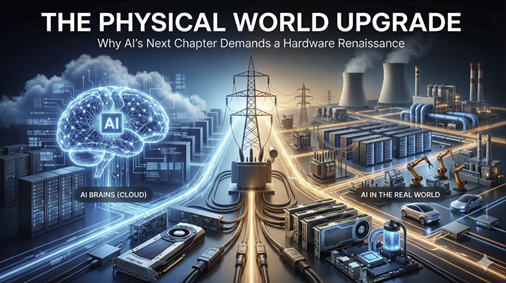
This year, we are entering the next phase: the physical upgrade of the economy. AI’s migration from centralized data centers into enterprises, devices, vehicles, and machines requires a wholesale rebuild of power systems, cooling, electrical infrastructure, and edge compute. This shift mirrors the historical arc of electrification: productivity and PMI do not improve when generation is built, but when intelligence is embedded broadly across the economy. The inflection point is not defined by how much AI is being built, but by how widely it is being deployed.
Several forces are accelerating this transition. Inference is moving from the cloud to the edge, enterprises are deploying always-on AI agents, and intelligence is becoming localized inside workflows, machines, and physical systems. At the same time, power and infrastructure constraints are forcing architectural change. One visible expression of this shift is the growing adoption of localized and behind-the-meter power solutions, including Bring Your Own Generation (BYOG), as hyperscalers and enterprises respond to grid bottlenecks, permitting delays, and the physics of always-on AI workloads. BYOG is not an energy trade; it is one component of a broader move toward distributed, resilient infrastructure that shortens AI critical time-to-deployment.
The result is a PMI-positive impulse. As AI-driven investment spreads beyond a narrow set of technology suppliers into power equipment, electrical systems, cooling, controls, construction, automation, and industrial services, the beneficiary set broadens. New orders diffuse across more firms simultaneously, pushing PMI higher even if aggregate AI capex growth moderates. The AI cycle shifts from a concentrated, deflationary infrastructure build-out to a classic mid-cycle industrial expansion.
This paper argues that PMI improves not when AI is built, but when AI spreads and that the convergence of edge deployment, enterprise adoption, and localized infrastructure marks an inflection point in the AI cycle now beginning to surface in economic data.
From Cloud AI to the Physical World
For the past two years, the artificial intelligence revolution has been primarily a software story. Billions of dollars poured into training ever-larger language models, each new release measured by parameter counts and benchmark scores on text-based reasoning tasks. Investors fixated on the companies building these digital brains: the hyperscalers constructing massive data centers, the semiconductor firms producing cutting-edge GPUs, the startups racing to build the next ChatGPT competitor. But this focus on Large Language Models (LLMs) represents only the first act of a much longer transformation. We stand now at an inflection point where AI’s evolution from text-based reasoning to multimodal perception and physical action will trigger the most significant hardware upgrade cycle the global economy has witnessed in decades. The arrival of NVIDIA’s Blackwell architecture and the rapid advancement of Vision-Language-Action models (VLAs) mark the beginning of AI’s migration from cloud servers into the physical world, a transition that will require wholesale reinvention of nearly every compute device, industrial system, and physical asset across the global economy. Understanding this transition requires recognizing that AI is following electricity’s playbook. First you build the brains and the grid. Then you plug intelligence into everything, and that’s when productivity shows up and the broader economy benefits.
The distinction between LLMs and VLMs is not merely academic; it represents a fundamental shift in AI’s utility and economic impact. Large Language Models excel at processing and generating text, reasoning about abstract concepts, and providing knowledge synthesis. They are, in essence, disembodied intelligence optimized for linguistic tasks. Vision-Language-Action models, by contrast, integrate visual perception with language understanding and physical manipulation, enabling AI systems to observe the world through cameras, reason about spatial relationships, and control robotic actuators to interact with physical objects. This evolution from pure cognition to embodied intelligence changes everything about hardware requirements.
Where LLMs could be accessed through thin clients and existing devices, VLMs demand edge compute capability, low-latency processing, continuous sensor fusion, and real-time actuation. The entire compute stack must be reimagined. Blackwell’s architecture was designed precisely for this transition, with dedicated hardware for transformer inference, video processing pipelines, and the kind of sustained power delivery required for always-on edge AI. The chip isn’t just faster than its predecessors; it’s fundamentally optimized for a different kind of workload, one that operates in milliseconds rather than seconds, that processes continuous streams of sensor data rather than discrete text prompts, that must make decisions in physical space where failure carries real-world consequences. This architectural shift represents NVIDIA’s recognition that AI’s next trillion-dollar opportunity lies not in making chatbots smarter but in giving intelligence the ability to see, manipulate, and operate in the physical world.
The parallel to electricity’s industrialization is exact. Electricity didn’t matter because of light bulbs, it mattered because factories reorganized around motors, workflows were redesigned, and productivity exploded after electrification. Right now, the “brain” lives mostly in the cloud. Latency, cost, privacy, and reliability are constraints. Enterprises still call intelligence instead of embedding it. That’s exactly where electricity was before industrial reconfiguration. Once electricity was reliable and cheap, motors went inside machines, intelligence went local, and factories stopped relying on a central steam engine.
The Edge and Enterprise Shift: Intelligence Moves Local
AI follows the same arc: from cloud-only AI to edge inference, from centralized reasoning to distributed intelligence, from workflow redesign to agent autonomy. The move to the edge isn’t ideological, it’s driven by physics and economics. Agents making decisions can’t wait on round-trip cloud calls. Inference at scale is too expensive in centralized clouds. Enterprises won’t send crown-jewel data off-premises forever. AI becomes mission-critical and must work offline. This creates three parallel AI grids: cloud for training, coordination, and large-scale reasoning; enterprise and on-premises for private agents and proprietary workflows; and edge for devices, robots, vehicles, and sensors. Exactly like electricity’s national grid, industrial substations, and local motors.
The hardware implications cascade across every category of compute device and enterprise infrastructure. Consider the smartphone, a product category that has stagnated for nearly a decade with incremental camera improvements and marginal processing gains. VLM-capable phones will require neural processing units (NPUs) orders of magnitude more powerful than current offerings, multi-sensor arrays for spatial understanding, thermal management systems capable of sustained AI inference, and battery technology that can support continuous on-device processing without daily charging. Gartner forecasts AI PCs will reach 55% market share in 2026, up from 31% in 2025, representing a massive replacement cycle for the corporate fleet. Apple’s pivot toward on-device AI processing previews this transition, but current implementations barely scratch the surface of what’s required. The same logic applies with even greater force to personal computers, where the rise of AI agents capable of operating software applications, managing workflows, and executing complex multi-step tasks will demand processing power that makes today’s “AI PCs” look quaint. Gartner predicts 40% of enterprise applications will feature task-specific AI agents by end of 2026, versus less than 5% in 2025, a velocity of adoption that will force enterprises to shift from API calls to the cloud toward hybrid architectures combining private clusters for steady-state inference with edge processing for latency and privacy. Microsoft and the PC manufacturers have begun positioning for this transition, but the installed base of enterprise and consumer PCs represents a replacement cycle that could stretch across the remainder of the decade. Automotive represents perhaps the most capital-intensive upgrade requirement, where the evolution from assisted driving to full autonomy demands complete reinvention of vehicle compute architectures: multiple redundant processing systems, 360-degree sensor coverage, real-time inference at the edge, and vehicle-to-infrastructure communication systems. Tesla’s head start in this transition provided it a multi-year moat, but every automotive manufacturer now recognizes that vehicles without VLM-capable systems will become unsellable within this decade. Even consumer appliances, refrigerators, washing machines, home security systems, thermostats, will eventually incorporate vision-based AI, requiring compute capability and connectivity that simply doesn’t exist in current product generations.
The enterprise infrastructure upgrade represents an even larger capital deployment, particularly as AI agents transition from experimental tools to mission-critical systems operating continuously across global organizations. The Fortune 500’s existing server infrastructure was designed for human-paced work: systems that peak during business hours, that process transactions in batches, that assume humans are in the loop for decision-making. AI agents don’t sleep, don’t take weekends off, and will generate transaction volumes that dwarf current enterprise loads. This operational reality demands a wholesale buildout of edge server capacity, bringing compute closer to where decisions get made, reducing latency from hundreds of milliseconds to single digits, and enabling the kind of real-time responsiveness that AI-mediated workflows will require. The “always-on” nature of agentic AI creates incremental demand for racks, switches, storage, power distribution, and cooling, smaller per site than hyperscalers but more numerous, driving diffusion across thousands of enterprise locations. This is precisely the shift from centralized utility to distributed deployment that electricity underwent, and it’s what transforms AI from a concentrated capital expenditure story into a broad economic expansion. The parallel explosion of blockchain-based settlement systems and stablecoin transactions adds another dimension to infrastructure demands: financial systems processing millions of micropayments per second, smart contracts executing automatically based on AI analysis, and treasury operations running continuously across time zones. Banks and financial institutions have barely begun to size the compute infrastructure required to operate in this environment.
The military dimension is equally profound, where the integration of AI into command and control systems, autonomous vehicles, drone swarms, and battlefield intelligence creates both an imperative and a vulnerability. Every major military power now recognizes that AI superiority will determine conventional military outcomes, driving massive investment in hardened edge compute, satellite-based AI processing, and autonomous systems capable of operating in contested environments without continuous connectivity to cloud infrastructure. The wars in Ukraine and the Middle East have made it clear that modern warfare is no longer about brute force but technological supremacy, with AI at its core. The Department of Defense’s JADC2 initiative previews the scale of this transition, but the timeline for full implementation stretches years into the future, creating sustained demand for specialized hardware that can meet military specifications for reliability, security, and performance under extreme conditions.
Beyond the upgrade of existing device categories, the emergence of humanoid robotics represents an entirely new hardware category that could rival smartphones in economic impact. The confluence of improved actuator technology, more efficient batteries, and VLMs capable of understanding and responding to unstructured environments has finally made general-purpose humanoid robots economically viable for real-world applications. Figure AI, Tesla’s Optimus, and a growing cohort of Chinese manufacturers are racing to bring robots to market that can perform useful work in warehouses, factories, retail environments, and eventually homes. Marc Andreessen captured the strategic stakes clearly: “AI is not just about large language models sitting in the cloud. We’re entering the age of embodied AI where intelligence takes physical form. That means robotics, autonomous machines, and real-world infrastructure.” Each humanoid robot represents a more complex hardware challenge than any consumer device: dozens of precision actuators, multiple camera and sensor systems, substantial onboard compute, high-density batteries, and all of this packaged into a form factor that must be safe, reliable, and capable of operating in human environments. The supply chain to support humanoid production at scale doesn’t yet exist, creating opportunities across precision manufacturing, advanced materials, battery chemistry, and specialized semiconductors. If humanoids achieve even a fraction of the penetration that smartphones achieved, we’re looking at hundreds of millions of units over the next two decades, each one vastly more complex and expensive than the devices that preceded them. The economic multiplier extends beyond the robots themselves to the infrastructure required to support them: charging stations, maintenance facilities, edge compute to coordinate robot fleets, and eventually the social and regulatory frameworks to govern their operation. Underpinning all of this physical-world AI, the upgraded devices, the enterprise edge servers, the autonomous vehicles, the humanoid robots, is the continued exponential growth in data center capacity and power infrastructure.
Power Is the Bottleneck — Not Compute
The buildout of AI training and inference capacity hasn’t peaked; it’s accelerating. U.S. data centers consumed approximately 4.4% of total U.S. electricity in 2023 and are projected to rise to 6.7% to 12% by 2028, with absolute consumption rising from 176 TWh to between 325 and 580 TWh. This represents an incremental demand equivalent to 74 to 132 GW of new power capacity, assuming 50% utilization. The magnitude of this requirement forces a fundamental shift from utilizing existing grid slack to requiring net-new generation and deep grid upgrades. Today’s AI capex is overwhelmingly compute, GPUs and accelerators; power generation and grid upgrades; cooling and networking; and centralized hyperscale infrastructure. This is the utility phase, not the productivity phase. We did not overbuild applications first, we overbuilt capacity. Just as electricity required centralized generation, transmission lines, grid reliability, and standardization of voltage and plugs before it could transform industry, AI requires foundation models as the “brains,” data centers and networking as the transmission infrastructure, power generation and cooling for grid stability, and CUDA, APIs, and model architectures as the standardization layer.
Blackwell’s power requirements dwarf previous GPU generations, and the next architecture will demand even more. The grid infrastructure to supply this compute doesn’t exist in most markets, creating a parallel investment wave in power generation, transmission, and distribution. What makes the 2026 cycle distinct from previous infrastructure buildouts is the acute concentration of bottlenecks in electrical engineering. U.S. transformer supply deficits are projected to hit 30% in 2026, with transmission-scale transformer lead times extending to three to six years. These are not temporary supply chain disruptions; they represent structural capacity constraints that create guaranteed revenue pipelines for electrical equipment manufacturers well into 2028.
BYOG and Behind-the-Meter Power: The Diffusion Accelerator
The shortage forces utilities to place orders years in advance, while hyperscalers increasingly invest directly into power pathways, with Alphabet’s Intersect acquisition explicitly tied to powering AI infrastructure and expected to generate 10.8 GW by 2028. Natural gas peaker plants are being kept online or brought back as AI and data center demand strains the grid, a direct signal that existing capacity cannot absorb the load. Battery storage and grid management systems must be upgraded to handle the volatility AI workloads create. This isn’t a short-term buildout that peaks and declines; it’s a sustained infrastructure investment that stretches across decades as AI compute demands continue their exponential trajectory.
Bring Your Own Generation (BYOG) represents a structural shift in how AI infrastructure is deployed and financed. Rather than waiting years for grid interconnection, hyperscalers and enterprises are increasingly deploying on-site gas turbines, generators, battery systems, and microgrids behind the meter. This is not about energy efficiency or sustainability optics; it is about speed, reliability, and architectural necessity. AI workloads, especially inference, agents, and edge systems, cannot tolerate power uncertainty or latency. BYOG compresses deployment timelines from years to months, unlocking immediate capital deployment across a much broader supplier base.
From a PMI perspective, BYOG is a diffusion accelerator. Grid-tied infrastructure concentrates spending among utilities and a narrow set of transmission suppliers, producing limited PMI lift. BYOG, by contrast, activates a wide industrial ecosystem simultaneously: power equipment manufacturers, medium-voltage switchgear, power electronics, cooling systems, construction EPCs, fuel logistics, controls software, and maintenance services. When many suppliers report improving orders at the same time, PMI rises, regardless of whether aggregate AI capex growth is accelerating or merely shifting in composition. BYOG therefore turns AI from a capital-concentration trade into a capital-dispersion cycle, marking a decisive PMI inflection rather than just another leg of the data-center build-out.
The physical AI buildout creates acute dependencies on commodities where China dominates global supply chains. Beyond copper’s role in power transmission, the transition demands rare earth elements for permanent magnets in robotic actuators and EV motors, lithium and advanced battery materials for portable AI systems and energy storage, and processed materials like refined graphite and cobalt where Western capacity barely exists. These supply chain chokepoints mean that even as the U.S. and Europe race to build AI infrastructure, they remain structurally dependent on Chinese processing capacity, creating a strategic vulnerability that policy cannot resolve on the timeline the technology demands.
The Pennsylvania Energy & Innovation Summit announcement of over $92 billion in new investment, backed by tech and energy leaders with sharp focus on funding data centers and power infrastructure, demonstrates how paranoia about falling behind in the global AI arms race is reshaping investment priorities. As one executive noted, China is significantly ahead of the U.S. in building out electricity supply, further intensifying pressure to catch up. The rise of DeepSeek made it uncomfortably clear that China may be much closer to AI parity with the U.S. than most had assumed, while the escalation of tariffs brought renewed focus to the strategic vulnerabilities outlined above.
This convergence, the simultaneous upgrade of consumer devices, enterprise infrastructure, military systems, humanoid robotics, and the power systems to run it all, represents the longest and most capital-intensive hardware cycle the global economy has experienced since the postwar industrialization boom. The character of this cycle differs fundamentally from previous infrastructure waves. Unlike the 2003 to 2007 boom, driven by China’s WTO accession and U.S. housing, which was a broad-based “volume” shock lifting every commodity from iron ore to lumber, the 2026 cycle is shaping up as a “value” shock, a high-intensity, precision industrial boom concentrated in electrical engineering, thermal management, and advanced semiconductor packaging. The 2003 era was characterized by urbanization plus housing, funded by debt across households and sovereigns, focused on steel, iron ore, and oil, with demand as the primary constraint and rising globalization. In contrast, 2026 is defined by data centers plus edge AI, funded by cash from corporate balance sheets, concentrated in copper, aluminum, and lithium, with supply, specifically power and chips and labor, as the binding constraint, all occurring amid trade fragmentation.
The concentration of advanced semiconductor manufacturing in Taiwan represents the single greatest supply chain vulnerability for the AI buildout. TSMC produces virtually all of the world’s leading-edge AI chips, with no comparable domestic alternative in the U.S. or Europe. A conflict in the Taiwan Strait would not merely disrupt chip supply; it would halt the entire AI infrastructure cycle overnight. This geopolitical fragility is why the CHIPS Act’s $52 billion commitment to domestic semiconductor manufacturing represents not industrial policy but strategic necessity. Intel, TSMC, and Samsung are constructing leading-edge fabs in Arizona, Ohio, and Texas, but these facilities won’t reach volume production until 2025 at the earliest and won’t achieve cost parity with Asian operations for years beyond that. The buildout timeline creates a paradox: the U.S. is racing to secure domestic chip production precisely as AI demand is exploding, meaning the period of maximum dependency on Taiwan coincides with the period of maximum geopolitical tension. This mismatch forces hyperscalers and defense contractors to simultaneously bet on Taiwanese capacity today while funding redundant domestic capacity for tomorrow, effectively paying twice for the same strategic input. The capex burden compounds across the entire supply chain, from packaging and testing facilities to the specialized equipment manufacturers, chemical suppliers, and industrial gas producers required to support advanced node production. Unlike commodity manufacturing that can be reshored with relative ease, semiconductor fabrication demands an ecosystem that takes a decade to build and hundreds of billions to capitalize.
PMI Improves When AI Spreads, Not When It Is Built
Given these structural supply constraints across power, chips, and critical materials, understanding when this transition manifests in economic data requires recognizing that the Purchasing Managers’ Index is a diffusion index, not a growth index. PMI does not ask how big AI capex is. PMI asks whether more firms are doing better than worse this month. That distinction is everything. PMI rises when new orders broaden, supplier deliveries tighten, employment stabilizes, and capex intentions spread. Which means PMI lags infrastructure concentration and leads productivity diffusion. Many investors today assume that because AI already happened, PMI should already be strong. That’s backwards. Infrastructure concentration suppresses diffusion. Diffusion, not spend, drives PMI. The period from 2022 to 2024 was utility construction, PMI neutral to negative. Spend was concentrated in hyperscalers, GPU vendors, and power, cooling, and networking. Extreme capex with a narrow beneficiary set and long lead times created bottlenecks. PMI stayed subdued even as AI headlines exploded because only a small subset of firms saw new orders, most manufacturers faced higher costs from energy, labor, and rates, and productivity gains were not yet visible. This phase mirrors building power plants and transmission lines: capital intensity high, utilization low, no factory redesign yet.
We are now moving into the grid completion and early diffusion phase, the PMI inflection point that defines 2025 to 2026. AI is shifting from training to inference, from cloud-only to hybrid and on-premises, from tools to embedded workflows. Enterprises stop experimenting and start deploying. This is the PMI unlock. More companies benefit simultaneously: industrials, automation suppliers, semiconductors beyond GPUs, electrical equipment, and software tied to workflows rather than standalone applications. New orders broaden, backlogs stabilize, and productivity offsets wage pressure. PMI rises even if AI capex growth slows because benefits diffuse. This mirrors factories reorganizing around electric motors, productivity jumping after wiring is complete, and demand spreading across suppliers. The next phase, edge and enterprise AI expansion, represents the non-consensus call. AI shifts from centralized “brain in the cloud” to distributed intelligence everywhere, creating edge devices, on-premises inference clusters, and embedded AI in machines, vehicles, and tools. This drives broad PMI participation as small and medium enterprises benefit, not just mega-cap tech. Capex spreads geographically and sectorally. The diffusion index moves decisively above 50, and employment stabilizes or improves despite automation. PMI behaves like a classic mid-cycle upswing even though the catalyst is digital.
The crucial insight is that PMI improves not when AI is built, but when AI spreads, and we’re moving from brain builders to economy-wide beneficiaries. The timeline matters: 2023 to 2024 was AI utility build, 2025 is grid reliability and cost compression, and 2026 is enterprise and edge deployment. That’s when new orders broaden, supplier delivery times tighten across multiple industries, capex intentions spread beyond tech, and PMI finally reflects the AI cycle. After nearly three years of contraction, with U.S. manufacturing PMI spending most of 2023 through 2025 below 50, the setup for a sustained expansion is compelling. The global manufacturing sector spent 2024 and 2025 in protracted destocking following the post-COVID glut. As 2026 begins, inventories across the industrial supply chain are lean. If end demand ticks up even marginally due to the AI capex wave, manufacturers will be forced to ramp production immediately rather than drawing down stock. The gap between new orders and inventories in the J.P. Morgan Global PMI began to widen in late 2025, a classic leading indicator of a production ramp.
Investment Implications and the Risk of a Physical Stop
For investors, the implications are profound. The software-focused AI thesis that dominated 2023 and early 2024 captured only the opening chapter of this story. The companies positioned to benefit from the physical world upgrade represent a far more diverse opportunity set. The trade for 2026 is to own the “bottleneck assets.” Unlike 2003, when owning the resource, the commodity, was the winning strategy, 2026 rewards owning the process technology required to overcome physical constraints. The real value doesn’t come from chat interfaces or single-use SaaS wrappers. It comes from embedded intelligence, autonomous workflows, and AI as a background utility. Just like electricity stopped being something you used and became something that ran everything.
Semiconductor firms beyond NVIDIA, including memory manufacturers producing the high-bandwidth memory required for AI accelerators, specialized processors optimized for edge inference, and packaging companies executing the CoWoS advanced packaging that has become the chokepoint for AI chip production. TSMC is expanding CoWoS capacity from approximately 30,000 wafers per month to between 100,000 and 127,000 wafers per month by late 2026, and this capacity is fully booked through 2026, a hard signal that demand remains structural rather than speculative. Contract manufacturers who will produce the billions of upgraded devices. Battery and power management companies enabling portable and embedded AI. Networking equipment providers building the connectivity fabric for edge compute, where AI data centers are two to three times more copper-intensive than traditional data centers due to higher power density and liquid cooling requirements.
The move to liquid cooling, necessitated by Blackwell and future architectures, creates an entirely new manufacturing vertical producing coolant distribution units, manifolds, and specialized cold plates. Companies like Vertiv and nVent are effectively becoming the “plumbers” of the AI age, seeing order growth that outpaces the broader industrial sector as rack density moves from 10kW to 100kW, making liquid cooling transition from “nice to have” to mandatory. Industrial automation suppliers whose products get displaced by more capable AI-driven alternatives. Materials science companies solving the thermal, power, and miniaturization challenges that VLMs create. The electrical equipment manufacturers, producers of transformers, switchgear, and grid automation software, have two-year backlogs and pricing power, benefiting directly from the power pivot as utilities shift spending from efficiency to capacity expansion.
European industrials like Schneider Electric, Siemens Energy, and Prysmian are seeing earnings growth reaccelerate, forecast at 13% EPS growth in 2026, as they export transformers and high-voltage cables to the U.S. and Asia. Japan’s machine tool orders, a leading indicator of the global capital equipment cycle, turned positive in October 2025 with orders exceeding 140 billion yen, signaling that the industrial base is preparing for a 2026 upswing. China’s manufacturing data shows a widening gap between weak fixed asset investment in real estate and retail sales while seeing surging output in robotics, lithium batteries, electric vehicles, and drones, suggesting growth is pivoting toward strategic technologies that position China to benefit from the same AI-fueled investment cycle.
Hyperscaler capex projections for 2026 have been revised upward to approximately $600 billion, with upside scenarios reaching $700 billion, representing a 36% year-over-year increase from 2025. Microsoft’s additions to property and equipment reached $64.6 billion in fiscal year 2025, up from $44.5 billion in fiscal 2024, with $32.1 billion committed for building construction, primarily data centers. Meta guided $64 billion to $72 billion in 2025 capex, explicitly citing incremental data center investments for AI. Alphabet raised 2025 capex guidance to $91 billion to $93 billion, with the vast majority in technical infrastructure, two-thirds servers and one-third data centers and networking. Amazon’s expected cash capex of approximately $125 billion in 2025 is projected higher in 2026. Crucially, the mix of spending is shifting. In 2024, approximately 70% of capex went to GPUs and semiconductors. In 2026, this is forecast to shift closer to 50/50 as the passive infrastructure, power, cooling, and physical shells, catches up. You cannot deploy $300 billion of chips without $300 billion of infrastructure to house them.
Market-based indicators confirm the thesis. Copper prices and the Kospi both surged to new multi-year highs, signaling broad rotation into economically sensitive sectors. The CRB Raw Industrials Index recently hit its highest level since 2022, suggesting real demand is materializing. Yield curves have begun to steepen, a classic market signal of reaccelerating growth and modestly higher inflation expectations. A weaker dollar, experiencing its worst start to a year in many decades, historically leads to PMI bounces as global liquidity expands. These crosscurrents, all pointing toward reflation, are exactly what tends to precede a sustained upturn in manufacturing activity.
The risk to this thesis is not a lack of demand but a “physical stop.” If permitting delays, grid connection queues that currently average five years from interconnection request to commercial operations, and transformer shortages prevent the deployment of capital, the AI cycle could hit a “capex air pocket,” a pause in spending forced by physical constraints rather than financial ones. This would leave the global industrial economy vulnerable to a deflationary rollover, particularly if tariff regimes tighten further. The primary falsifier would be hyperscaler capex cuts, not just slower growth but guidance resets downward across multiple major players, or if transformer and switchgear lead times collapse because orders are canceled rather than because supply improved. However, the weight of evidence suggests the opposite outcome. The capacity is fully booked, the bottlenecks are real, and the strategic imperative to deploy is intensifying rather than moderating with government support.
The timeline for this transition stretches not quarters or even years but decades, creating the kind of secular growth opportunity that generates sustained outperformance for companies positioned at critical chokepoints. The investments tied to this transition are not a passing trade. The road to artificial general intelligence is expected to take at least four to five years, and what follows is an era of embodied intelligence where humanoid robots, autonomous systems, and next-generation infrastructure redefine entire industries. That timeline alone demands sustained capital expenditure unlike anything seen in recent cycles. The world spent the past two years teaching AI to think. The next twenty years will be spent teaching it to see, move, and build, and every step of that journey requires hardware the world hasn’t yet manufactured. This is not a speculative bubble built on unproven demand financed with debt. The compute is real, the applications are scaling, the infrastructure is being stretched, and the financing is coming from corporate balance sheets driven by paranoia around military supremacy at the country level and obsolescence at the enterprise level.
Unlike the dot-com era or even the 2003 to 2007 commodity supercycle, this cycle is characterized by infinite digital demand colliding with finite physical resources. The collision will drive an intense industrial boom in specific verticals, power, electrical engineering, advanced manufacturing, thermal management, that is powerful enough to lift global PMI into expansion territory even without the broad-based volume gains of prior cycles. The biggest winners will not be the light bulb companies, they will be the factory reorganizers, the companies that embed intelligence into workflows rather than sell it as a standalone product. Positioning has been heavily skewed toward services and software for over a decade, but as the AI narrative expands beyond code into physical infrastructure, commodities, industrials, and hardware are poised to become the structural winners of this new era. The canals being dug to channel the flood of AI capital represent where the industrial alpha of the next decade will be found.

