

Edge Inference Demands Memory-Centric Design as Physics Constraints Force Capital Reallocation
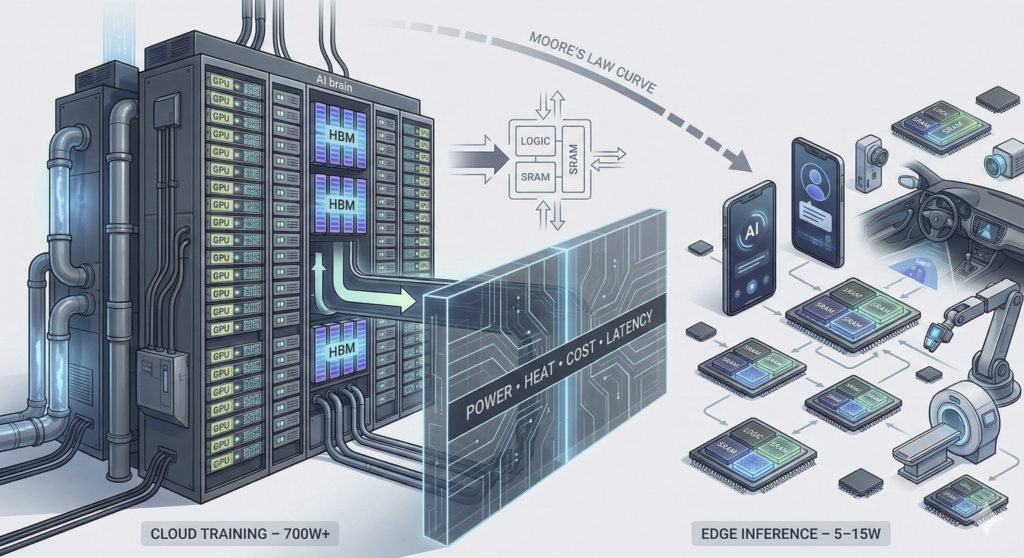
Source: Gemini
Executive Summary: The Thesis in Brief
- The Transaction: Nvidia’s strategic absorption of Groq’s talent and IP is not a defensive consolidation of market share, but a strategic pivot to edge inference, a market governed by different physics and economics than the cloud.
- The Problem: The current “Cloud AI” hardware stack (massive GPUs + HBM memory) is physically impossible to scale down to edge devices (phones, cars, IoT) due to power (watts) and cost constraints.
- The Pivot: We have hit the limits of Moore’s Law (transistor shrinking). The next frontier of value creation is architectural innovation, specifically, moving memory closer to compute (SRAM) to eliminate data movement costs.
- The Investment Opportunity: As AI workloads bifurcate into “Cloud Training” and “Edge Inference,” the winner-take-all dynamic of the cloud breaks. Value shifts toward specialized silicon architects, IP licensors, and advanced packaging firms that can deliver intelligence within strict power/cost envelopes.
The Signal in the Noise
When Nvidia acquired Groq’s inference technology and key talent last week, headlines focused on competitive positioning and SRAM versus HBM debates. They missed the signal. This transaction is not just industry news; it is the semiconductor industry’s recognition that as we move into embodied AI, we have hit fundamental physics constraints. The path forward requires abandoning Moore’s Law thinking in favor of radical architectural innovation.
As the industry transitions from centralized model training to distributed edge inference, placing “brains” in smartphones, vehicles, and enterprise devices, the binding constraint is no longer transistor density but rather how efficiently we can move data between memory and compute within severe power and cost envelopes. The Nvidia-Groq deal is not defensive maneuvering; it is offensive positioning for a market structure shift where memory architecture expertise becomes more valuable than manufacturing scale.
The Physics Constraint: Why Cloud Solutions Don’t Scale Down
Groq’s technology reveals a fundamental problem: the memory systems that work brilliantly in data centers simply cannot fit into phones, cars, or other consumer devices. Think of it like the difference between a city power plant and a battery. Data center AI chips can use expensive, power-hungry memory systems because they have unlimited electricity, active cooling, and costs spread across millions of users. A smartphone or car computer has none of these luxuries.
Groq solved this by building memory directly into the chip itself, making data access ten times faster while using a fraction of the power. This matters because edge devices face three unbreakable constraints: they run on tiny batteries (5–15 watts versus 300–700 watts for data centers), they must respond instantly (voice assistants can’t pause for half a second), and they must cost under $50 to manufacture or consumers won’t buy them.
The memory technology that powers cloud AI, called High Bandwidth Memory (HBM), adds $500–$1,000 per chip, drains batteries in minutes, and physically won’t fit inside a phone or car dashboard. You cannot simply shrink data center technology and expect it to work in a pocket or vehicle. The physics of heat, power, and cost require entirely different architectural approaches like designing a motorcycle instead of miniaturizing a semi-truck.
The End of the Moore’s Law Playbook
This inflection point mirrors the often-cited reality that Moore’s Law was never a physical law, but rather a self-fulfilling prophecy maintained by the massive allocation of capital and talent toward a singular goal. For fifty years, the semiconductor industry focused resources on shrinking transistors to increase density and speed. When AI emerged, capital initially flowed to the same playbook: better chips meant more transistors, faster clocks, newer process nodes.
But technical reality reveals this approach has hit multiple walls simultaneously. SRAM bit cells, the fast on-chip memory critical for edge inference, are struggling to scale even at TSMC’s leading 2-nanometer node after minimal gains at 3-nanometer, representing a fundamental materials science barrier. HBM supply is controlled by three vendors (SK Hynix, Samsung, Micron) with multi-year sold-out conditions, and advanced packaging capacity at TSMC has become an equally binding bottleneck. The constraint is no longer “can we make smaller transistors” but “can we architect systems that move data efficiently within physical limits we cannot overcome through manufacturing advances alone.”
Market Bifurcation: The Parallel Universe of Edge AI
The market structure implications become clear when we recognize that AI workloads are bifurcating, not converging. Cloud infrastructure will continue serving complex reasoning, knowledge retrieval, and model training, workloads that justify $30,000–$50,000 GPUs with massive HBM pools and hundreds of watts of power because costs amortize across millions of API calls.
But running AI locally on devices creates a parallel universe. Instead of the massive, power-hungry ‘brains’ found in cloud data centers, billions of smartphones and cars rely on compact, streamlined models, often 1/100th the size of the giants. These aren’t designed for creative philosophical debates; they are built for speed and specific jobs, like translating speech in real-time, helping a car spot a pedestrian, or processing sensitive business data without it ever connecting to the internet.
This edge market spanning 1.2 billion smartphones annually, 80 million vehicles, and tens of billions of IoT devices requires SRAM-centric architectures. Groq’s approach wins here because the workload fits in limited on-die memory and the speed advantage (eliminating off-chip memory round trips) directly translates to battery life and user experience. Nvidia’s acquisition of Jonathan Ross, Google’s original TPU architect, signals the company understands that dominating edge inference requires different talent and IP than what enabled their cloud GPU monopoly. The competitive moat shifts from CUDA ecosystem lock-in and HBM supply chain control to memory-compute co-design expertise, the ability to architect chips where data movement costs (in watts and milliseconds) matter more than peak throughput.
The Investment Thesis: Talent, IP, and the New Value Chain
Capital allocation is already following this realization, even as investor consensus lags. The Groq deal exemplifies a broader pattern: Microsoft’s Inflection and Amazon’s Adept transactions were structured as talent-plus-IP absorptions rather than traditional acquisitions. These deals target architectural capability and systems insight, not manufacturing scale or standalone company growth.
Memory architecture IP providers (SRAM optimization, in-memory compute, alternative memory technologies like ReRAM and MRAM) will capture disproportionate value as edge chip designers at Qualcomm, MediaTek, automotive tier-ones, and hyperscalers vertically integrating downward all need licensing solutions they cannot develop in-house quickly enough.
Advanced packaging will bifurcate: TSMC’s premium CoWoS remains critical for cloud, but edge economics demand lower-cost fan-out and embedded die solutions from OSAT providers like ASE and Amkor who historically lacked pricing power. Model compression and optimization software, quantization tools, distillation pipelines, sparse inference frameworks become essential infrastructure as every edge deployment requires translating frontier models into SRAM-constrained form factors. The winners are companies architecting for edge constraints from first principles rather than trying to scale cloud solutions down, and investors positioned in memory-centric IP rather than transistor-centric manufacturing will capture the next cycle’s alpha.
Conclusion: The Age of Memory Walls
The Nvidia-Groq transaction ultimately represents the semiconductor industry’s acknowledgment that we have exhausted the returns to Moore’s Law capital allocation for the AI era’s next phase. Training foundation models will continue demanding cloud-scale infrastructure, but deploying intelligence into the physical world, the autonomous vehicle making split-second decisions, the smartphone translating conversations in real-time, the hospital running diagnostic AI on-premise for HIPAA compliance, the factory floor processing sensor data locally requires solving the inverse problem.
Instead of “how much compute can we pack into a datacenter,” the question becomes “how much intelligence can we deliver within a 10-watt, $50, 50-millisecond constraint.” This is not a cloud versus edge zero-sum game but a workload bifurcation creating parallel value chains with different physics, different economics, and different winners. Crucially, this architectural shift breaks the “winner-take-all” dynamic of the cloud era; by moving intelligence to the edge, the market expands from a few hyperscalers to a diverse ecosystem of specialized chip designers and device manufacturers, creating a broader set of investable opportunities.
Memory architecture, how we co-locate and integrate compute with the data it needs, becomes the new frontier where capital and talent must concentrate, just as transistor density once was. Nvidia, by acquiring Groq’s SRAM-heavy design philosophy and the architect who pioneered Google’s alternative to GPU dominance, is hedging against a future where inference efficiency per watt matters more than training throughput per dollar. For investors, the implication is clear: the next five years belong to companies mastering the architecture of data movement under extreme constraints, not those incrementally improving the manufacturing of transistors under relaxing constraints. The age of Moore’s Law gave way to the age of memory walls, and the Groq deal is Nvidia’s insurance policy that they will be positioned on the right side of that transition.

