

I EU leaders predictably after long negotiations only early Friday morning agreed to an in the end surprising deal to borrow €90bn against the common EU budget and relend them to Ukraine as an interest free loan, repayable only if Russia eventually pays reparations to Ukraine. This is a surprising solution to the EU’s main task of funding Ukraine’s defense against Russia’s ongoing aggression. In the end, as discussed in earlier notes Ukraine got its money, while Russia’s asserts remain immobilized for now in a compromise that will please few and only has an indirect link to them. A number of important issues emerge from this compromise.
First the surprising rescuer of the day for the EU was none other than Hungarian prime minister Viktor Orban, who had previously threatened a veto against new common EU debt issuance for Ukraine. In the end, Orban agreed to merely – with Slovakia and Czechia – abstained in return for being exempt from any of the financial effects of the loan. Precisely why Orban offered this diplomatic concession to the rest of the EU (and Belgium in particular) to save their day is unclear, but could be related to his ongoing (tough) election campaign in Hungary or a desire to build political capital with other EU leaders.
Secondly, additional Eurobond issuance of €90bn in the coming two years will benefit supranational EU bond market liquidity, and there is no guarantee that the €90bn will suffice to cover Ukraine’s full costs until the end of 2027, should the war go on that long at undimmed intensity. That more common Eurobond issuance will be required for Ukraine can hence not be ruled out, as it seems plausible that EU leaders will also in the future choose to rely on this funding channel with only an indirect link to Russian assets.
Thirdly, the decision to fund the interest rate free loan to Ukraine with Eurobonds rather than cash balances from Russia’s immobilized assets will not immediately affect Ukraine, but have an impact on the EU’s own future budget process. As the EU issues new debt, it will incur interest rate costs that must be covered from the regular budget. This will invariably mean that other spending items will face increased competition for resources on the common EU budget from increased interest rate costs. As the EU is today a “single issuer”, e.g. all debt issued by the European Commission in the name of the EU, is essentially the same bond class and paid from the same common budget, it will not be straight forward insulate Hungary, Slovakia and Czechia from the financial costs of this particular category of Eurobonds. This will presumably have to be done through earmarked national rebates to the three countries, as part of the annual implementation legislation for the EU’s 7y budget. This seems likely to be a politically difficult endeavor for the three countries in question, as the rest of the EU will have many opportunities to block their other political and budget priorities. Ultimately, rejecting solidarity with the rest of the EU may prove costly for the three (and Belgium).
Fourthly, there remains an indirect link between the immobilized Russian assets and the loan principal now offered interest rate free to Ukraine, in so that Kyiv only has to repay the loan if Russia pays it reparations after the war. This remains a distant prospect, and EU taxpayers hence carry a material financial risk from this loan. At the same time, however, the EU can simply rollover the Ukraine loan for as long as it wants to, given that repayment – unlike as is the case with NGEU bonds for which repayment must in principle commence in 2028 – is linked to Russian reparations to Ukraine, and the EU budget must only cover the ongoing interest costs. Only if the EU decides to unfreeze Russia’s assets at some point in the future will it be on the hook for repaying the principal of the €90bn loan to Ukraine. This evidently makes it far less likely that the EU will ever declare that Russia is no longer a threat to the EU and unfreeze the money, and this deal hence – like the Reparation Loan itself would have – serves to keep Russia’s assets immobilized forever.
Fifthly, it is possible that these EU interest rate costs may come down from lower yields, as the EU bond market liquidity increases, but adding €90bn in new debt will nonetheless demand additional outlays for interest payments from the EU budget. This sets up an interesting political dynamic, as the member states most in favor of the Reparation Loan proposal is also by and large the EU budget’s main net contributors in Germany, the Netherlands and Scandinavia. These “frugal countries” are likely to resist that the EU budget as a whole is expanded to cover these costs, but instead demand that other spending items in the next long-term EU budget from 2028-34 are cut – unless of course a new deal for directly accessing the cash balances from Russian assets is agreed at some point in the future. This is particularly the case, once the potential rollover of NGEU debt (rather than repayment initiated) after 2028 will be discussed. As such, while reopening the Reparation Loan proposal does not look likely in the coming months, the Russian assets will invariably become a part of the EU’s coming long-term budget negotiations. Should the war go on – which is the base case – as EU member states begin to realize the future budget costs of leaving them immobilized, they are likely to look for ways to access them in some shape or form.
Lastly, it is clear that German Chancellor Friedrich Merz and Commission President von der Leyen are the main near-term political losers from this deal, as both were the main proponents of the Reparation Loan proposal. This suggests that not least Merz will now be even more politically dependent on the eventual passage of the EU-Mercosur FTA, ratification of which was postponed to mid-January by a last minute intervention by Italy’s prime minister Giorgia Meloni. French President Macron was a noticeably low key, if not outright anonymous presence as the summit, despite its geopolitical agenda. Yet the French president on the other hand did help secure more issuance of Eurobonds, a long-standing French wish and the abandonment of the Reparation Loan proposal also insulated French banks from any of its effects.
In sum, the EU found the needed money for Ukraine, but did so in a manner via Eurobonds that will eat into the financial and political space available for the next long-term EU budget. So in a sense, the EU paid for its unwillingness to access Russia’s assets by constraining its ability to fund things in the next budget. This will in time see other member states’ priorities curtailed – the EU budget is not that big and even limited additional interest costs without new earmarked revenues to cover them will crowd out other spending priorities. Other capitals will in time feel these costs more acutely, so while Russia’s assets hence remain merely immobilized, they may not remain untouched in the longer-term.
II In contrast to the late-night drama in Brussels, the ECB’s December rate setting meeting went predictably without surprises. No changes were made to either rates or the meeting-by-meeting monetary policy rate setting outlook. If anything, President Lagarde’s emphasis on avoiding taking any directional stance regarding the next change in interest rates suggests that neither hawkish nor doveish groups on the Governing Council feel particularly strongly about their case at this point.
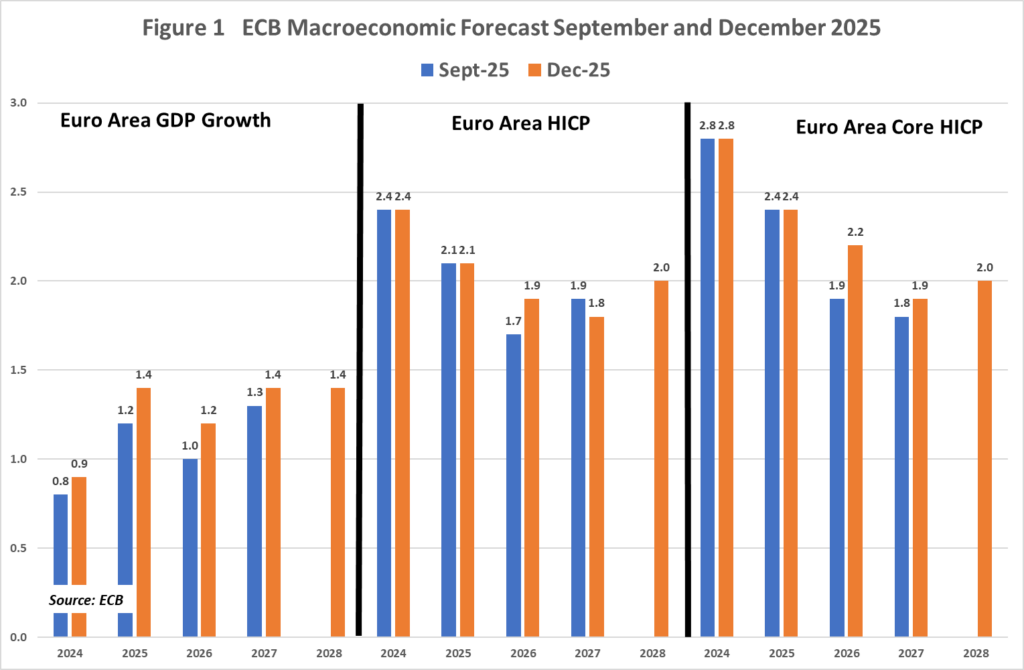
The updated macroeconomic outlook now including 2028 data was similarly relatively uneventful (figure 1), though by presenting a GDP growth upgrade for both 2025, 2026, and 2027 and an increase inflation in 2026 to 1.9 percent, e.g. essentially at the ECB’s 2 percent target, this forecast will have quelled belief that the Governing Council might implement another “insurance cut” to prevent inflation undershooting in 1H 2026. This now looks much less likely, and the base case for the ECB to do nothing on rates for all of 2026 has further increased. A macro forecast further suggesting for the final year in 2028 that growth will be essentially at potential with 1.4 percent, and HICP (and core) inflation will be at the 2 percent target does not imply a Governing Council in any haste in making monetary policy changes.
Bottomline is that the ECB remains – and look likely to through 2026 – to be in a “good place” and have to change interest rates.
Jacob

