Back China Strategy

China: Stimulus Expectations Dip Ahead of Year-end Meetings (CHESS Update)

Published on December 3, 2025

Download the PDF Report

By

Michael Hirson

Houze Song

SUMMARY:

  • 22V’s CHESS sentiment tool shows that analyst expectations for stimulus have declined in the last month, to a level around neutral; a key driver is the stabilization of US-China relations since the Trump-Xi meeting in late October.
  • Analyst sentiment towards the macroeconomic outlook remains high, reflecting confidence in China’s exports due to reduction of trade tensions; our in-house view of the economic outlook is more cautious, given domestic headwinds and limited urgency to stimulate.
  • Equity market sentiment remains high, in stark contrast to very weak sentiment for the property sector.

In our recent preview of China’s Central Economic Work Conference (report link HERE), to be held in mid-December (dates TBD), we emphasized that Beijing is unlikely to signal significant near-term stimulus – despite the fact that growth momentum continues to slide.

For another perspective on these dynamics, this report is our monthly update of the China Economic Sentiment Series (CHESS). CHESS uses ChatGPT to assess the sentiment of analysts commenting in China’s domestic media.

The main takeaway from the latest CHESS signals is that, like us, analysts do not have high expectations for near-term stimulus. That said, their views on the macroeconomic outlook are more optimistic than ours. Analyst sentiment toward the equity market remains quite high, in stark contrast to very weak sentiment for the property sector. Further details and charts below.

Stimulus Expectations Fade

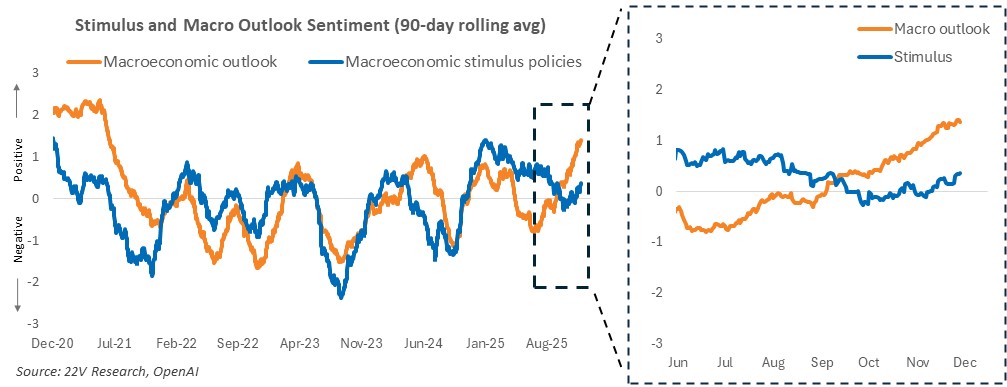
The chart below shows analyst sentiment towards stimulus (orange line) versus sentiment towards the macroeconomic outlook (blue line). Stimulus expectations have faded since the summer and are now essentially at neutral, after a long stretch in positive territory since Beijing’s “policy pivot” in September 2024.
A graph of a line graph

AI-generated content may be incorrect.

While the decline in CHESS stimulus expectations is consistent with our own view, there is an important nuance. CHESS stimulus expectations have declined as CHESS sentiment towards the macroeconomic outlook has improved, and as the US-China trade truce has reduced risks for exports (see further below). We see China’s growth outlook as more challenged, given the domestic headwinds from weak household confidence, ongoing property sector contraction, and fragile local government finances. Our subdued expectations for stimulus stem from our view that the policy reaction function has shifted, with China’s leadership less concerned about growth and focused on longer-term strategic goals centered on innovation.

We would also note that, as the five-year chart above shows, CHESS stimulus sentiment tends to lead macroeconomic sentiment. This implies that analysts’ growth expectations could follow stimulus expectations downward.

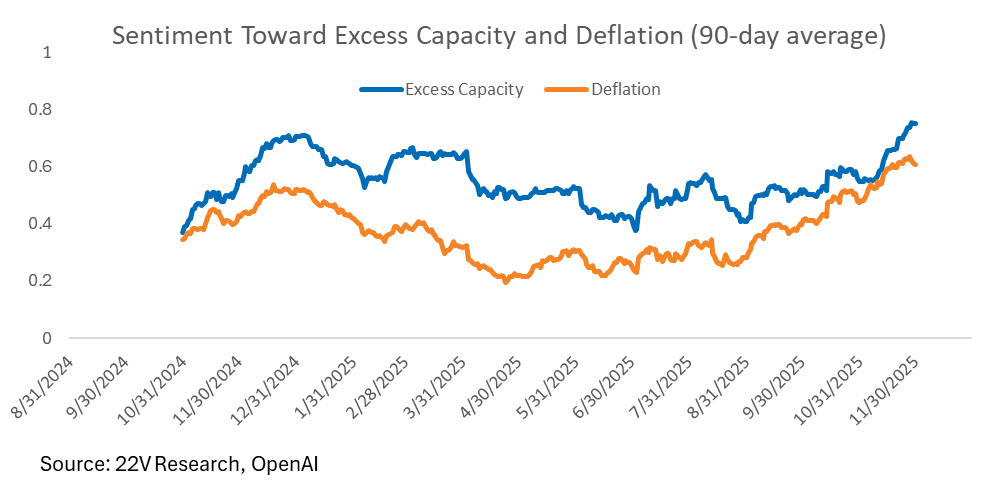
One factor in analysts’ positive view of the outlook is Beijing’s “anti-involution” campaign, and the hope that it can make progress in countering deflation and restoring pricing power for firms. Sentiment toward excess capacity (blue line below) and deflation-fighting (orange line) have improved since the launch of the campaign in the summer. We continue to be skeptical that the anti-involution campaign will have a lasting impact on deflation and excess capacity, as the main missing ingredient in Beijing’s strategy is stimulus that can help bring supply and demand back into balance.
External Sentiment Stabilizes

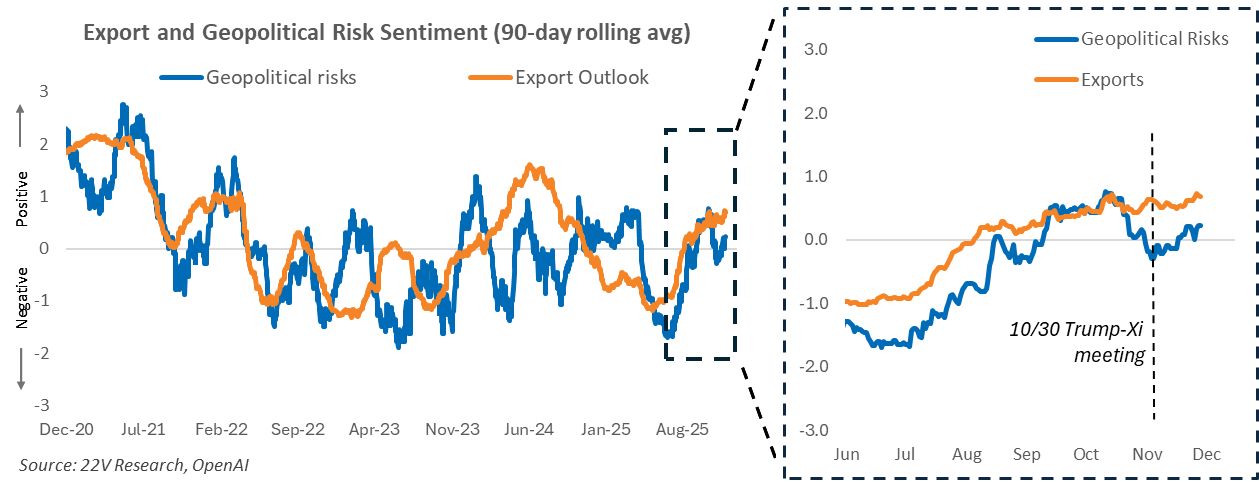
The chart below shows analyst sentiment toward China’s export outlook (orange line) and toward geopolitical risks, including trade tensions, faced by Chinese firms (blue line). For these series we use a 90-day rolling average (rather than a 30-day rolling average used above) to smooth out volatility and show the broader trend.

The key point here is that the months-long de-escalation of US-China trade tensions, plus the surprising resilience of Chinese firms to Trump’s tariffs, has brought sentiment towards the export outlook and geopolitical risks back to positive territory. Export sentiment is now at its highest level since before Trump took office.

The improvement in external sentiment is largely reasonable, as we see a low risk that US-China tensions re-escalate before US midterm elections next fall.
A graph of a person and person

AI-generated content may be incorrect.

Equities Stay Hot, While Property is in the Deep-Freeze

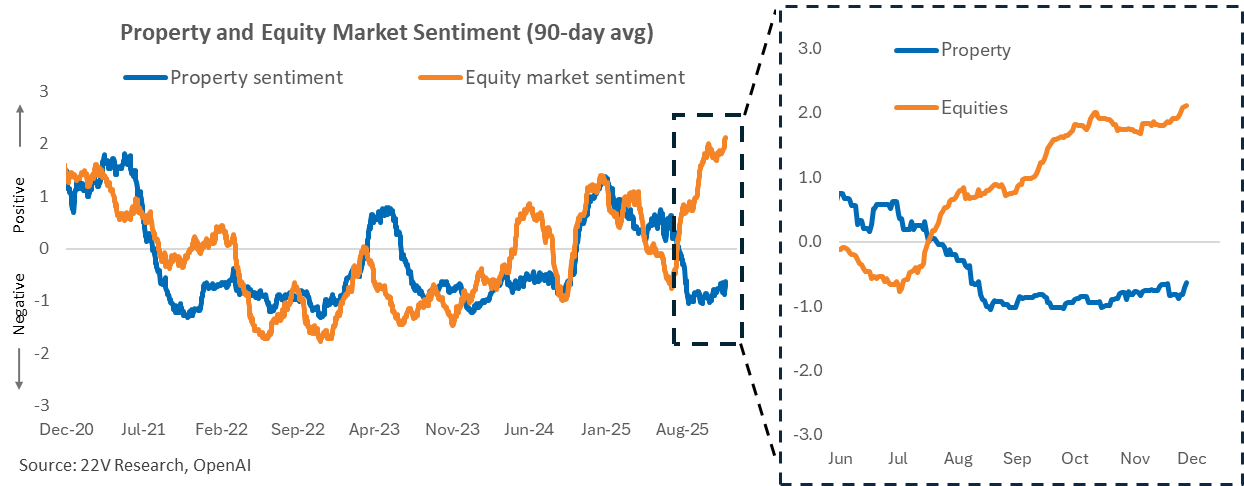
We conclude by comparing analyst sentiment toward the equity market (orange line) and sentiment toward the property sector outlook (blue line). The divergence is stark, with equity sentiment at its highest level in the last five years and property sentiment near its bottom.
A graph of a market fall

AI-generated content may be incorrect.

What to make of this? While Beijing’s policy pivot in September 2024 sought to stabilize prices for both equities and property, it has been far easier to do so for equities. The property market suffers not only from sector-specific issues, such as financial fragility of property developers (which may decline further as Vanke approaches a bond default), but also the macroeconomic headwinds from a soft labor market and weak household confidence.

Analysts – correctly, in our view – see Beijing as keen to support equities but as resigned to see property continue to weaken. As we argued in our CEWC preview, risks for equities are tilted towards the downside given the lack of near-term positive catalysts. That said, there is still a “policy put” in place – we would not suggest aggressively shorting the A-share market.


DISCLOSURES AND DISCLAIMERS

Analyst Certification

The analyst, 22V Research Group, primarily responsible for the preparation of this research report attests to the following: (1) that the views and opinions rendered in this research report reflect his or her personal views about the subject companies or issuers; and (2) that no part of the research analyst’s compensation was, is, or will be directly related to the specific recommendations or views in this research report.

Analyst Certifications and Independence of Research.

Each of the 22V Research analysts whose names appear on the front page of this report hereby certify that all the views expressed in this Report accurately reflect our personal views about any and all of the subject securities or issuers and that no part of our compensation was, is, or will be, directly or indirectly, related to the specific recommendations or views of in this Report.

22V Research (the “Company”) is an independent research provider. The Company is not a member of the FINRA or the SIPC and is not a registered broker dealer or investment adviser. 22V Research has no other regulated or unregulated business activities which conflict with its provision of independent research.

22V Research, LLC is a professional services and independent publication organization. 22V Research, LLC is not a securities broker-dealer, not a member of the Financial Industry Regulatory Authority (FINRA), not a registered investment advisor (RIA) and not a member of SIPC.

Securities transactions, when offered, are offered by 22V Securities, LLC through LPS Capital, LLC. Certain employees of 22V Securities, LLC are dually registered as securities representatives of LPS Capital, LLC or Analyst Hub Securities, LLC. 22V Securities, LPS Capital and Analyst Hub Securities are members FINRA, SIPC.

https://brokercheck.finra.org/

Current Ratings Definition.

SECTOR OUTPERFORM: An “outperform” rating anticipates the company will outperform the S&P Regional Banking Index (peer group).

SECTOR PERFORM: A “market perform” rating anticipates the company will perform in line with the S&P Regional Banking Index (peer group).

SECTOR UNDERPERFORM: An “underperform” rating anticipates the company will underperform the S&P Regional Banking Index (peer group).

Limitation Of Research And Information.

This Report has been prepared for distribution to only qualified institutional or professional clients of 22V Research Group. The contents of this Report represent the views, opinions, and analyses of its authors. The information contained herein does not constitute financial, legal, tax or any other advice. All third-party data presented herein were obtained from publicly available sources which are believed to be reliable; however, the Company makes no warranty, express or implied, concerning the accuracy or completeness of such information. In no event shall the Company be responsible or liable for the correctness of, or update to, any such material or for any damage or lost opportunities resulting from use of this data. Nothing contained in this Report or any distribution by the Company should be construed as any offer to sell, or any solicitation of an offer to buy, any security or investment. Any research or other material received should not be construed as individualized investment advice. Investment decisions should be made as part of an overall portfolio strategy and you should consult with a professional financial advisor, legal and tax advisor prior to making any investment decision. 22V Research Group shall not be liable for any direct or indirect, incidental or consequential loss or damage (including loss of profits, revenue or goodwill) arising from any investment decisions based on information or research obtained from 22V Research Group.

Reproduction And Distribution Strictly Prohibited.

No user of this Report may reproduce, modify, copy, distribute, sell, resell, transmit, transfer, license, assign or publish the Report itself or any information contained therein. Notwithstanding the foregoing, clients with access to working models are permitted to alter or modify the information contained therein, provided that it is solely for such client’s own use. This Report is not intended to be available or distributed for any purpose that would be deemed unlawful or otherwise prohibited by any local, state, national or international laws or regulations or would otherwise subject the Company to registration or regulation of any kind within such jurisdiction.

Copyrights, Trademarks, Intellectual Property.

22V Research Group, and any logos or marks included in this Report are proprietary materials. The use of such terms and logos and marks without the express written consent of 22V Research Group is strictly prohibited. The copyright in the pages or in the screens of the Report, and in the information and material therein, is proprietary material owned by 22V Research Group unless otherwise indicated. The unauthorized use of any material on this Report may violate numerous statutes, regulations and laws, including, but not limited to, copyright, trademark, trade secret or patent laws.