

Starting to Look Ahead to 2026
- While the December FOMC remains a close call, favoring a final Powell cut, in recent week’s conversations with investors have shifted focused to the 2026 outlook.
- On the labor market, our tentative base case is that with tariff uncertainty starting to resolve later in the summer the market has started stabilizing itself but this will take time. The shutdown added an additional to headwind but hiring seems not to be appreciably weakening. Claims show steady trends and are our key indicator.
- While the doves are trying to make an optimistic case looking-through tariff-driven inflation and core services ex housing that remains well above target, more likely is a bumpy gradual descent towards a slightly higher-than-expected trend inflation.
- We remain most out of consensus on growth, where expectations for next year continue to seem far too low in a non-recessionary world (BBG consensus is currently 1.9%). A reasonable non-recessionary base case looks to be in mid-2s for growth.
- The rest of this note focuses on the baseline growth outlook and risks into 2026.
Building a Growth Forecast
The easiest way to think of any economic forecast is a nowcast of what is currently and just recently happened, a view on where things should settle out in the long-run (particularly in a non-recessionary environment which will be higher than across-the-cycle growth), and then a model-based approach to the medium-term which links the short and long-runs. The majority of effort gets spent on the medium-term, while views on the nowcast and underlying are equally if not more important as they set the base rates for the medium-term.
The Near-term Is Noisy but the Jumping Off Point Strong
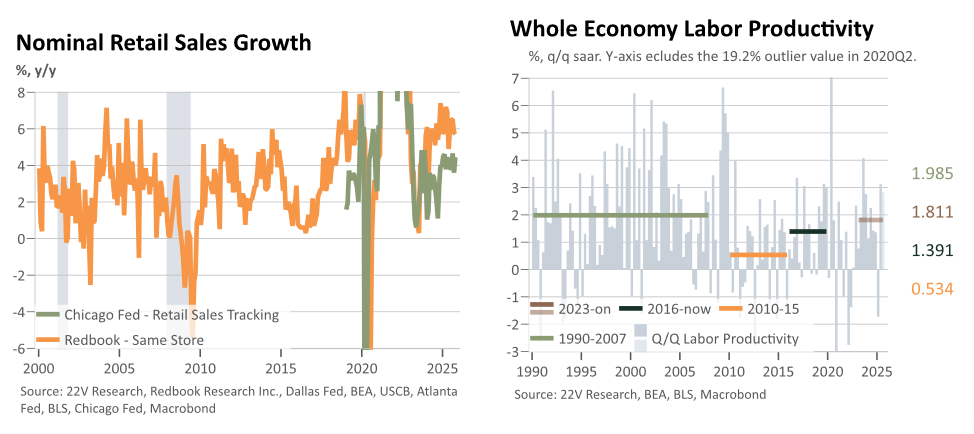
Nowcasts for Q3 are tracking at a surprisingly robust 3-4%. Q4 will be negatively impacted by the government shutdown, shaving off roughly 75bps, perhaps a bit more, from quarterly growth; private final demand should be little impacted (card and retailer commentary shows no deterioration into Q4 and a general reacceleration since Q2).
The shutdown will be paid back almost entirely in Q1 provided a mechanical, if somewhat artificial lift. Another tactical risk for Q1 is that the residual seasonality issues afflicting the inflation data in recent years, a larger than usual risk given potential post-holidays tariff price pass-throughs, could serve as a hit to real activity in Q1, with flat to somewhat higher nominal activity. History suggests this should not be extrapolated and it pays think about H1 inflation and growth wholistically, avoiding excess pessimism on Q1 growth hits and excess optimism derived from Q2 inflation; a lesson very imperfectly learned so far.
Trend is Not So Bad
The main issue with most growth forecasts since covid that they continue to excessively anchor to the lower investment and dynamism that characterized the post-financial crisis experience. While the productivity trends of the 1990s and early 2000s are a long way off, the economy does seem to have been jolted into a new somewhat faster growth equilibrium post-covid (many signs of business formation and dynamism have moved modestly higher, one could also say since 2015 or so as the immediate risk aversion, balance sheet repair, and credit rationing dynamics of the GFC started to fade).[1] Trade flows and the growth in government spending show a much noisier and bit less optimistic picture in topline figures but the broader conclusion still stands.
In 2026, my baseline is that underlying GDP growth will be between 1.8-2%. Productivity growth looks solid on an underlying basis, even as tariffs provide a mild medium-term drag, and baseline hiring growth will be roughly 20-30bps, much slower than prior non-recessionary periods.
Layering on the Cyclical Forecast
Looking ahead the baseline cyclical impulse seems to be improving rather than deteriorating, in contrast to much of the narrative.
Peak tariff impacts are likely in the rear-view and the baseline expectation of the Supreme Court ruling against the IEEPA tariffs will be a source of modest demand stimulus in ‘26H1. Tariff uncertainty will remain a part of the background; it is simply a part of baseline reality going forward but that should not be a reason for dramatic caution as there are more guardrails in place. The administration will almost surely engage in some new policies through more traditional, predictable, and less arbitrary channels over the course of the year. But the off-cycle election results and policy actions since then suggest that with cost of living concerns still a key political driver the willingness and ability to claw back all of the IEEPA tariffs net revenue hits is far from certain.
Fiscal policy will be a modest boost to growth next year as well, concentrated in the first half of the year. The OBBB ‘spends’ much of its deficit on extending the TCJA tax cuts, which as they roll current policy forward prevent contraction far than stimulate, but there are some more immediate impacts on consumption for lower and medium-income households. As the noise from tariffs starts to fade, the investment boosts from the bill’s immediate expensing provisions should start to see some impact on as well.
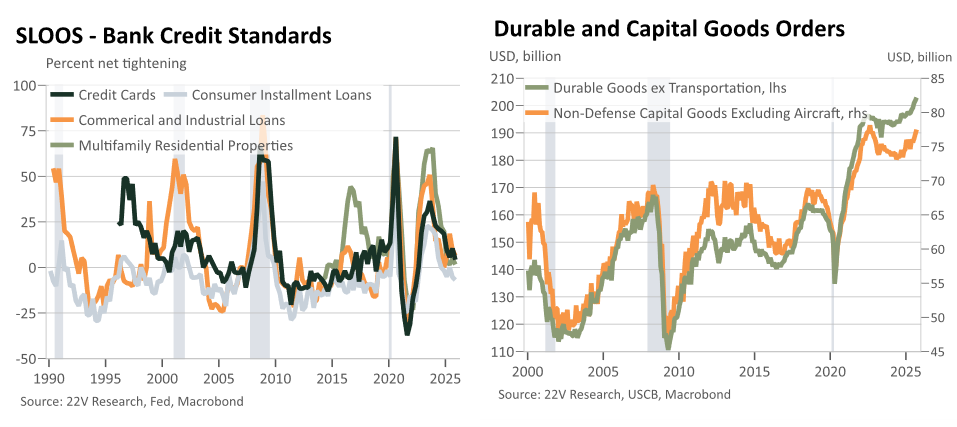
Manufacturing seems to be slowly reemerging from its multiyear doldrums. Regional PMIs have been gradually ticking higher, despite the negative but fairly idiosyncratic impacts of tariffs, and durable and capital goods orders have been moving higher, at an accelerating pace, since mid-2024.
Household and corporate balance sheets largely remain in a solid position and there is substantial room for household releveraging if or as sentiment towards borrowing improves. While some areas of lending continue to see some stresses, largely concentrated in sub-prime lending during the covid boom, the Fed’s senior loan officer survey shows banks are starting to ease credit conditions a bit and loan demand is picking across borrower types. This should support investment and corporate sentiment some. This seems consistent with the gradual uptick in manufacturing orders data, despite tariffs.
Putting it all together
Taking all the above into account, the near-term growth outlook remains quite healthy. The non-recessionary baseline is a strong one and we remain appreciably above a too-pessimistic consensus.
- As noted above, trend growth appears to be stronger than many baselines are penciling in. This raises forecasts across the horizon somewhat mechanically. This seems to be more a second half than near-term concern. Each time markets readjust and pull some high fliers back to earth this risk is lessened a bit in the near-term.
- The jumping off point remains substantially stronger than the vibes or many intra-quarter forecasts have expected with Q2-Q3 GDP well above 3% and spending looking solid into Q4.
- Fiscal policy, easy FCIs, a mild easing in credit standards and pickup in loan demand, and nascent escape from the doldrums in manufacturing and capital goods orders are all helpful medium-term tailwinds. Tariff impacts have likely peaked, even if distortions and whipsaws will remain.
- Sequentially this suggests a gradual deceleration in underlying driven largely by slower labor supply growth, buoyed a bit fiscal stimulus and fading tariff impacts in H1, but remains substantially above consensus due to an excess anchoring on topline GDP growth’s noise in ’25 rather than the continued very solid PFDD.
- With the usual caveats about the imprecision of q/q growth forecasts, my baseline for next year looks roughly like: Q1 3.0% or so (depends on shutdown noise, possibly another shutdown, tariff rulings, and how hot the Jan-Feb inflation prints are); Q2 2.7%; Q3 2.1%; and Q4 2.1%. In a non-recessionary world, risks seem to perhaps a bit slower H1 but hotter H2.
- For Q4/Q4 growth, that adds up to roughly 2.4%, well above the Fed’s likely baseline in December and current consensus.
- This is a ~5% trend nominal growth world that is gradually slowing but with near-term upside risks.
It is Not a Year Without Risks Though
While the past 20y have taught us that the range of risks to the economy can be much wider than typically expected (our uncertainty bands are almost always too narrow) it is worth flagging the most obvious potential endogenous or at least reasonably forecastable risks. Elevated levels of rates and depressed levels of activity in impacted sectors provide a substantial medium-term buffer if topline channels of growth are hit appreciably given the room for releveraging on household and non-financial corporate balance sheets.
- The biggest risk is the AI boom popping and jolting household and corporate sentiment enough that housing cannot respond in time to catch the cycle.
- A housing-led broader downturn is the most classic channel but with volumes depressed for years, builders signaling that starts have troughed, and purchase apps very mildly rebounding the causal story here seems like a stretch. Historically construction employment declines presage recessions, but not all recessions have this feature, and with trend payrolls so low, immigration pressuring the labor supply pool, and the above features I am skeptical that roughly flat NFP and ISM construction payrolls in recent months are an glaring pre-recessionary indicator, but that cannot be fully dismissed either.
- Related to the above two is the risk that overheating concerns lead to more appreciably restrictive FCIs which hit corporate investment and lead to another impactful leg down in housing. With labor market already easing a bit and policy mixed bag, this might be enough to lead to a mild proper recession.
- The multipliers from fiscal policy could also be even smaller than expected but that’s a downside non-recessionary risk more than an outright tail. In this event margins are still supported though (the private sector financial balance likely improves next year), and this is remains an anti-left-tail buffer. Downside risks from fiscal policy run through tighter FCIs and long-term rates.
- IEEPA tariffs could be upheld causing firms to have to respond with another similarly sized price reset higher in Q1 as we have already seen. This would likely also not be recessionary but a large dent to growth that optimism becomes continued muddling through.
The invariance of the Fed’s 1.8% long-run GDP forecast is one of the odder quirks of the SEP. This was likely a bit below estimates of potential pre-covid, certainly so s few years ago, and is now closer to inline due to rapidly slowing immigration growth but still seems a bit too low to me. ↑

