

SUMMARY:
- Analyst sentiment toward the equity market shows signs of cooling from its very positive levels, given a lack of obvious catalysts on the horizon to extend the rally.
- Sentiment toward the macroeconomic outlook remains modestly positive, driven by the continued resilience of the export sector.
- Expectations for stimulus are subdued, as analysts pick up on Beijing’s lack of urgency to support growth in the near-term.
A BUSY MONTH FOR POLICY
The past several weeks have been important for China’s policy outlook:
- The meeting between President Donald Trump and General Secretary Xi Jinping on October 30 yielded a significant de-escalation of recent trade and technology tensions, even if the underlying pressures remain in place (see our note HERE).
- The CCP’s Fourth Plenum (10/20-23) previewed the next Five-Year Plan, indicating that Beijing will double-down on its ambitions to control key technologies and supply chains (see our coverage HERE).
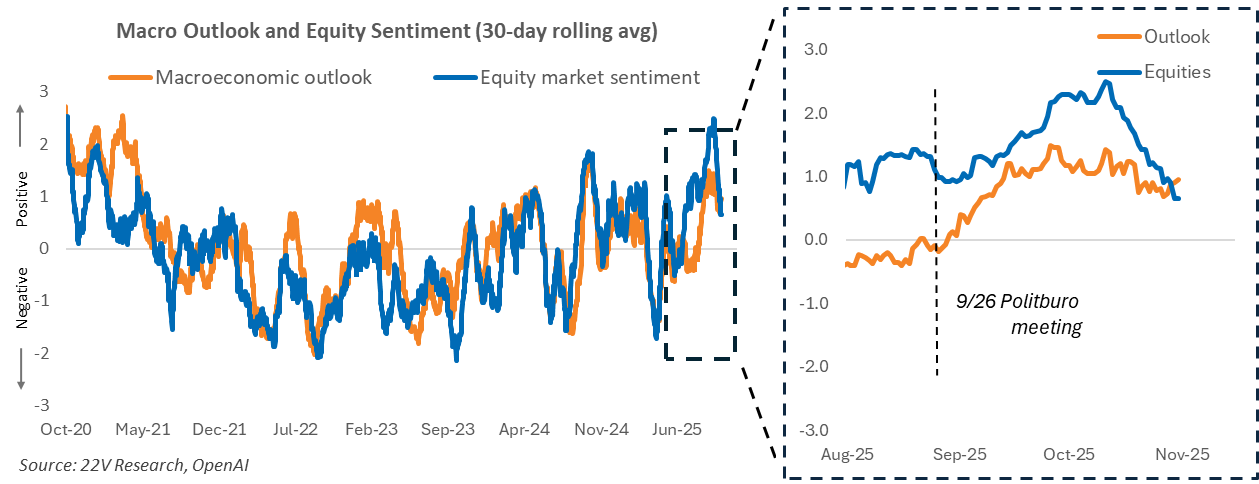
- China’s Politburo did not hold its traditional quarterly meeting on the economy, which in itself underscores that Beijing is not in a rush to roll out new stimulus policies. Growth momentum is slipping, but with Beijing’s annual GDP target of 5% easily within reach, the leadership will wait until towards the end of the year to implement support measures.
To assess how Chinese economists view these developments, we use our proprietary China Economic Sentiment Series (CHESS) tool. CHESS uses ChatGPT to monitor the sentiment of analysts commenting in China’s domestic financial media, providing a real-time view of shifts in expert opinion.
EQUITY MARKET SENTIMENT COOLS
The chart below shows sentiment toward the equity market over the last twelve months, both as a 30-day moving average (more sensitive to recent changes) and a 90-day moving average (more stable). The 30-day moving average shows a notable decrease since early October, remaining positive but at its lowest level since July.
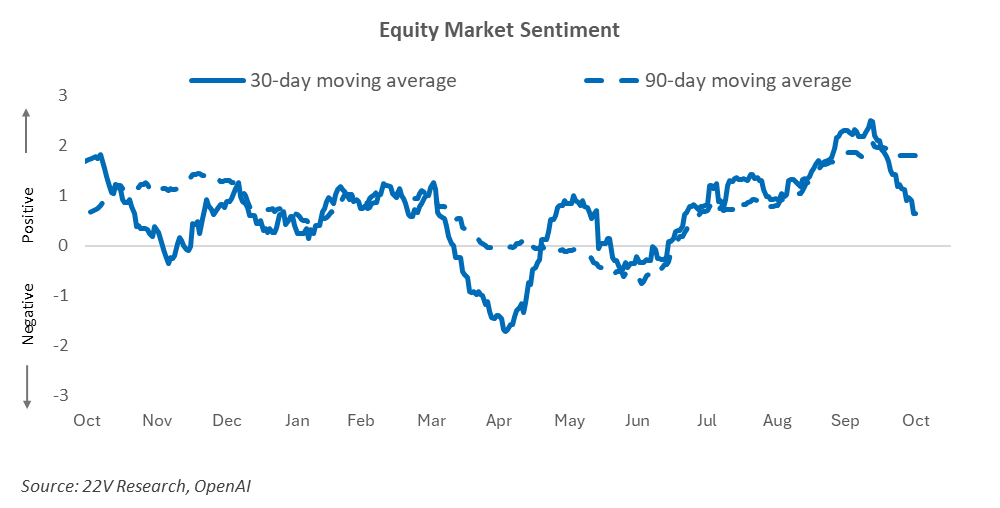
A read through the underlying commentary articles captured by the CHESS scores suggests that the issue is not new negative factors impacting equities, but instead a lack of obvious catalysts on the horizon to drive shares higher – especially with the Trump-Xi meeting now concluded.
A slowing of momentum in equity market sentiment does not come as a complete surprise. A key theme for China’s markets this year, especially since the spring, has been the divergence between a hot equity market and a more subdued macroeconomic backdrop. Equities and macro are now converging, at least in terms of sentiment: the macro outlook has modestly improved in the last two months, while expectations for equities have lately come off their boil – see chart below.
What does this suggest for the equity market outlook? Macro conditions are unlikely to see a major improvement in coming months (see next section), which means that equity catalysts will likely need to come from other drivers, such as developments in the tech sector, policy actions to drive more institutional and retail flows into the market, or global factors. One shouldn’t rule these out – especially with Beijing keen to support the equity market – but the timing and scale are uncertain.

EXPORT RESILIENCE PROPS UP MACRO SENTIMENT
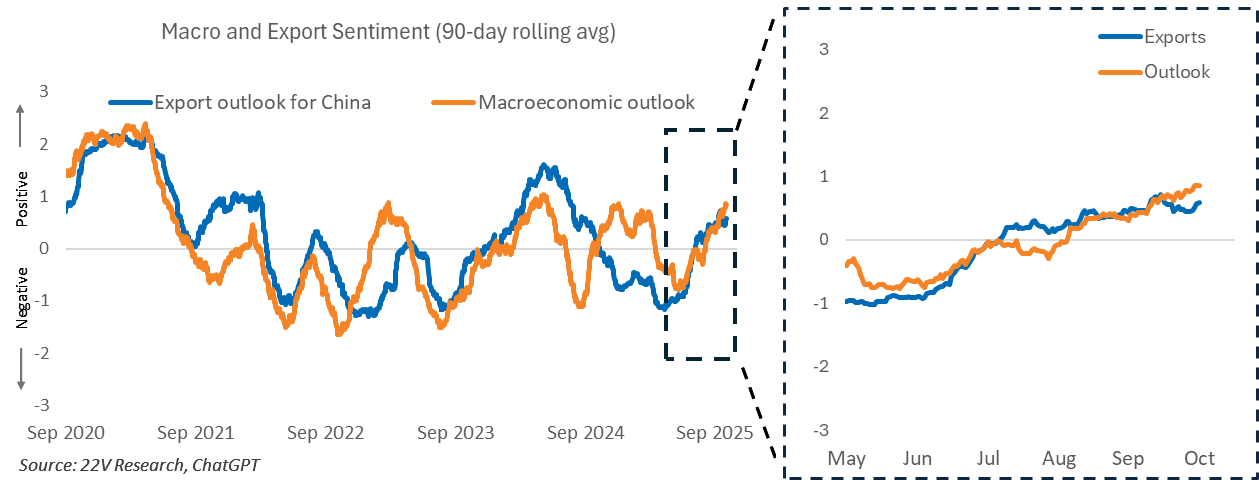
The chart below shows sentiment towards the macro outlook (orange line) and China’s exports (blue line), in both cases using a 90-day average to smooth out noise and capture the broader trend. China’s export performance – notably resilient in the face of US tariffs – has been a key driver of the improvement in macro sentiment since the summer.
By contrast, analysts’ stimulus expectations (orange line in the chart below) have declined since summer, as it became clear that the surprisingly strong export performance would lower Beijing’s need to support demand. 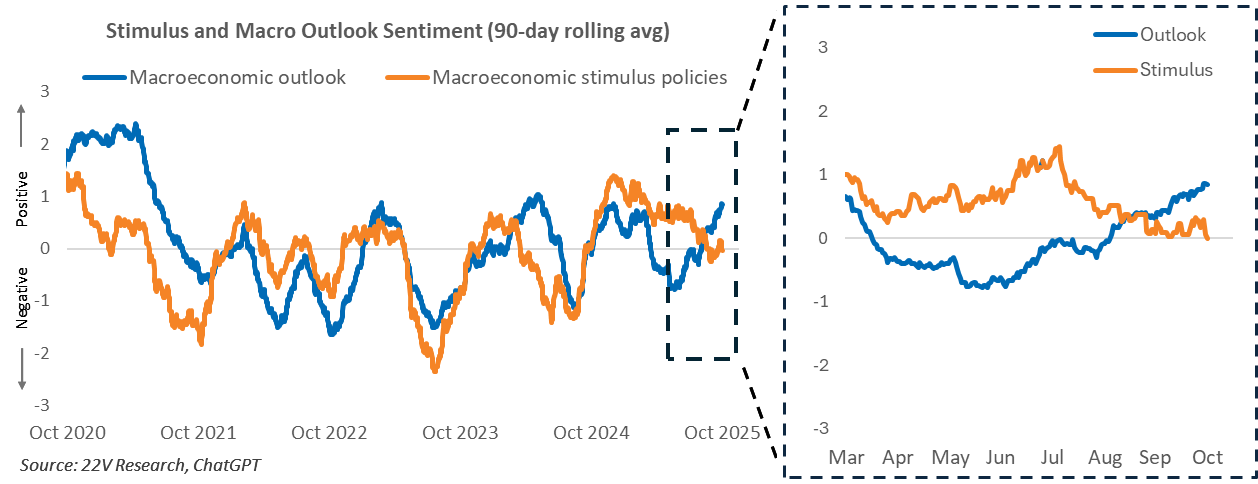
We are a bit less optimistic than CHESS sentiment about the overall macro outlook in the near term. While Trump’s recent lowering of tariffs on imports from China is a clear positive, we do not expect China’s export growth to fully offset headwinds for domestic demand: the property sector continues to contract, a soft labor market is dragging on household confidence and consumption, and Beijing’s recent efforts at modest fiscal stimulus have not been effective. It will take strong pro-growth measures to stabilize growth, and we do not expect such measures to come until late December or early January.

