

The main relevance of the CPI is that it allows us to update our best guess for the core PCE and associated detail for the same month. Once the PCE data are released, the CPI and its detail become irrelevant, except for TIPS and other issues related to indexing, such as Social Security Payments. (The need for indexing, incidentally, is why the CPI was even produced this month.) Normally, we would supplement the CPI with additional data from the PPI and (secondarily) IPI to get a tighter sense of how the core PCE and related will print. But this month will be different because the PPI and IPI are not going to be released until after the government shutdown ends. And who knows when the PCE price data themselves will be released. In the meantime, we need to guess what the Fed is probably guessing about what the PCE will probably show. We can probably do that well enough, with help from the informed consensus. In that spirit, the news from Friday’s CPI was benign and perhaps more so than is appreciated in two regards:
- The weak reading in rent inflation during August has to some extent (let’s not overstate the point) been dismissed as an unwind of a measurement distortion during July, when rents spiked at some price points in the South. But that would have no effect on the 3- or 12-month rate of change, which looked better. More importantly, marginal rents matter more than average rents (reflected in the government data) and the recent news on marginal rents has been quite constructive.
- People may not fully appreciate that the informed consensus’ mapping of the CPI detail to estimates of the Core PCE and related detail includes an add from an assumed rise in portfolio management and advisory fees, which are basically a noisy lagging measure of how the stock market has performed. And this month, this appears to be a moderately important issue for guesses of the Core PCE and (with greater importance) the services component of it. Just because it is fun, I like to point out that equity types can’t get bearish equities because of the effect on the surging stock market on measured PCE inflation. That argument is self-defeating.
My single best measure of underlying inflation, whatever its other merits or demerits, effectively brackets these issues and is on track to print at 19 bps on the month. The single best measure ignores non-market prices, which reduces noise, which is particularly valuable right now. But the costs of that is that it has a — hopefully stable — downward bias of about 20 bps (ar). So when looking at the implied 3-, 6- and 12-month rates in the presentation below, just add back 20 bps to get a ballpark sense of what that measure implies for progress towards the Fed’s 2% inflation target — around which the Fed has expressed some lack of urgency, for good or ill. (Putting on my normative hat just briefly, I would say good.)
Core goods inflation is on track to print at +10 bps, which is highish, given that the pre-Covid globalization-adjacent trend there would be -10 or -20 bps. But it is widely recognized that globalization is being reversed and that the Trump tariffs imply upward pressure on goods prices. So, we need to assess “high” relative to what. Six months ago, I would have said we would be lucky to stumble into monthly goods price inflation prints of just 10 bps. So, this is not so bad. Excluding used MV, core goods price inflation has seemingly accelerated 25 bps between July and August, going from slightly negative to slightly positive. I think this was flagged to some extent by the Pricing Lab data that I flagged a couple weeks ago. But if those data are indeed predictive, then the bigger absolute rise in core goods prices (the first derivative, not the second) is coming in October. We will have to monitor how the Pricing Lab data evolve in the interim. For now, the inference to good prices from the September CPI is hardly a problem, given what we might have expected.
On services, I must return to the issue of portfolio management and advisory fees. The MPO version of the services PCE is invariant to that. And my reading of the informed consensus is that they are effectively factoring decent DISINFLATION there. The underlying trend of inflation in the goods and services market is slightly above the Fed’s target. But it is so by a narrower margin than we thought three months ago and by a much narrower margin than we thought when Trump was doing the Lethal Weapon imitation around Liberation Day. I am not talking my book. I figured things would be worse. But for a variety of reasons, which I have tried to flag when they arose, they have not been. In fairness, this is not over.
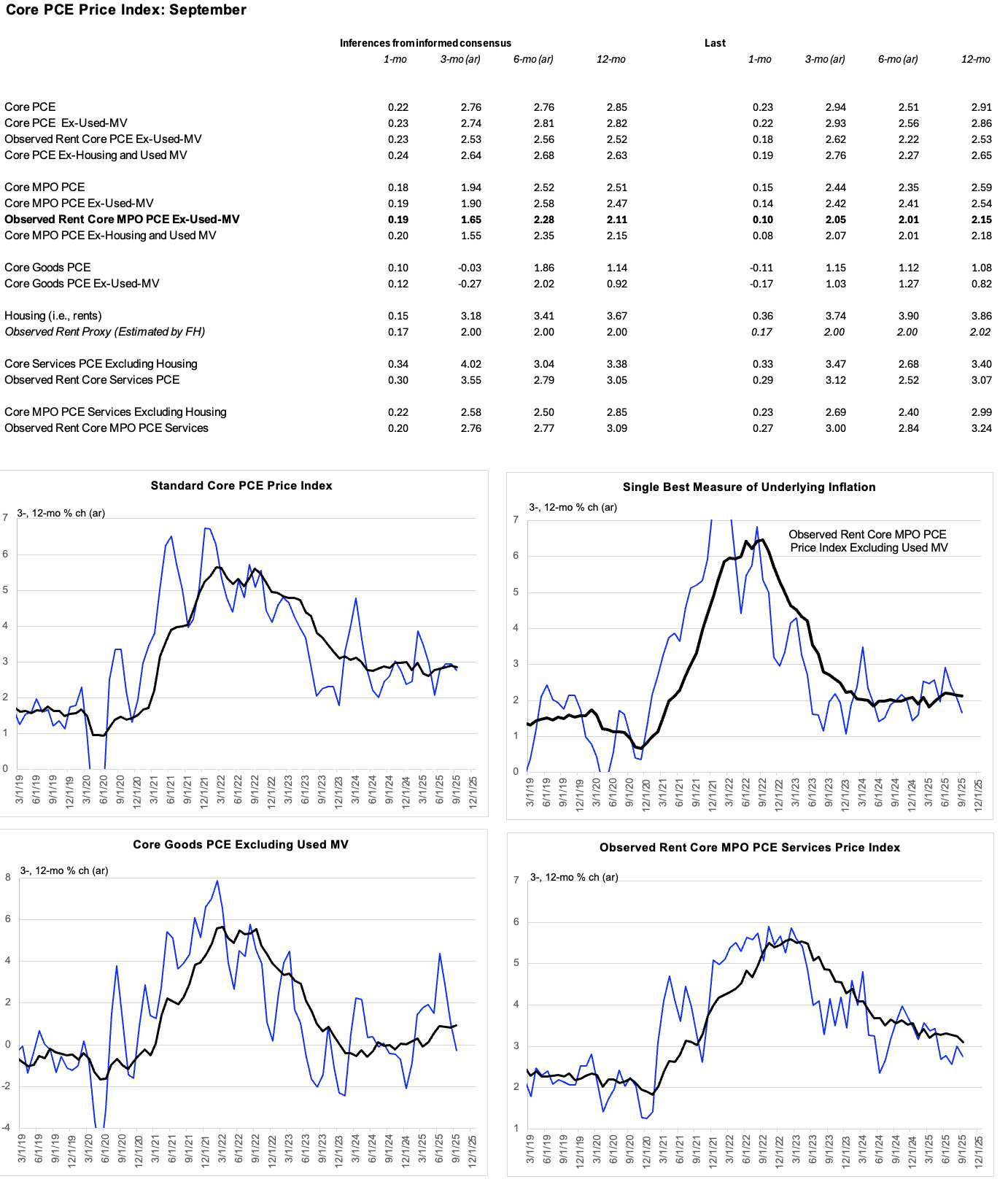
Data are actual to August and estimates for September.

