

SUMMARY:
In the first half of this report, we size up the prospects for a near-term US-China truce on rare earths and export controls, which we assess is highly likely. In the second half, we put this issue in the broader context of the US-China relationship and explain why such flare-ups will nonetheless continue, with risks to critical supply chains.
Key takeaways:
- President Trump and General Secretary Xi Jinping will very likely announce a truce on rare earths and export controls when they meet this month in South Korea, with details to be worked out in following weeks.
- The key risk is not near-term re-escalation, but that a truce will be difficult to sustain over the next year and beyond; investors should expect continued tensions and periodic disruptions to supply chains as the US and China grapple for the upper hand in an era of “weaponized interdependence.”
- Momentum will continue to build for efforts to reduce US/allied dependence on Chinese rare earths, but the timeline will be longer than many investors expect. China may also use production of mature semiconductors as a deterrent against the US and its allies, as is playing out this week in the dispute over Nexperia.
- At the macroeconomic level, China’s focus on supply chain resilience means an ongoing focus in the next Five-Year Plan on high-tech manufacturing. This policy priority will continue to obstruct a decisive effort to reduce deflation and excess capacity.
- The flareup on rare earths/export controls has left little time for the two sides to tee up other concrete deliverables as outcomes for the Trump-Xi meeting this month. If the meeting goes well, the two sides will plan for a Trump visit to China in Q1 2026. Beijing could conceivably restart some purchases of US soybeans later this year as a good faith effort.
Prospects for a Rare Earths Truce
There are strong incentives for Washington and Beijing to avoid a re-escalation of tariffs and supply chain restrictions when Trump and Xi meet in South Korea later this month. President Trump was explicit about this fact, telling Fox News recently that a return to the high tariffs he has threatened is “not sustainable.”
Trump has, helpfully, been increasingly specific about what he wants to see from China and is prepared to give. In comments over the weekend, he outlined his asks: (1) that Beijing refrain from “playing the rare earths card”; (2) progress in countering fentanyl production; and (3) resumption of purchases of soybeans (and likely Boeing planes). To this list we can also presumably add: (4) Beijing finalizing approval of a TikTok deal. Trump expressed a willingness to lower tariffs on Chinese imports in return.
What does China want from a deal? In direct terms, Beijing’s highest near term priority is for the US to suspend or amend the “50% rule” published by the US Commerce Department on September 29. The rule has the practical impact of adding thousands of Chinese companies to the Commerce Department’s Entity List and making them subject to US export controls, with wide ripple effects. Indeed, the 50% rule helped trigger the Dutch government’s recent takeover of chipmaker Nexperia, by making the Chinese-owned, Netherlands-domiciled firm subject to US export controls. Beijing’s sweeping October 9 measures on rare earths, to which Washington (and other capitals) has reacted with fury and alarm, were a direct response to the 50% rule.
More broadly, we agree with this recent analysis by one of China’s leading foreign policy analysts, Professor DA Wei of Tsinghua University (link HERE): Beijing seeks a framework for managing US-China tensions, including over export controls. China’s leaders in fact thought that the two sides had arrived at such a framework in Madrid talks this summer, but regard the 50% rule as an implicit (and perhaps explicit) violation of that agreement.
The necessary core elements of a truce are:
- Agreement by China to effectively suspend its October 9 rare earth control regime, which in theory mandates companies to apply for licenses from China for transactions anywhere in the world involving products made with a minimum content of Chinese rare earths.
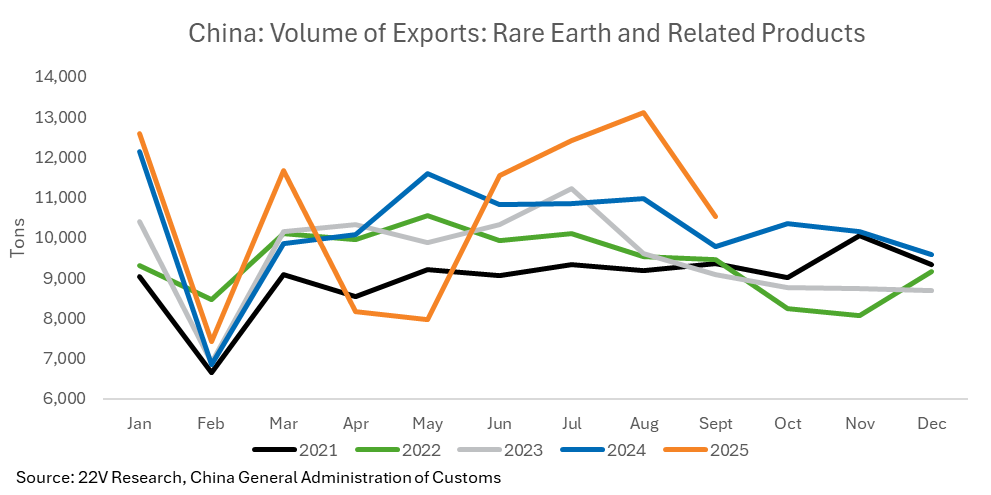
- Agreement by China to accelerate approvals of existing rare earth licenses, which tightened again in September (see chart below).
- Agreement by the US to amend or suspend implementation of the 50% rule, narrowing the scope of Chinese entities affected. Trump is no particular fan of US export controls, which he views as hurting industry, and has sidelined China hawks in the White House (some of whom were “Loomered” earlier this year).
The two sides may make additional demands on each other, which would further complicate negotiations:
- Beijing may insist that the US revise its recently implemented fees on Chinese built and operated cargo ships, loosen other US export controls (such as on certain semiconductor tools), or lower tariffs on China.
- Washington may insist that China take broader steps to roll back its rare earths framework, and resume rare earth flows to firms related to US defense applications rather than just broad industry.
While a truce is likely (80% probability), both sides are engaging in gamesmanship as the Trump-Xi meeting approaches. Beijing has strong confidence in its leverage over Washington, based on the deterrence effect of rare earth controls and the judgment that Xi has a much higher political pain tolerance than Trump to endure a re-escalation of the trade fight. US officials are motivated to show China that the US also has pain points to exploit, including Trump’s October 10 threat of imposing controls on “critical software.” Reuters reporting today implies that US officials are considering using the foreign direct product rule to limit the flow of global exports to China for any product that contains or is produced using a minimum amount of US software, which would make the scope of these controls potentially enormous.
The complicated issue of sales of Nvidia and AMD chips to China may also be part of the backdrop. Beijing, increasingly confident (over-confident?) in its domestic chipmakers, has been reluctant to take Nvidia’s H20s. This is likely partly a negotiating strategy to hold out for better chips from Nvidia, but also a signal to spur domestic industry to wean itself off of the US. But we do see room for upside: A broad agreement on rare earths and export controls could lead Beijing to allow some advanced chips to flow to China later this year. For all of China’s growing confidence in domestic chipmakers, they lack the capability of producing true alternatives to Nvidia, especially at scale.
The most important near-term watchpoints on these issues are what comes out of a meeting between Treasury Secretary Bessent and his Chinese counterpart Vice Premier He Lifeng later this week in Malaysia, and whether a Trump-Xi meeting remains on the calendar. If the two leaders plan to meet, it implies that they perceive a viable offramp. If the meeting is cancelled, the odds of escalation climb.
We suspect that the flareup on rare earths/export controls has left little time for the two sides to tee up other concrete deliverables as outcomes for the Trump-Xi meeting. If the meeting goes well, the two sides will plan for a Trump visit to China in Q1 2026. Beijing could conceivably restart some purchases of US soybeans later this year as a good faith effort.
As for a broader deal in 2026, much will come down to whether Trump is willing to meaningfully relax tariffs on Chinese imports. We have been emphasizing that Xi Jinping seeks overall stability in the relationship, but does not feel heavy pressure to make major accommodations to Trump. As Tsinghua University’s Prof. Da comments: “Beijing’s negotiating posture has crystallized around a simple principle: a deal would be good, but no deal would not be disastrous.”
Why Supply Chain Battles Will Continue
Let us shift the discussion from the near-term prospects of a truce to assessing the question of whether a truce on supply chain warfare is durable. We assess that it is not, and that investors should expect repeated flareups of these tensions, particularly over rare earths and semiconductors. Two academic concepts help explain how the US and China have arrived at this moment and what comes next: “weaponized interdependence” and “the security dilemma.”
Since at least 2016, Washington and Beijing have been engaged in a dynamic of “weaponized interdependence,” in which each side looks to exploit the other’s dependencies. International relations scholars Henry Farrell and Abe Newman coined “weaponized interdependence” in 2019 [link HERE], and it was the subject of their excellent 2024 book Underground Empire. While Newman and Farrell used the concept to describe actions by the first Trump administration, they ironically ended up inspiring Trump officials in turn, as Chris Miller noted in his book Chip Wars.
China’s key dependencies on the US (and its allies) include advanced semiconductor technology, the US dollar clearing system, software, and some specific supply chain chokepoints such as jet engines. US dependencies on China include rare earths, of course, but also a much broader set of supply chain inputs, including a growing dependence in pharma and biotech.
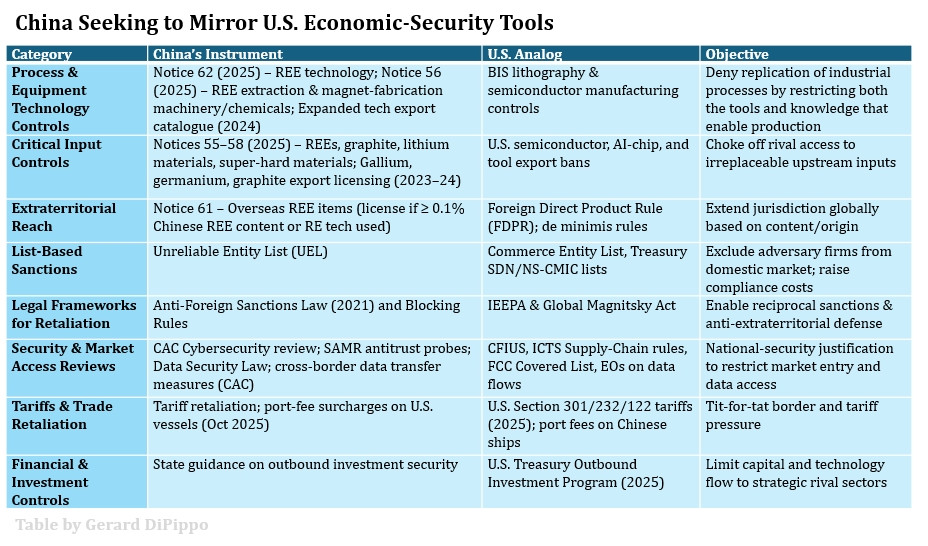
Washington has been the pioneer in weaponizing interdependence, but Beijing has spent the last several years incrementally copying Washington’s main policy regime. The October 9 rare earths measures are simply the latest example (see chart below from RAND expert Gerard DiPippo).
On the one hand, the disputes over rare earths and export controls are forcing Washington to acknowledge that it has reached something of a stalemate with China – or as Secretary of State Rubio put it in July, “strategic stability.” The two sides risk mutual assured economic disruption from weaponizing their respective chokepoints.
However, we expect this stalemate to be continually tested by each side. At the practical level, we expect that it will be much more difficult for the US to reduce reliance on China’s rare earths and associated products (such as permanent magnets) than many investors expect. Yes, the US is aggressively cutting deals with companies such as MP Materials, and working with allies such as Australia. And yes, rare earths are less “rare” than the name suggests, and their total dollar value and volume are relatively small.
However, the economic structure and technology of these supply chains make breaking China’s dominance difficult:
- Rare earths are costly to mine and to refine. China’s concentrated market power provides it with the ability to control prices, which can be extremely volatile. We agree with Treasury Secretary Bessent’s comments that the US will need to effectively set price floors in order to encourage non-Chinese market players to make long-term investments. While the US and allies are gathering momentum, it is too soon to conclude that these efforts will be sufficiently comprehensive, sustained, funded, and aggressive enough to wean themselves off dependence on China anytime soon. President Biden’s former Deputy National Security Advisor, Daleep Singh, explains the tricky economics HERE.
- The technology behind permanent magnets, a key application of rare earths, involves tackling a fundamental physics challenge: high temperatures degrade magnetic properties. Magnets used in car seat adjustment motors typically operate up to around 250°F, while magnets in EV drive motors must withstand temperatures of 400°F or higher. Applications such as missiles and fighter jets require magnets that can perform under even more extreme thermal conditions. Although the West is making progress in producing magnets for lower-temperature applications, scaling production of ultra-high-temperature magnets remains significantly more difficult.
- China will not be a passive player in this process. Beijing will look to maintain China’s dominance through measures such as subsidizing rare earth production and expanding restrictions on the export of equipment and technology to produce permanent magnets and other rare earths products.
This brings up the second key concept, “the security dilemma.” International relations scholars have long observed (since Thucydides) that when one country takes what it regards as purely defensive measures, it increases its rival’s sense of vulnerability and exacerbates tensions.
As a contact in Beijing expressed last month, the US and China are racing against each other for self-sufficiency: the US in the area of rare earths, and China in the area of advanced semiconductors. Both sides face technical and economic hurdles in achieving those goals, but have reasons to hope for progress over the next 2-5 years. The problem, of course, is that if one side achieves self-sufficiency first, it means the other side’s deterrence (chips in the case of the US, rare earths for China) loses effectiveness. This provides strong incentives for Washington to prevent China from replacing US semiconductor technology, and for Beijing to maintain dominance in rare earths and other supply chains.
Add in the strategic and economic importance of AI, and you have the recipe for why investors should expect flareups to continue across several domains:
- As China’s domestic chip industry makes further advances in producing AI chips, Washington will feel pressure to maintain and perhaps even tighten controls on semiconductor manufacturing equipment and China’s access to high bandwidth memory chips.
- If China’s AI model companies, including DeepSeek and Alibaba, continue to produce models that are cheaper and “good enough” to rival US frontier models for practical applications, US officials may feel greater urgency to restrict their use.
- US-China supply chain conflict will extend beyond advanced GPUs to include mature semiconductors. Beijing views dominance of mature chips as a pathway to move up the value chain into advanced chips, and as a potential deterrent against the US and its allies. This is already playing out this week, with Nexperia’s Chinese parent, Wingtech, retaliating against the Dutch takeover by restricting the flow of chips to Nexperia’s European operations, creating anxiety for global automakers [see FT coverage HERE].
- China may sanction US or foreign firms competing with Chinese rare earth companies to discourage US efforts to reduce China’s dominance. A similar dynamic is underway in shipping, with China last week sanctioning US subsidiaries of Hanwha shipping, the South Korean firm that is exploring proposals to help the US revive its shipbuilding industry.
- China’s growing role in advanced biotech drugs is deepening the anxiety of US policymakers over dependence on China for active pharmaceutical ingredients and pre-clinical and clinical services. Congress is seeking to revive the BIOSECURE Act, which restricts US pharma companies from contracting with Chinese firms, by attaching it to the annual defense authorization bill.
- Geopolitical tensions – Russia/Ukraine, Iran/Israel, and potentially China/Taiwan – will drive the US to impose export controls and financial sanctions on Chinese firms, and Beijing to take reciprocal actions.
These issues are too complex for any US-China “framework” to manage smoothly, particularly at a time of deep mutual distrust. Moreover, President Trump has structured his second term administration in ways that make adhering to any such framework more difficult, by sharply reducing the staffing and functional role of his National Security Council. Treasury Secretary Bessent has the lead in negotiating with China, but twice in the last several months the Commerce Department has upended agreements with export control measures. It is not clear that the president will have the patience or inclination to reduce provocative actions, including those from Congress.
Macro Implications for China
The discussion above is highly relevant to China’s preparations for its next Five-Year Plan (2026-2030), which Beijing previewed at the fourth plenum meeting that concluded on October 23 (see our coverage note HERE).
A backdrop of intense US-China “weaponized interdependence” means that Beijing’s overarching priority will be trying to reduce reliance on the US in advanced semiconductors, and to extend China’s dominance of critical supply chains in manufacturing as a deterrent against Washington and its allies.
This has macroeconomic consequences. The strategic imperative to keep a tight hold on manufacturing reduces Beijing’s incentives to take decisive measures against excess capacity, since cutthroat competition at home continues to translate into market share abroad in sectors such as electric vehicles. While Beijing is also aware that it must boost domestic consumption in the face of US trade frictions, this agenda competes with the priority on advanced manufacturing – both for budget resources and policy attention. The net result is to reaffirm our view that efforts to boost consumption and reduce deflation, excess capacity, and a large trade surplus will remain gradual. For Chinese equities, tech names will enjoy major policy support, but the broader macro backdrop will remain challenging.

