

I France got a new government this week, as Sebastien Lecornu was renominated as prime minister by President Macron and has now announced his entire (not very) new cabinet. Lecornu has further, as part of the political preparation for his new government announced a suspension of the recent French pension reform, aiming to secure the tacit backing of the center-left Socialist Party, and avoid an immediate no confidence vote. This sends a strong signal of continuing short and medium-term fiscal deterioration in France, corresponding with analysis in earlier Notes, and stand in marked contrast to the short-term fiscal outlook in Italy. Fiscal divergence between France and Italy will correspondingly continue in the coming years.
Prime minister Lecornu announced, in relation with the unveiling of his full cabinet, that the recent French pension reform from 2023 which raised retirement ages from 62y to 64y, will be suspended until after the presidential elections in France in 2027. This will, according to Lecornu, cost the French government €400mn in 2026 and another €1.8bn in 2027, as the planned gradual increase in retirement age (scheduled to reach 64y by 2030) is now suspended until January 2028, where it will resume unless the next president and parliament decides otherwise.
Politically, the suspension of the pension reform has worked for Lecornu, as he has now survived two votes of no confidence in the French Parliament, as the Socialist Party refrained from supporting the two votes following his gambit. France hence now has a new government in office that in in principle has the opportunity to propose and negotiate a 2026 budget just in time for the year-end deadline. This is a significant improvement in the near-term French political outlook, as it is now look to be the base case that next year’s French budget can – with the support of the Socialists – be legislated in Parliament in the comings two months. The near-term risks of new elections in France have hence declined very significantly, once the political implications of the pension suspension and the confidence votes are taken into consideration.
Lecornu’s willingness – obviously with Macron’s blessing – to at least temporarily abandon Macron’s signature (read only) domestic economic reform of the French pension system to secure the support of the Socialist Party makes it highly likely that the new prime minister is also offer the Socialists additional fiscal concessions to secure the backing of the final 2026 budget. This should ensure its timely passage. That the Socialists have chosen to back Lecornu and not support the no confidence vote called by the French far left further makes it extremely unlikely that any new “Leftist Coalition” (a Nouveau Front Populaire 2) could be established in any potential new early elections. This in turn would make Le Pen’s RN party the commanding favorite to win such an election, giving the Socialist Party a crucial political incentive to ultimately see that a budget is passed and that such an early election in which its parliamentary representation would possibly be reduced is avoided.
Improved near-term political stability and the associated (likely temporary) bond market reprieve in France has, however, been purchased at significant potential near and medium-term fiscal costs. First of all, it is now almost a given that Lecornu will acquiesce to Socialist demands to effectively abandon meaningful fiscal consolidation in the 2026 budget. Consequently, once expected lower French growth rates for 2026 are factored in, the base case for the French fiscal deficit next year should be roughly similar to the 5.4 percent of GDP expected in 2025.
Secondly, with the suspension of the rise in the retirement age now in place, the political threshold for a permanent abandonment of this reform by the next president/parliamentary majority elected in 2027 will have been significantly lowered and is arguably now close to 50-50. It will be extremely tempting for any candidate for president to – when invariably asked during the campaign – pledge to make the suspension permanent also after 2028. This could increase annual French public pension expenditures by perhaps half a percent of GDP, relative to a fully implemented reform in the years after 2030. This in turn would see French medium-term government debt levels potentially rise materially, or an implied simplified 5 percentage points of GDP per decade. France would quickly reach Italian debt stock levels in this scenario.
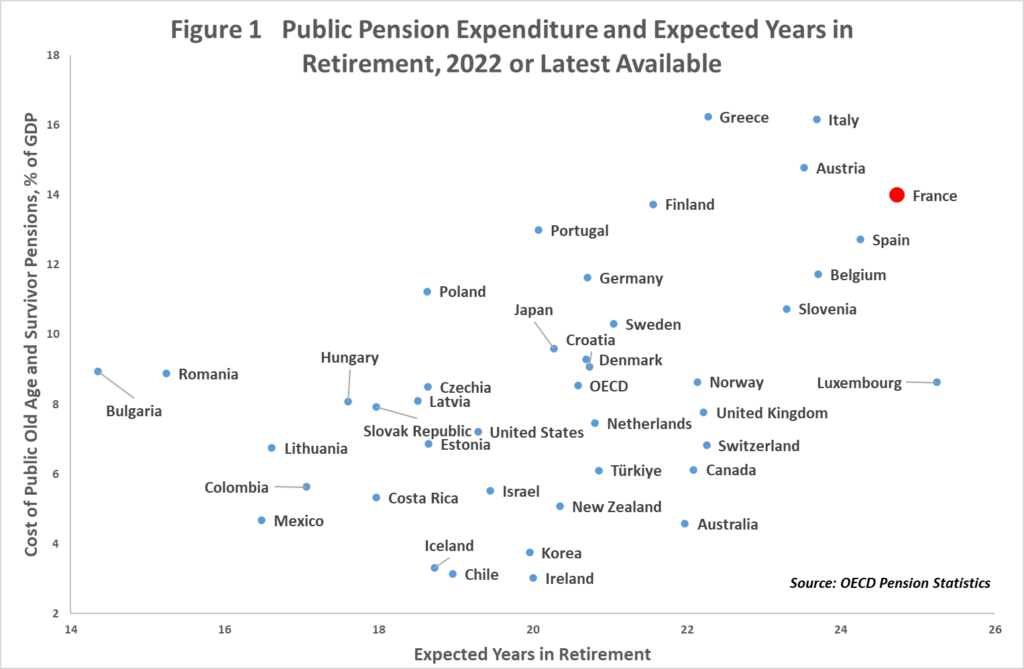
And thirdly, by at least temporarily abandoning the pension reform, this French centrist government has essentially given up on producing a near-term credible plan for French fiscal policy. This cannot be done without addressing the high and rising costs of the pension system, best addressed precisely by raising the retirement age. Figure 1 illustrates how France is (almost) unique among OECD countries in terms of the scope of its current public pension expenditure level and the expected number of years the French can currently expect to live in retirement. The latter makes France’s public finances particularly prone to longevity risk from life expectancies rising further at (not so) high ages after retirement.
France’s inability to produce a credible medium-term fiscal plan without policy action on pensions will also cause political and communication problems for France with regards to EU fiscal rules, and risks further accelerating future credit downgrades.
The contrast for next year’s fiscal policy outlook for France and Italy is, with the actions now taken in Paris, particularly sharp in 2026-27. In Italy, the budget proposal for 2026 foresees a deficit falling marginally below 3 percent of GDP (likely enabling Italy to exit the EU’s Excessive Deficit Procedure), and will likely include a modest middle income tax cut in stark contrast to likely additional tax increases implemented in France. Even more pertinent, the Italian government is prudently (Italy like France is in the problematic upper right corner of figure 1) proposing not to limit the otherwise automatic increase in retirement ages (linked to life expectancy in Italy through earlier reforms and currently at 67y). Again this is in stark contrast to decisions taken in France on retirement ages. Finally, Italy will – unlike France – continue in 2026 to enjoy a material fiscal boost from the final year of the EU’s NGEU pandemic era fiscal stimulus plan.
All told, Italy’s budget for the coming year looks set to put the country on a modestly declining gross debt level path, assuming unforeseen expenses are avoided. The difference to the budget outlook in France is stark, and is likely to be reflected in the relative bond market performance of the two economies in the coming years.
II Just as the EU and not least Ukraine thought they had steered Donald Trump towards a more aggressive stance towards Russia, featuring continued US weapons sales to Ukraine, including possibly of Tomahawk missiles and ongoing political pressure by Donald Trump on Russia’s main fossil fuel customers to reduce purchases, the US president had another phone conversation with Vladimir Putin, and is now set for another possible summit with Putin in Budapest. Trump’s message on social media reveals another successful political flattering of him by Putin:

Nothing concrete other than another possible summit in Budapest is included in Trump’s message, though obviously this surprising announcement will greatly disappoint the EU and not least the Ukrainians with President Zelensky already in DC for tomorrow’s planned White House meeting with Trump.
It appears as if Putin managed to charm Trump with nice words about his Middle East peace plan and possible future US-Russia business deals, and dangling the prospect for another possible personal summit in Budapest with Putin after meetings of respective high-level delegations. Whatever happens next, this certainly counts as another successful Russian damage mitigation diplomacy, as the near-term prospects for Trump sending Tomahawks to Ukraine will now have significantly declined – it has though never really been clear just how close such deliveries actually have been.
At the same time, with a Ukrainian delegation already on the ground in Washington and the Zelensky-Trump meeting presumably going ahead as planned tomorrow, it remains to be seen what – if anything – comes out of these already planned meetings. It is entirely possible that already discussed concrete plans for US weapons sales to Ukraine/EU still go ahead, and other joint economic and military plans also unfold as already prepared. Zelensky might also – much to Kyiv’s disappointment now leave Washington without much additional concrete US support.
So – we must await more information tomorrow (expect a follow-up note!) about the actual current stance of Donald Trump in the Russia-Ukraine war, but today – October 16th 2025 – has clearly already been a potentially good day for Russian diplomacy.
Jacob

