SUMMARY:
China’s week-long Golden Week/National Day holiday ends on Wednesday. When markets reopen, investors will face a very active month for the policy agenda:
- A plenum meeting on October 20-23 to preview China’s next Five-Year Plan
- A late October quarterly Politburo meeting (dates TBD) to outline economic support in Q4
- A likely Trump-Xi meeting in South Korea on the margins of the APEC Leaders meeting (October 31-November 1), though recent reporting suggests the meeting may be brief or – less likely – possibly not happen at all. The possibility of a downgraded meeting would be due mainly to logistical constraints around the leaders’ schedules, but also reflects the limited ambition that both sides have for this meeting.
Ahead of these events, we take stock of how analysts view China’s financial and economic outlook by updating the signals coming from our proprietary China Economic Sentiment Series (CHESS) tool. CHESS uses ChatGPT to assess the views of leading analysts commenting in China’s domestic financial media. The key takeaway is that analysts have strongly positive views towards the equity market despite a less optimistic view of the economy and of near-term stimulus prospects.
Equity/Macro Divergence Remains Wide
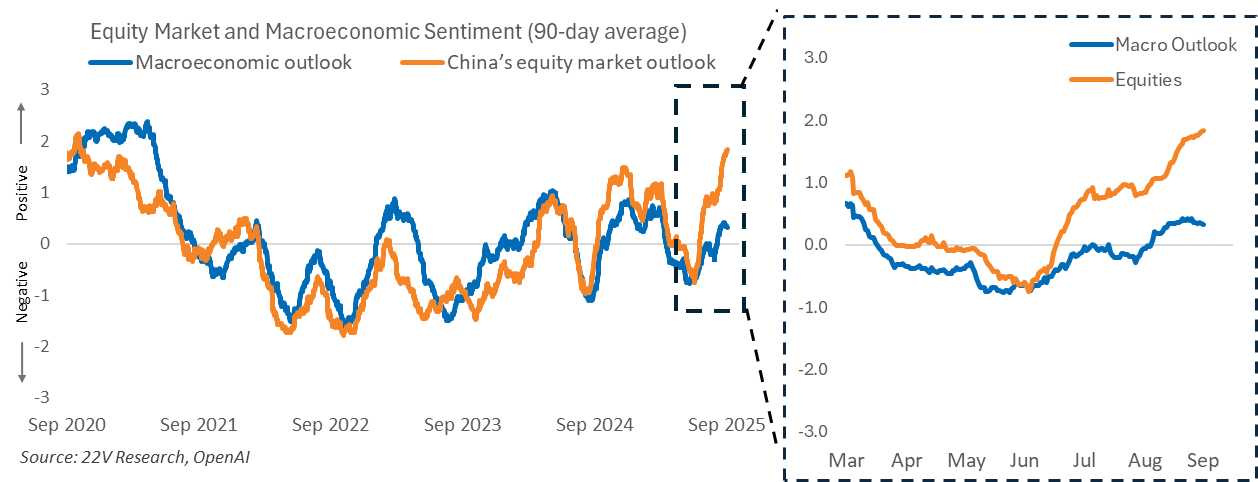
Equity market sentiment (orange line below) in China is at its highest point since late 2020. Sentiment towards the macro outlook (blue line) is much more subdued, at slightly above neutral – and even that level looks a bit optimistic to us given headwinds from property and exports and only modest stimulus.
As we noted in our recent trip report on China [link HERE], there are reasonable arguments to justify the equity/macro divergence, including surging AI/tech optimism, expectations that rates will stay low for a long time, and continued direct and indirect policy support for equities. While we would not suggest shorting Chinese equities, the divergence does pose some risks for how much further the equity rally can extend from here. One risk is that even with a strong AI/tech narrative, investors will eventually become disappointed if the broad earnings outlook fails to improve. The second risk is policy-related: that the authorities will worry about speculative activity if equities seem increasingly divorced from the state of the economy. For now, the sentiment among domestic analysts suggests they do not yet view these risks as serious.
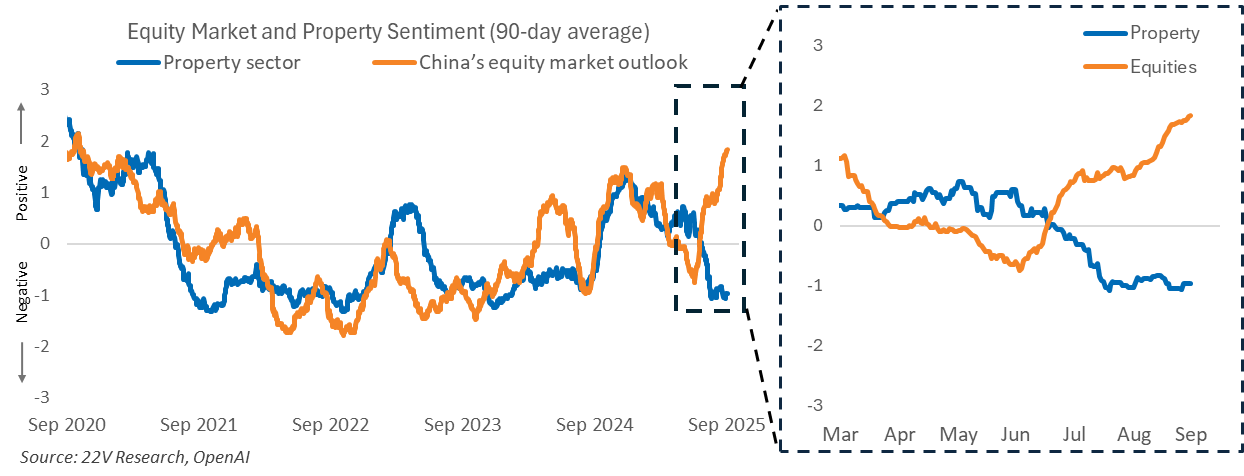
It is also worth briefly noting the even wider divergence between equity market sentiment (orange line) and property market sentiment (blue line), which is deeply negative. Equity sentiment and property sentiment do not necessarily need to move together – indeed, the weakness of the property sector is one reason why households are shifting savings into stocks. But it will be hard for the economy to improve, and deflationary pressures to abate, until the property sector shows signs of bottoming out. We do not expect a bottom until H2 2026 at the earliest.
Low Stimulus Hopes Ahead of the Politburo Meeting
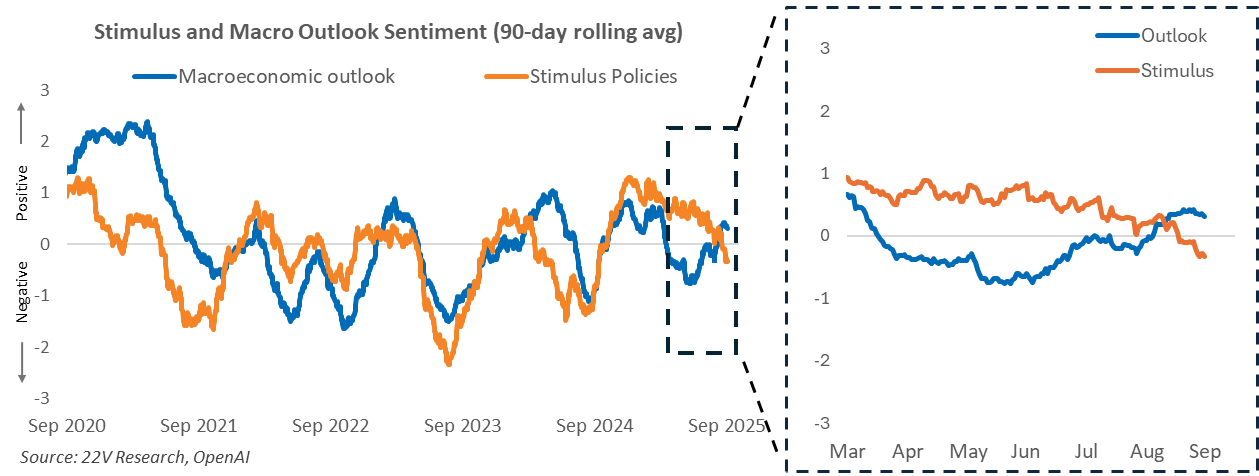
One of the key factors for the macro outlook in coming quarters is the strength of stimulus, particularly fiscal stimulus. Strong government spending supported growth in H1 but has slowed since then as local governments have run out of budget room. A continued decline in sentiment towards stimulus (orange line below) shows that analyst expectations for near-term support are modest.
This aligns with our own view. We expect stimulus in Q4 to mainly take the form of an already-announced investment program, financed by CNY 500 billion in lending from China’s policy banks, to support tech-related infrastructure as data centers and industrial parks. This funding will be enough to turn fiscal policy from contractionary to mildly stimulative, stabilizing growth at low levels in coming months. Any additional stimulus announced by China’s quarterly Politburo meeting on the economy in late October will be incremental.
With external demand facing tariff headwinds, and domestic demand held back by the property contraction and a soft labor market, the lack of stimulus suggests the macro outlook will remain subdued.
External Sentiment Remains (Too?) Strong
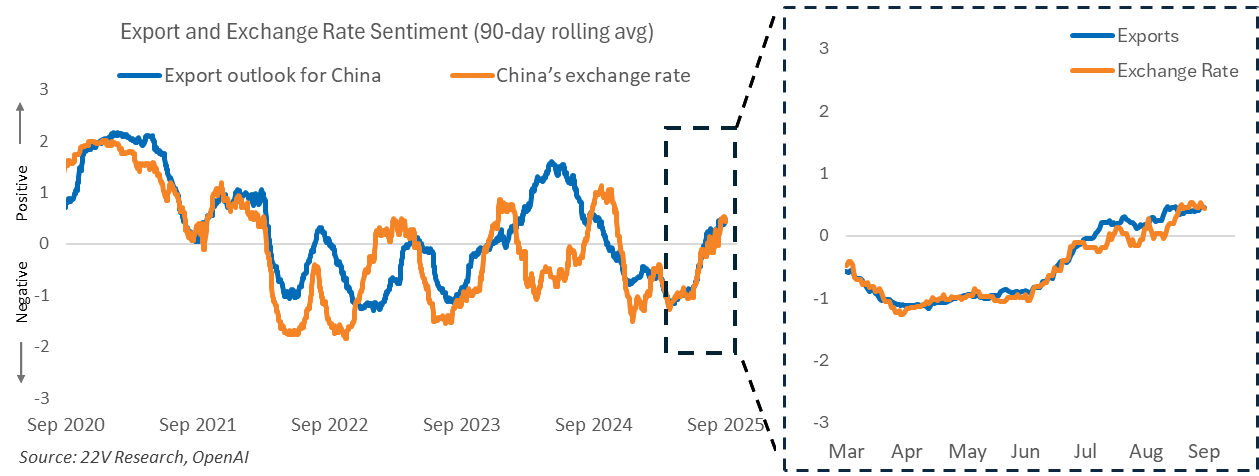
Analyst views toward both exports (blue line below) and the exchange rate (orange line) remain positive. That take on the trade outlook seems optimistic to us, as we expect export growth to continue to slow in coming months with the end of the front-loading of orders to avoid tariffs. We also see the risks for the exchange rate as tilted towards the downside but still very modest; the currency will have support from official intervention if necessary, and from capital inflows so long as domestic equities remain strong.
Consumption Outlook Fades
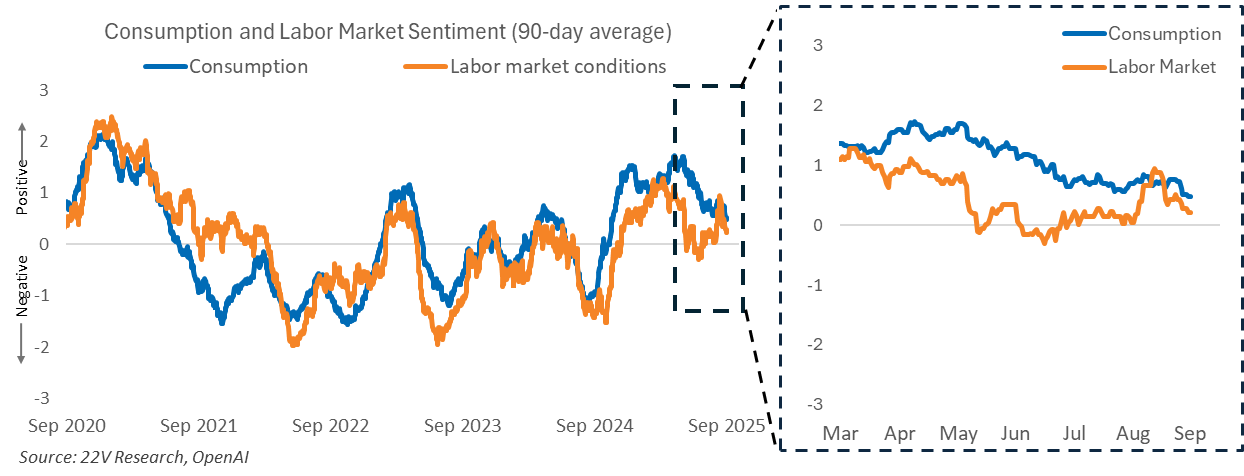
Sentiment towards consumption (blue line below) has continued a slow decline since the spring. This partly reflects the diminishing impact of, and funding available for, the consumer trade-in program (electric vehicles, appliances, and electronics goods). We see little to argue with here, as we expect policy support for consumption in coming quarters will be modest, particularly relative to the headwinds of falling property prices and a weak labor market.
The plenum meeting on October 20-23 will have a strong emphasis on promoting consumption in China’s Fifteenth Five-Year Plan (2026-2030). But the extent of policy support will fall short of the rhetoric, with China’s leadership still reticent to adopt forceful demand-side policies (such as income transfers) at scale.
Anti-Involution: Measured Optimism
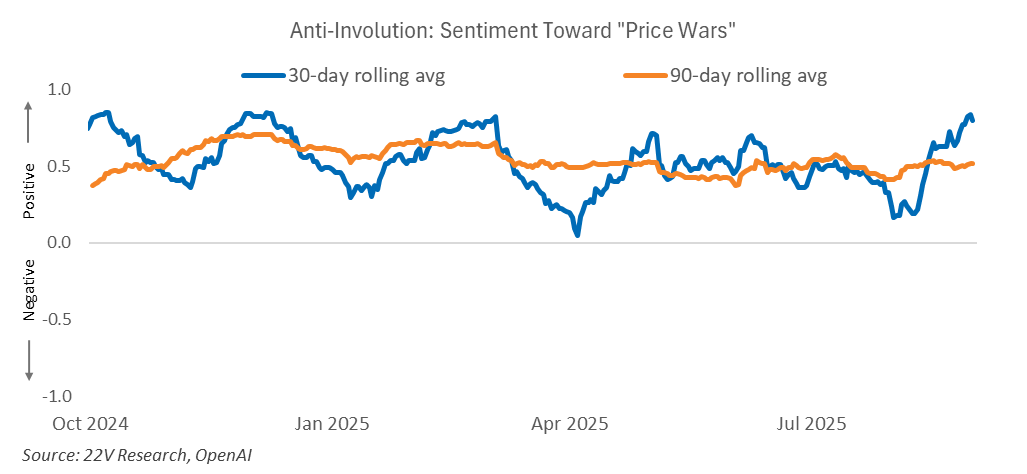
Finally, we conclude with a brief look at the latest analyst sentiment towards Beijing’s “anti-involution” campaign, specifically the outlook for price wars – a key focus of the campaign. As the chart below shows, the 30-day rolling average for sentiment (blue line) has picked up since early September, reflecting a series of incremental policy announcements that have reaffirmed the political importance of the campaign since its launch at the end of June. That said, the overall level of sentiment (0.8) is only modestly positive; the sentiment scale for this chart is -2 (most negative) to +2 (most positive). At the macro level, analysts have a measured take on the outlook for the campaign.