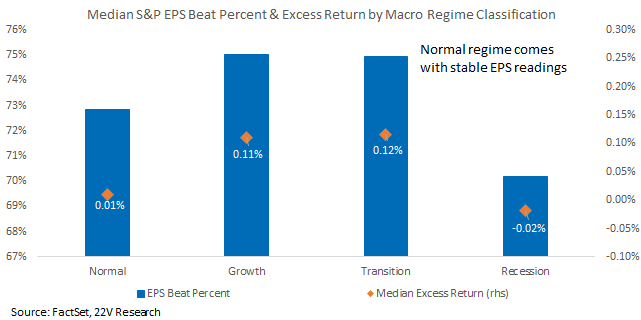
Recession risk remains low with growth better than expected. The start of the Fed rate cutting cycle has also helped ease concerns about near-term growth. We are expecting a non-recessionary cutting cycle, in part because our Macro Regime model continues to put high odds on the U.S. being in a normal economic expansion. Market volatility remains low, even as macro data have weakened somewhat, consistent with low recession risk.
Market internals have been unusually Risk-on tilted over the past two months. Momentum and risk-on factors have led, consistent with our modeling. The unusual returns were to Size and Realized Value, which were both stronger than expected. Size is highly correlated with the AI theme, helping explain its gains. Realized Value is unusually positioned in this cycle, having a positive beta to the market.
Persistent – lasting longer than 5 weeks – risk-on periods are unusual but occur about 25% of the time historically. The government shutdown, particularly if it lasts a week or more, threatens to disrupt the risk-on trend. 1 month/5 weeks. Unless the macro backdrop deteriorates, any weakness in risk would be a buying opportunity, especially as 3Q reporting season is about to get underway.
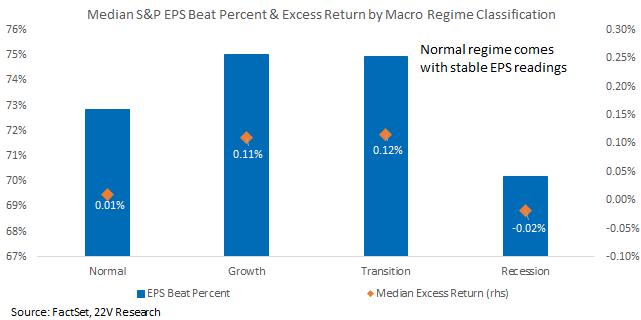
Earnings Outlook in a Normal Regime: 3Q earnings season will kick off in two weeks, after the recovery in 2Q, estimates have been trending higher heading into 3Q reporting. In a Normal regime with stable estimates EPS beat rates and excess returns tend to be high. While we do not expect the level of beats seen last quarter, which were exceptional, the setup into reporting suggests another strong quarter.
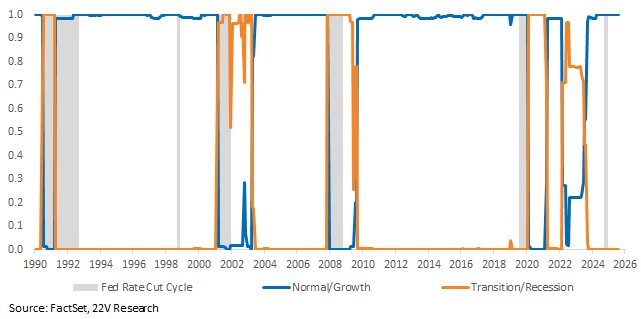
Stable Market Backdrop Continues to Support Earnings: The Fed cutting cycle that started in September is meant to reduce the risk of a disorderly weakening of the labor market. Labor demand has softened, as this morning’s ADP report suggests, but we have not seen any significant increase in nearby Recession risk. Fed cutting cycles do not always end with a recession (HERE), and market performance is very different in non-recessionary cuts vs. recessionary cuts. Our Macro Regime Classification model is still pointing to a low recession risk backdrop with a stable economic expansion. That suggests further market gains as we move through 4Q.
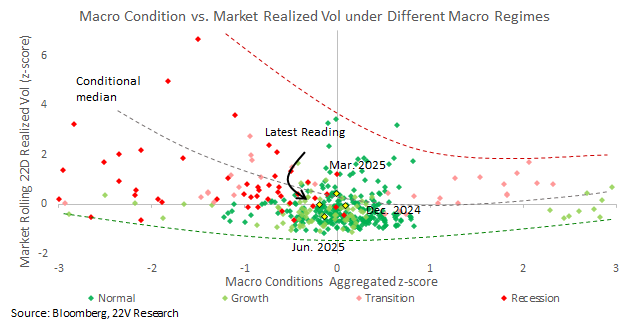
Market volatility is not pricing rising recession risk either. Though macro data has weakened, implied volatility is roughly similar to the beginning of the year. That is consistent with a backdrop of low recession risk and a slowing but still expanding economy. Weakening of macro data has moved the Vol vs. macro conditions plot closer to where recessions tend to occur. Typically, the macro vector would be MUCH weaker during recessions.
Supported by relative low market volatility and easing financial conditions, market internals have been unusually tilted towards Risk-on regimes (Everything Rally and Growth Continuation) over the past two months. Market internals had been unusually risk-off for most of 1H25, so the recent rebound in risk factors can be seen as a bit of catch-up. With growth better than expected and rate cuts reducing concerns about near-term U.S. growth, we expect the risk rotation to continue. The government shutdown, particularly if it lasts a week or more, should reverse some of the recent risk-on gains. Unless data deteriorates significantly, that weakness will be a buying opportunity.
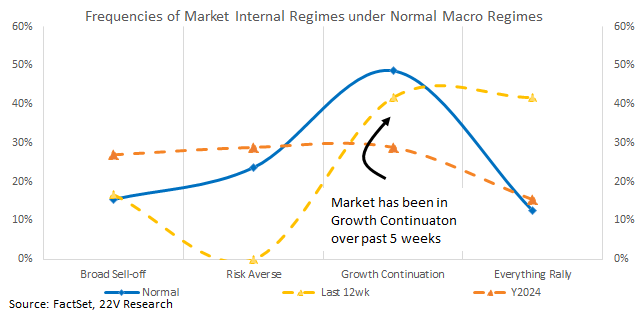
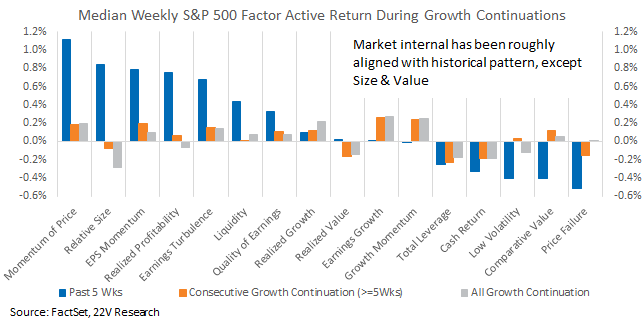
Growth Continuation has persisted for 5 consecutive weeks. Though market internal regimes are typically more volatile than macro regimes, continued Growth Continuation internals are not rare. Roughly 25% of Growth Continuation periods lasted more than 5 weeks. Factor performance during the current Growth Continuation has been roughly in line with historical Growth Continuations, led by Momentum and Risk-on factors. The exception has been Size and Realized Value, as both have posted better than normal returns recently. The AI theme is concentrated in mega names, and positive Realized Value beta helps explain that outperformance.
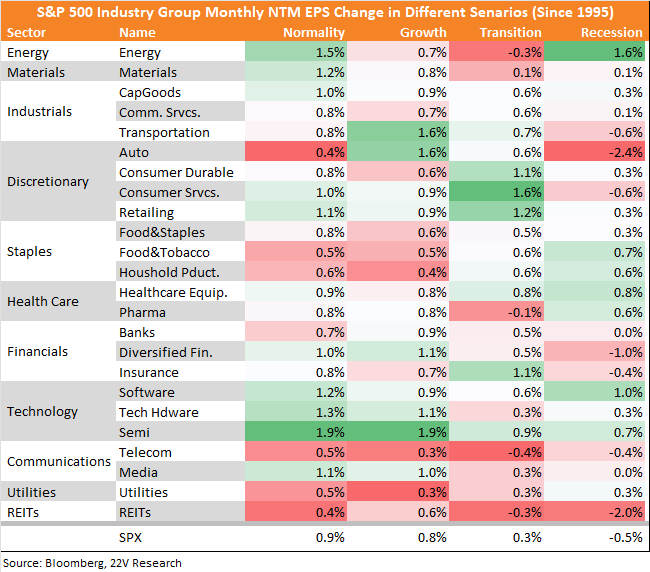
Earnings Outlook in a Normal Regime: 3Q earnings season will kick off in two weeks, after the recovery in 2Q from the tariff shock. 3Q earnings season is expected to be more stable and continue trending higher. In a Normal regime, Tech and Deep Cyclicals used to have higher NTM EPS growth. This year, Tech and Communications have seen the most NTM EPS Growth, with Energy the weakest, though that trend reversed a bit over the past month.
As earnings expectations stabilized, the earnings beat percent and excess return are unlikely to be as strong as last quarter, which was a multi-year high. A Normal regime backdrop suggests continued growth for earnings, with most names likely to beat estimates.