

Is Anything Going Right in the Labor Market? More than Meets the Eye
- NFP growth is lackluster and likely to be appreciable worse after benchmark revisions, slack has been moving wider recently after stabilizing for much of the winter and spring, and, while topline spending and income trends remain robust, the lower end consumer may be softening further.
- Rapidly slowing labor supply growth has partially attenuated the impact of such slow hiring on slack and necessitates adjustments in framing NFP trends. Still, this is not good per se.
- What is going right? Or, put differently, where are there some tentative signs for optimism in the labor market? Turns out, somewhat to even my optimistic surprise, that some of the internals of the household survey on job transitions suggest some positive signs of deceleration or cessation of further slack and seem more early than late cycle.
- In addition, layoffs remain contained and, tentatively, job openings might be steadying.
- These alternate series seem more consistent with the notion of a narrow hiring recession that began in late 2022 and has seen some fits and start since, rather than a looming ‘properly nonlinear’ recession.
- A bit more slack is likely to emerge over the fall before a mild rebound in hiring meets sluggish labor supply growth to steady slack in a “curious kind of balance,” to use Chair Powell’s term.
Due to low hiring rates, whether looking at NFP’s net or the JOLTS’ gross flows, the labor market has eased appreciably since mid-2022. Because much of the decline in hiring has coincided with a decline in labor supply growth less slack has emerged than might have otherwise been expected. That slack has been concentrated on the often higher-churn periphery of the labor market rather than among more core cohorts (more on this later in the week).
There have been two somewhat distinct moves towards a less solid labor market. The first came from mid 2022 to summer 2024 with a second smaller, so far, move since Liberation Day (the unemployment rate lagged a bit and troughed in spring of 2023). There was a respite in late 2024 and early ’25 as it looked like after a few years in the doldrums much of the cyclical economy (ISM, cyclical hiring) was starting to reaccelerate but that was arrested by tariffs and the broader environment of policy uncertainty.[1]
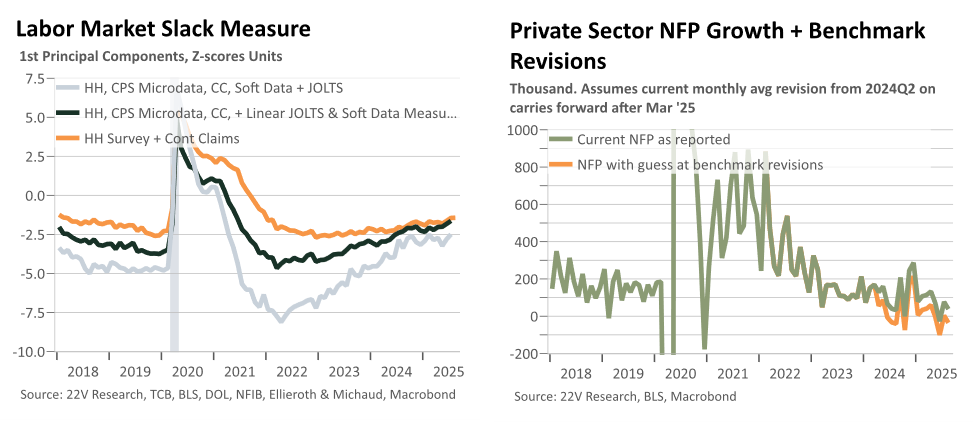
Under the hood in the household survey’s microdata (CPS) there is a set of countervailing trends in job turnover which now look more early cycle than late. This suggests that the second leg higher in slack seen since the spring is on somewhat less broad-based footing than was the initial leg.[2]
These first four CPS-based turnover metrics below are good cyclical indicators distinct from the topline rates we get from the HH survey and suggest that the deterioration seen in those topline and peripheral measures since the spring may be a bit less concerning than at first glance. They are analogous to the JOLTS concepts but derive from the household survey’s microdata and are thus somewhat more timely but often noisier.
- Layoffs into non-employment for the overall working population has started falling and for prime-age workers have now been flat over the past 6-9 months.
- Quits into non-employment, which are a riskier conceptual subset of the JOLTS measure which cover all reasons for job quitting, have moved sharply higher for all workers in recent months and moderately so for prime-age workers as well.
- Quits directly into employment have seemingly stabilized as well. This measure exhibits a bit less cyclicality than others but still the lack of recent downward movement is a good sign.
- Hiring flows from those who are not employed have also started to improved. Somewhat surprisingly this bounce is concentrated among those outside the labor force which tends to exhibit positive hysteresis and rebound late cycle as non-participants are enticed into work. Hiring out of the unemployed tends to increase during episodes of higher unemployment, unsurprisingly, so it is harder to know how to categorize this. in recent months has largely been moving sideways after a modest move higher but it hard to draw a definitive conclusion.
- Separately from the CPS data, the evidence from WARN notices (a legal requitement for mass layoff events) and initial jobless claims both continue to paint fairly benign pictures of firms’ propensity to layoff. The pessimist might reasonably point out that layoffs lag, but 2.5y into the current period of cyclical sluggishness and amid or just after a bout of massive policy and economic uncertainty, the time seems like it is looming for that concern to come to a head.
- By far the most tentatively, the pace of job openings’ decline seems to be decelerating in recent weeks. This may be entirely noise but would be consistent with job churn finding a floor.
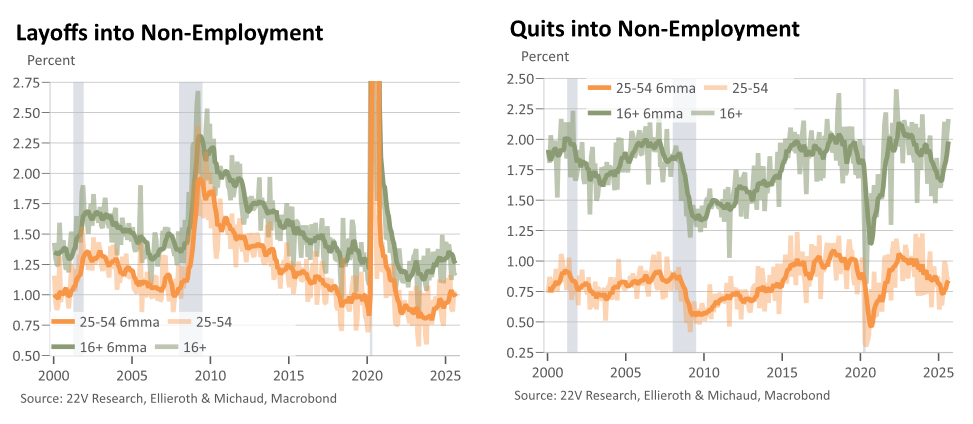
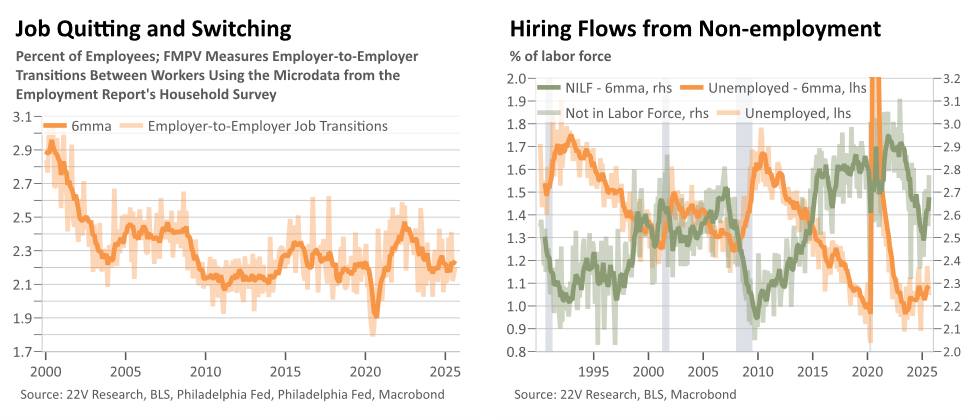
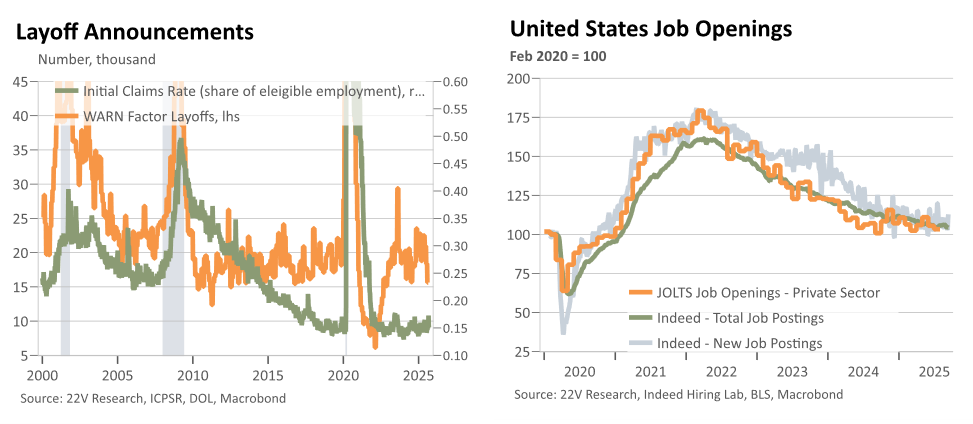
These conclusions are not set in stone by any stretch but serve as reasons for underlying non-pessimism with the labor market in such a strange state (optimism given the supply-side may be a bridge too far given that the narrowness of non-inflationary hiring may leave many indicators looking somewhat middling regardless). The CPS data could be mostly showing correlated noise in recent months and these more positive series could revert into a more pessimistic direction.
But for now these internal measures of the flows inside the household survey paint a more optimistic picture than much of the topline HH survey data, and certainly more so than the NFP data and its related outputs such as hiring breadth (which we should be substantially down weighting unless making extremely careful qualifications to given the impacts of a breakeven payrolls growth rate between 0 to 50k per month, at most half of its pre-covid pace).
I wonder if this microdata optimism inside the CPS may have been flagged to Fed officials in before the most recent FOMC meeting and if it may have been part of the reason for the improvements in the unemployment rate forecasts. Those forecast shifts could have also come due to more dovish policy and the growth upgrades, but even still I found thee market shift in the median and distribution of 2026-27 unemployment rate forecasts somewhat surprising.
The internals of the HH survey discussed above suggest that some measures of slack are starting to improve, or at least show less cause for concern, but it likely takes a bit longer for a broader-based stabilization. Some further easing in labor market slack remains likely over the fall until firms start to meekly return to the hiring market; given continued solid margins and the benefits from easing fiscal policy and easy financial conditions a reacceleration in layoffs seems unlikely. With labor supply growth so anemic, even a modest move higher in hiring will allow for slack to steady itself.
In the chart of our in-house slack measures, the two broader series, which show the most cyclical movement, both now include the 4 total series on quits and hiring flows from the CPS discussed below. ↑
Thanks to Guy Berger’s substack for flagging the latter of these series which I had not checked in some time. ↑

