Back Quantitative

Quant Market in Numbers: Non-Recessionary Cuts Suggest Continued Market Gains

Published on September 21, 2025

∙ Download the PDF Report

By

Dennis DeBusschere

Brian Herlihy

Sophia Wang

Kevin Brocks

The Fed officially started cutting this past Wednesday, framing the reduction in rates as preventative rather than reactionary. That is consistent with the breadth of economic data, which indicates an ongoing normal economic expansion.

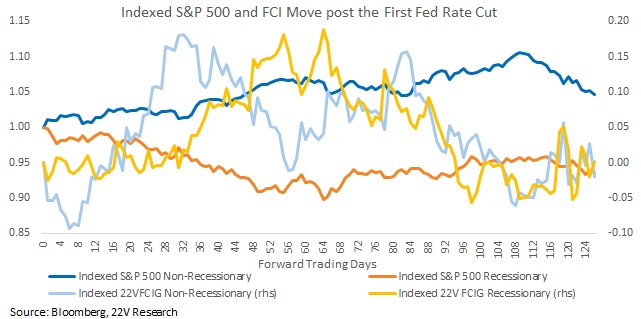
Rate-cutting cycles during periods of low recession risk and supporting financial conditions typically see risk-on factors leading market internals. Fundamental factors outperform broadly as well, including Value, Momentum, and Growth. Returns leading into and following the FOMC have largely followed this pattern, and we expect that to continue near term.
A graph of different colored lines

Description automatically generated

Long-term, market trends are less a function of rate cuts and more tied to recession risks. During con-Recessionary cutting cycles, markets continue rising as cuts continue. If recession risk increases – financial conditions tighten, unemployment moves higher, spreads widen – rate cuts are not enough to sustain market gains.

With more than 4 Fed cuts being priced by the end of next year, earnings/margins strong, and consumer spending firm, financial conditions are likely to remain easy. That backdrop could change IF labor markets weaken materially from here or if inflation backs up, reducing the ability of the Fed to keep cutting rates in 2026. Until one or both of those trends looks likely, the path for market and risk factors is likely higher.

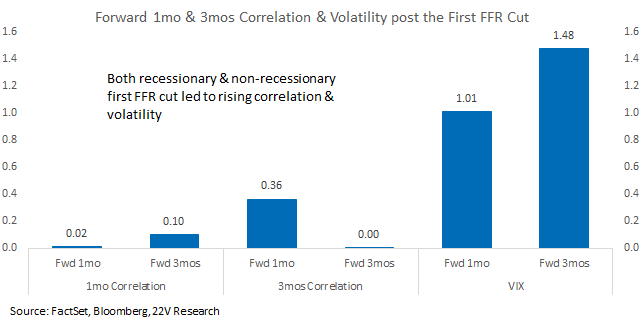
There are some headwinds to keep in mind, though. During both non-recessionary and recessionary rate cuts, S&P correlation and implied volatility tend to rise. That is consistent with a more uncertain backdrop and will eventually work against the risk-on trend that has taken hold over the past few weeks. Higher vol and higher correlations will also act to limit PE expansion. However, those are likely considerations for 2026 or possibly late in 4Q25.

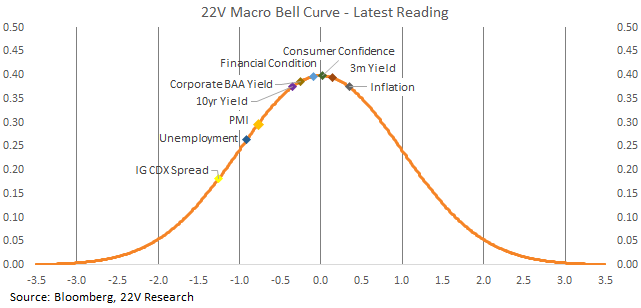
Non-Recessionary Cuts Suggest Continued Market Gains: Trying to prevent a disorderly weakening of the labor markets, the Fed started its rate-cutting cycle on Wednesday. Spreads are narrow, unemployment is low, corporate profits are strong, and consumer spending trends are firm. This is a protective cut in a non-recessionary backdrop. The breadth of data is today and has been for several quarters, consistent with a stable economic expansion.
A diagram of a graph

AI-generated content may be incorrect.

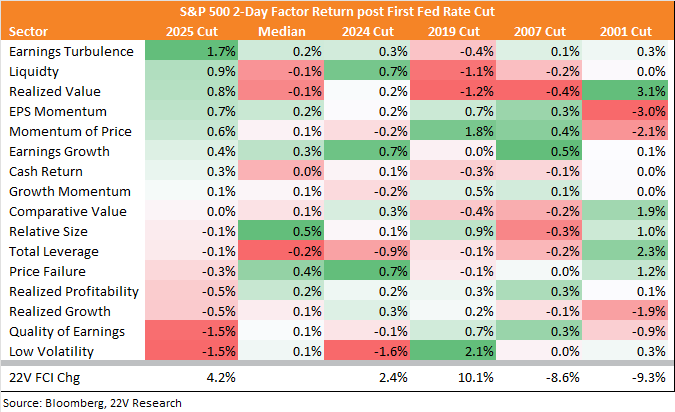
During non-recessionary rate cuts, factor leadership tends to be more risk-on tilted. Earnings Turbulence and Liquidity usually lead at the expense of Low Volatility. The window is very narrow, but internals have largely followed that pattern so far. Most fundamental factors have outperformed, too, including Value, Momentum, and Growth, all of which are in line with our regime-based expectations.
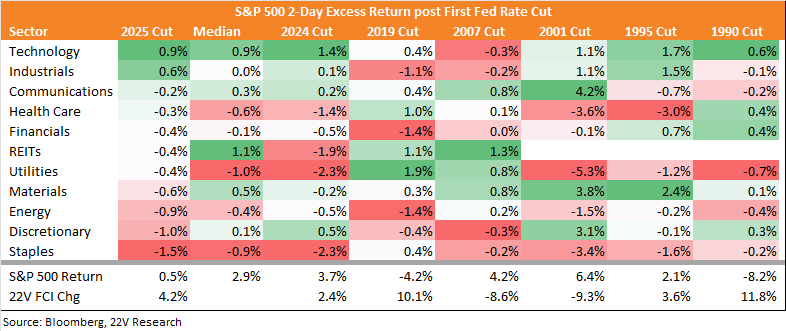
Early Cyclicals have taken leadership for now, especially Technology. Staples has been the worst performing sector. Early Cyclicals are likely to outperform Defensives given the path of rate cuts expected through year-end and continued economic strength.
A screen shot of a chart

Description automatically generated

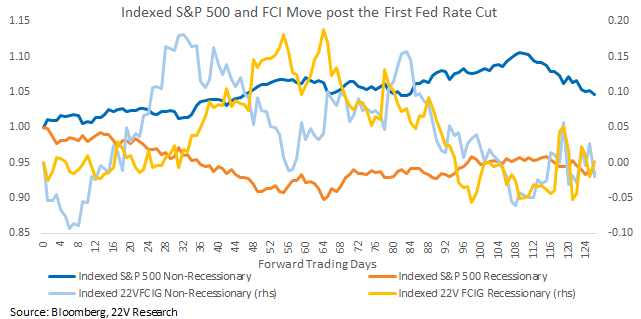
Longer-term, market performance and internals following the start of rate cuts are tied to subsequent recession risk. For the Fed rate-cutting cycles since 1990, non-recessionary cuts saw the S&P continue to rise for several months following the first cut. During those periods, financial conditions also eased. During recessionary cuts, financial conditions were typically tightening INTO the cuts and continued to do so after.
A graph of different colored lines

Description automatically generated

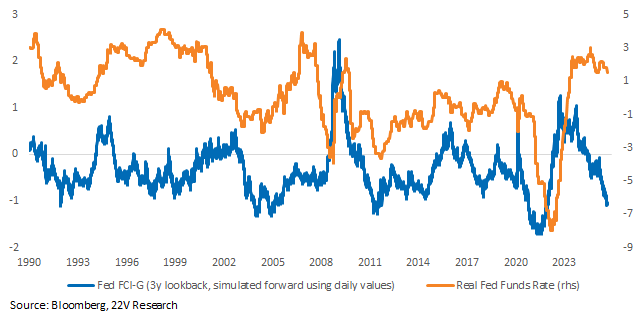
Historically, there is a loose correlation between the real Fed Funds rate and financial condition changes. A lower real Funds rate usually coincides with easing financial conditions. Today’s backdrop is complicated somewhat because financial conditions are already exceptionally low and the real funds rate unusually high. We expect financial conditions will remain easy until the labor market starts to improve or inflation picks up materially. Neither is an imminent concern.
A graph of blue and orange lines

AI-generated content may be incorrect.

There is one headwind to consider. During both non-recessionary and recessionary cutting cycles, S&P short and long-term correlations and implied volatility tend to increase. More certain EPS estimates and the VIX returning to the low teens have helped drive the S&P higher and risk factors into leadership. If rate cuts reduce labor market risks, that backdrop should continue. That being noted, history suggests that when the Fed starts cutting rates, total uncertainty tends to rise, not fall.
A graph of blue squares

AI-generated content may be incorrect.

DISCLOSURES AND DISCLAIMERS

Analyst Certification

The analyst, 22V Research Group, primarily responsible for the preparation of this research report attests to the following: (1) that the views and opinions rendered in this research report reflect his or her personal views about the subject companies or issuers; and (2) that no part of the research analyst’s compensation was, is, or will be directly related to the specific recommendations or views in this research report.

Analyst Certifications and Independence of Research.

Each of the 22V Research analysts whose names appear on the front page of this report hereby certify that all the views expressed in this Report accurately reflect our personal views about any and all of the subject securities or issuers and that no part of our compensation was, is, or will be, directly or indirectly, related to the specific recommendations or views of in this Report.

22V Research (the “Company”) is an independent research provider. The Company is not a member of the FINRA or the SIPC and is not a registered broker dealer or investment adviser. 22V Research has no other regulated or unregulated business activities which conflict with its provision of independent research.

22V Research, LLC is a professional services and independent publication organization. 22V Research, LLC is not a securities broker-dealer, not a member of the Financial Industry Regulatory Authority (FINRA), not a registered investment advisor (RIA) and not a member of SIPC.

Securities transactions, when offered, are offered by 22V Securities, LLC through LPS Capital, LLC. Certain employees of 22V Securities, LLC are dually registered as securities representatives of LPS Capital, LLC or Analyst Hub Securities, LLC. 22V Securities, LPS Capital and Analyst Hub Securities are members FINRA, SIPC.

https://brokercheck.finra.org/

Current Ratings Definition.

SECTOR OUTPERFORM: An “outperform” rating anticipates the company will outperform the S&P Regional Banking Index (peer group).

SECTOR PERFORM: A “market perform” rating anticipates the company will perform in line with the S&P Regional Banking Index (peer group).

SECTOR UNDERPERFORM: An “underperform” rating anticipates the company will underperform the S&P Regional Banking Index (peer group).

Limitation Of Research And Information.

This Report has been prepared for distribution to only qualified institutional or professional clients of 22V Research Group. The contents of this Report represent the views, opinions, and analyses of its authors. The information contained herein does not constitute financial, legal, tax or any other advice. All third-party data presented herein were obtained from publicly available sources which are believed to be reliable; however, the Company makes no warranty, express or implied, concerning the accuracy or completeness of such information. In no event shall the Company be responsible or liable for the correctness of, or update to, any such material or for any damage or lost opportunities resulting from use of this data. Nothing contained in this Report or any distribution by the Company should be construed as any offer to sell, or any solicitation of an offer to buy, any security or investment. Any research or other material received should not be construed as individualized investment advice. Investment decisions should be made as part of an overall portfolio strategy and you should consult with a professional financial advisor, legal and tax advisor prior to making any investment decision. 22V Research Group shall not be liable for any direct or indirect, incidental or consequential loss or damage (including loss of profits, revenue or goodwill) arising from any investment decisions based on information or research obtained from 22V Research Group.

Reproduction And Distribution Strictly Prohibited.

No user of this Report may reproduce, modify, copy, distribute, sell, resell, transmit, transfer, license, assign or publish the Report itself or any information contained therein. Notwithstanding the foregoing, clients with access to working models are permitted to alter or modify the information contained therein, provided that it is solely for such client’s own use. This Report is not intended to be available or distributed for any purpose that would be deemed unlawful or otherwise prohibited by any local, state, national or international laws or regulations or would otherwise subject the Company to registration or regulation of any kind within such jurisdiction.

Copyrights, Trademarks, Intellectual Property.

22V Research Group, and any logos or marks included in this Report are proprietary materials. The use of such terms and logos and marks without the express written consent of 22V Research Group is strictly prohibited. The copyright in the pages or in the screens of the Report, and in the information and material therein, is proprietary material owned by 22V Research Group unless otherwise indicated. The unauthorized use of any material on this Report may violate numerous statutes, regulations and laws, including, but not limited to, copyright, trademark, trade secret or patent laws.
