

I Three important events took place this week regarding the war in Ukraine – Russia deliberately probed NATO air defenses in Poland, Ukraine targeted Russian crude oil export facilities, and the EU laid out the de facto plan for how it will finance Ukraine’s war going forward. Each has far-reaching implications for the outlook of the war. All three events are generally positive for Ukraine.
The incursion of up to 19 Russian drones into Poland earlier this week was – given the number – evidently a deliberate act by the Russian military. The aim is likely to have been a probe or test of how NATO responds to the type of “massive drone/missile attacks” that Russia launches against Ukraine on a daily basis. NATO basically failed the test, as it was in the end forced to launch modern fighter jets and shoot down $10-20k Russian drones with missiles costing at least $1mn a piece. This is not a sustainable response strategy against Russia, which we know can launch hundreds of drones on a daily basis. While of course NATO air defenses are better than Ukraine, they, too, would risk becoming exhausted by Russian drone attacks after only a few days. NATO in other words have a real problem.
The solution will have to be first accelerated development of low-cost anti-drone interceptor drones, gun or laser-based air defenses against Russian drones, or in other words essentially build on the strategies already being implemented by Ukraine. This will likely see further integration of Ukrainian and NATO (Poland has already announced its engagement) air defense development and production.
Secondly, NATO will have to expand its existing conventional deep-strike capability against Russia to at all times be able to “return the favor” to Russia in case of a large-scale drone attack. Given European concerns about the possible willingness of the United States to participate in such a retaliatory attack against Russia, this means the development of an independent European such deep-strike capability in the form of long-range drones and ballistic and cruise missiles. In other words, just as with air defense, pursuing military development and investments similar to the strategies currently pursued by Ukraine. Here, too, the outcomes is like to be increased military industrial collaboration between NATO members and Ukraine.
This week also saw the arguably first direct and explicit Ukrainian long-range attack on a Russian crude oil export facility – the Baltic port of Primorsk. This attack comes simultaneously with Ukraine’s accelerated air campaign against Russian domestic refineries, and marks a clear escalation from previous periods, where there was an informal agreement with first the Biden Administration and then likely also Trump for Ukraine not to directly attack Russian crude oil export facilities. The fact that this has now happened shows both Ukraine’s constantly increasing deep-strike capabilities and the decreasing influence of the United States on Ukraine’s war efforts. Kyiv today evidently feels less constrained by Washington’s concerns about global oil prices. Such attacks are likely to continue and has the capacity to inflict significant damage to Russia’s crude oil export capacity, imposing near-term additional financial harm to Russian government finances, as well as posing an upward risk for global oil prices.
Lastly, this week European Commission President Ursula von der Leyen in her annual State of the European Union speech gave the broad outline for how the EU plans to address Ukraine’s near-term financial needs. The EU’s chosen solution will be a so-called “Reparations Loan”, secured by the Russian assets immobilized in European financial institutions. Hereby the EU will offer to lend to Ukraine up to the “cash balances of Russian assets”, e.g. de facto the level of the principal or perhaps €200bn, with a requirement that Ukraine only repays the loan once Russia pays it reparations for the war. This will amount to the EU collectively taking the risk of repayment, as it would lend on this basis to Ukraine starting likely in the coming months.
This is essentially a political decision by the EU of how it plans to finance Ukraine’s war effort going forward, and von der Leyen’s announcements illustrates that the EU has chosen to do so via a “political link” between continued funding of Ukraine and Russia’s immobilized assets, but essentially – and appropriately – taking on all the credit risk. In practical terms, while the precise legal vehicle of choice for the EU to implement this has not yet been announced, this will mean that the EU will issue more common funding (Eurobonds) for Ukraine. Further details are likely to become available around the time of the Fall IMF meetings in October, when revisions to existing IMF program for Ukraine will be discussed.
It should be noted here that the continued EU funding of Ukraine is likely to make EU governments less willing to offer existing private sector bondholders access to privileged principal repayment. Or put another way, existing private sector holders of Ukrainian government bonds are not likely to be repaid until Russia offers war reparations to Ukraine, and if Moscow does not do so, private bondholders may not be repaid at all. Von der Leyen’s announcement of significant new EU funding for Ukraine should hence not be taken as any indication that existing private sector bondholders, who have already seen their Ukrainian bonds restructured, are any closer to repayment.
II The ECB this week as expected kept rates unchanged, and President Lagarde made it clear that the Governing Council continues to feel that “policy is in a good place” and the updated economic forecast continues to signal that medium-term HICP and core inflation is well anchored around 2 percent. The growth forecast was, in line with 1H data, revised up to 1.2 percent in 2025, while kept essentially unchanged in 2026-27 at a similar level above 1 percent and quite near the euro area potential growth rate level. There is hence a solid base case now that the ECB in the absence of new information will remain on hold until at least 2H of 2026. At the same time, while Lagarde noted that risks are more balanced, the ECB’s own inflation forecast now sees it dropping to 1.6 percent in Q1 2026 (figure 1), clearly raising the specter of a possible significant undershoot of inflation in 2026, if the ECB’s growth forecast does not pan out.
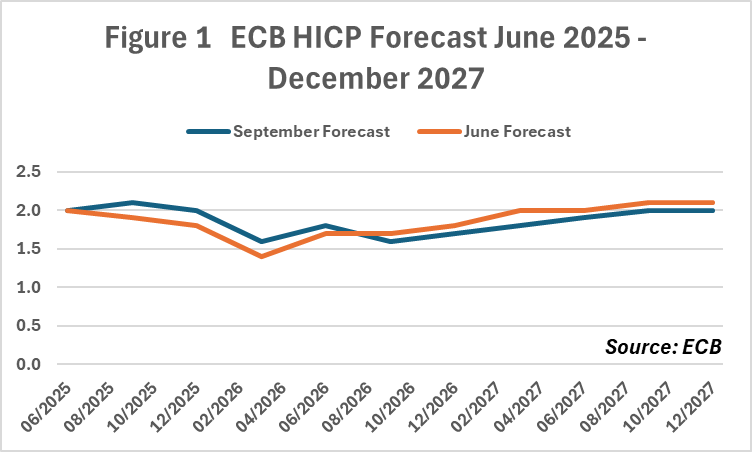
The higher near-term inflation outlook in 2H 2025 and 1H 2026, relative to the June forecast is clearly linked to the more benign trade policy outlook, but also remains contingent on the ECB’s continued belief in falling euro area savings rates and an associated increase in private consumption. Savings rates are now expected to fall from 15 percent in 2024 to 14.8 percent in 2025, 14.5 percent in 2026 and 14.0 percent in 2027. Recalling the political outlook in several large euro area member states remain volatile and the war in Ukraine should be expected to last through 2026 into 2027, this remains a fairly bullish outlook for private consumption in the euro area. As such, there remains a risk that inflation will undershoot more than expected in 2026, possibly requiring the ECB to cut again in the Spring of 2026.
In sum, while the strong base case (80 percent) remains that the ECB now holds rates in the coming quarters, the risks to that outlook are hardly symmetric and remains to the downside and one more cut (20 percent).
III The French government under Francois Bayrou was as expected ousted in a confidence vote, though President Macron surprised by proceeding immediately with nominating his defense minister Sebatien Lecornu as the next prime minister. Lecornu is a Macron loyalist and hence does not represent an act of political outreach to either the left or right, meaning his principal task of securing the passage of next year’s budget can now likely only be achieved through a watering down of consolidation commitments. He appears to have begun these negotiations before naming his new cabinet, holding out the possibility that some additional members from other parties may be included in the new cabinet. However, the now even stronger base case for French fiscal policy should be that the 2026 budget when eventually passed will not include any material budget consolidation and will with near certainty have a deficit of over 5 percent of GDP. The near-term risks of public unrest in France remain, and the continued political uncertainty – even in the absence of another early election – will continue to weigh on business and consumer confidence. French GDP growth and public revenue will suffer accordingly, as growth in 2025 will fall below 1 percent and seems unlikely to recover in 2026.
Gradual French fiscal deterioration is hence likely to continue in 2026-27, and should be reflected/amplified by additional ratings downgrades and rising long yields.
Jacob

