

China’s string of weak economic activity data since July has validated our earlier concern about a growth slowdown in the second half (see our second half outlook from early July HERE). In particular, property and investment show clear signs of weakness, while exports are also facing headwinds. This report outlines our view on fiscal stimulus in the coming months and its implications. The main takeaway is that fiscal support will be incremental, serving to cushion downside risks to growth but not leading to a meaningful rebound.
More Support Needed
A front-loaded fiscal expenditure program has been a key source of support to economic growth this year, with fiscal expenditures growing 6.8% year-to-date. If China is to achieve the 2025 GDP growth target of “around 5%”, fiscal expenditure will need to keep growing at 7% or higher for the rest of the year.
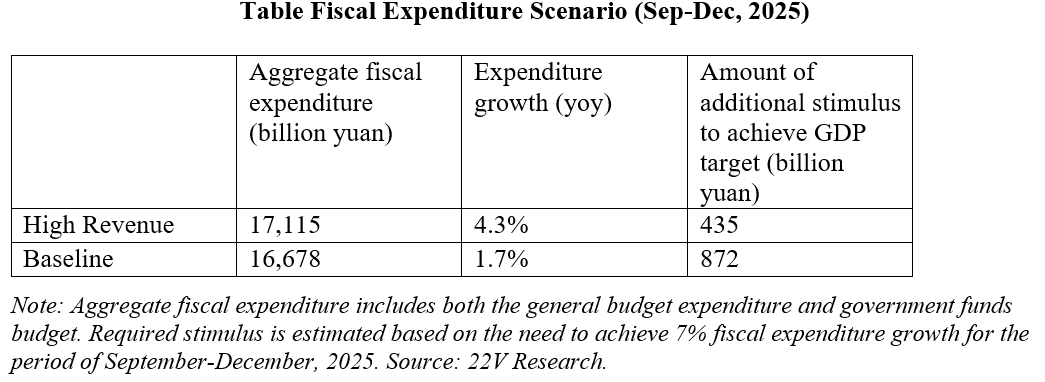
However, this will not be possible without a further increase in the deficit to allow more borrowing in Q4. By our estimate, even under optimistic assumptions for fiscal and land-sale revenue, aggregate fiscal expenditure growth (including both the general budget and government funds budget) is unlikely to exceed 4% for the remainder of 2025 without additional fiscal stimulus (see table). As nominal GDP growth is around 4%, fiscal expenditure growth of 4% is growth-neutral. Under more realistic assumptions, expenditure growth (absent additional stimulus) will be closer to 2%.
In concrete terms then, China faces a revenue shortfall of CNY 435-900 billion (0.3-0.6% of GDP), which must be filled by additional deficit borrowing to secure the growth target.
Stimulus Expectations
As has been the case in each of the last two years, a key question for Q4 is whether China’s leadership announces additional deficit borrowing to shore up growth for the remainder of the year. The signals will come at or around the next quarterly Politburo meeting on the economy at the end of October.
China’s leadership will set a high bar before approving a major stimulus package in Q4. While growth is slowing, a surprisingly strong economic performance in H1 means that real GDP growth requires only moderate support in Q4 to achieve the full-year target of “around 5%.” The runup in Chinese equities will not do much to directly lift the economy (wealth effects from the equity market are more than offset by falling property prices) but are at least helping stabilize overall confidence, a key goal of the leadership. Hence, Beijing’s level of urgency to support growth is not high.
Our expectations for Q4 stimulus are as follows:
- Base Case: We currently assign a 35% probability to Beijing announcing an additional fiscal deficit of 0.5-1.0 trillion yuan. This would take the form of central government borrowing (“special long-term treasury bonds”) to fund investment projects and some consumption initiatives (we notionally expect a 70/30 investment/consumption mix). This would be enough to stabilize activity but not lead to a rebound in growth momentum, even an optimistic scenario for government revenues. Stimulus implementation tends to be slow. In both 2023 and 2024, Beijing announced new measures in Q4, yet most of the funds were not spent within the year but rolled into the following year. This is likely a market-neutral outcome.
- A 30% probability of additional stimulus via policy lending without new deficit announcement. Even if the headline amount of new policy lending is fairly large, the growth dividends are modest as banks frequently reclassify existing loans to qualify for new incentives. This would be market-neutral to modestly market-negative.
- A 30% probability of a no new stimulus. This would be market-negative, though likely not enough on its own to derail the near-term momentum of China’s A-shares (see below).
- Only a 5% probability of stimulus that significantly exceeds expectations and is strongly market-positive. This would require a significant announcement of debt issuance (1 trillion yuan) and a holistic package similar to the “policy pivot” of September 2024, likely targeting local government investment and property.
Beijing will also cut interest rates, but the size will be limited due to the need to preserve the banking sector’s net interest margins, which are currently at the lowest level since 2010. We expect 15 bps cuts to both the 7-day repo rate and loan prime rate (LPR). Such modest rate cuts are unlikely to have meaningful impact on activity.
In sum, we expect Beijing to announce new fiscal stimulus, but its growth impact will likely be modest. Activity will likely remain soft through year-end, with procyclical sectors such as property and energy under continued pressure. For Chinese equities, Fed policy and domestic liquidity conditions may matter more than the macro backdrop, at least in the short term. Put differently, unless growth decelerates sharply—a scenario we see as low probability—A-shares may not be at major near-term risk, though the durability of their ability to trade independently from macro over a sustained period remains a question.

