

I Coming into next week’s ECB meeting, it is increasingly clear that the Governing Council will like what they have seen in the data and new policy developments over the summer. It is consequently now the strong base case that there will be no changes to policy rates next week. It is moreover, and I am changing my call here, given the seemingly well anchored inflation expectations, decent growth prospects and reduced trade policy uncertainty in the euro area now increasingly likely that the ECB deposit rate will stay at 2 percent throughout the rest of the year and through at least 1H of 2026. New unexpected events or information will likely be required for the Governing Council to shift euro area interest rates below 2 percent in the coming quarters.
Non-Energy goods inflation in the euro area now remain quite limited, and the relatively strong euro is likely to exert a dampening influence going forward, and with Brent oil prices $10-15 below last year (and projected by some to continue to fall towards $50/barrel) and European natural gas TTF prices similarly at around €32-33/MWh 15-20 percent below last year’s level, small ongoing negative contributions from energy to HICP also ought to be the base case (Figure 1).
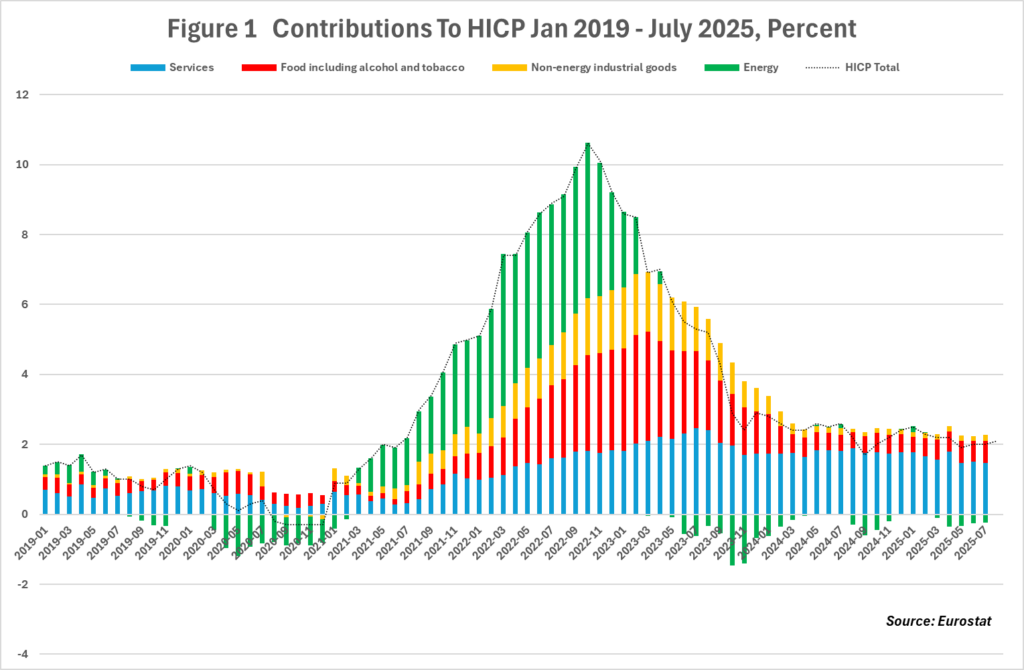
Euro area services inflation remains the bulk of overall HICP, but with sector wage growth expected to continue to decline in 2H 2025 towards a long-term sustainable level (Figure 2), the Governing Council will likely not be particularly concerned about services sector trends.
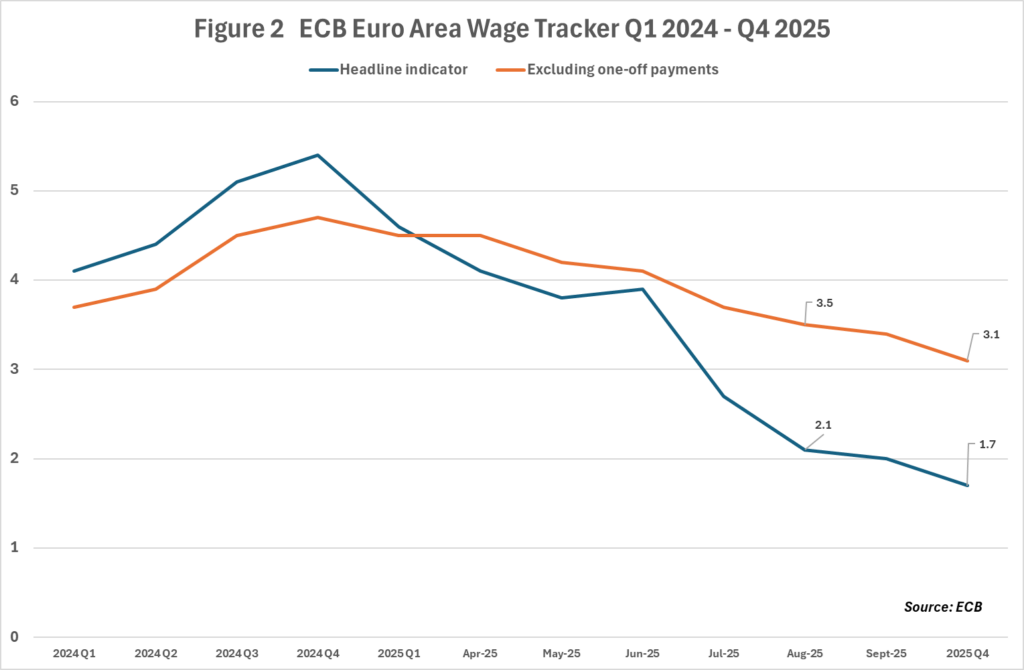
Figure 2 shows how the aggregate ECB wage tracker (covering just below half of euro area workers), which includes one-off payments, such as those related to inflation compensation, bonuses or back-dated pay, are now as these payments are no longer being granted workers as HICP has normalized projected to fall below 2 percent in Q4 2025. The wage tracker excluding one-off payments, i.e. better reflecting the scope of structural (or permanent non-one-off) negotiated wage increases, is projected to fall towards 3 percent by the end of the year. This is a level of nominal wage growth in the euro area that most on the Governing Council will regard as sustainable in the long-run for euro area firms, being “paid for” by 2 percent inflation and an assumed 1 percent annual increase in productivity.
The remaining “problem sector” in euro area inflation is by now increasingly the food sector (alcohol and tobacco prices are heavily influenced by taxation). This is self-evidently a category of the utmost political importance, and will also likely disproportionally shape consumer perceptions and expectations for euro area inflation, so the Governing Council will naturally keep it under close surveillance. At the same time, however, European (and global) food prices are directly affected by increasingly unpredictable weather patterns and labor availability, and as such are largely dictated by factors outside the reach of a central bank, likely requiring policy makers to see through any short-term fluctuations. Hence, food inflation itself is unlikely to dictate euro area rate setting.
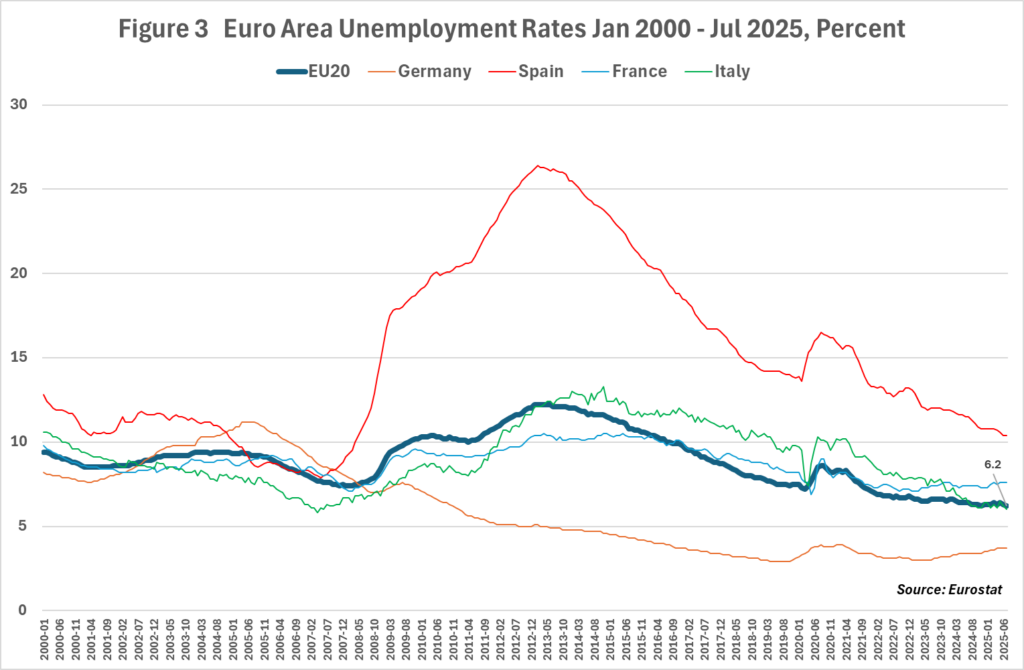
Labor markets is another encouraging sign for the ECB, as the uncertainty of 1H 2025 appears to have left no effect, as euro area unemployment in July fell back to its historic low of 6.2 percent, while Germany and even France remained stable at low levels over the summer and Spain and Italy continued gradual declines (Figure 3). Combined with relatively resilient 1H GDP growth (0.5 percent in Q1, 0.2 percent in Q2 and 1.4 percent Y/Y), you hardly need to be a monetary hawk to see the argument that the euro area does not need additional scarce (when below 2 percent policy rates) monetary stimulus right now.
Lastly, the Governing Council will appreciate the relatively benign outcome in the transatlantic trade confrontation, well below their own “adverse scenario” and not seeing dramatic declines in EU exports to the US (e.g. a subdued negative demand effect) and no EU retaliatory tariffs, leaving the euro area itself without direct tariff effects. While it remains unclear – given President Trump’s unpredictability and the U.S. legal process concerning the constitutionality of IEEPA tariffs – how this outcome will ultimately affect business confidence, it seems reasonable to say that “most of the worst possible outcomes were avoided”. Combined with a coming German fiscal stimulus starting gradually towards the end of the year, but accelerating in 2026-27, and a – at least reflected in the summer’s PMI survey data – cyclical recovery in European manufacturing, it seems likely that the ECB will upgrade their September macroeconomic growth forecast to above 1 precent – perhaps as high as 1.2 percent – for 2025, while maintaining their 1+ percent growth forecasts also for 2026-2027.
Overall, the ECB will view the situation as one in which they can step back for a while and then only respond to new events emerging in the coming quarters. These could – though all at a low probability – include a notable deterioration in French politics in the coming month, significant Russian battlefield gains, or a resumption of a full-blown US-EU trade confrontation.
II A fair amount of news headlines have, following the Alaska Summit, focused on the prospects for NATO agreement of “security guarantees for Ukraine” and the possibility of renewed US and EU economic sanctions on Russia. On security guarantees, the meeting this week among the “Coalition of the Willing” yielded no concrete outcome, other than vague promises for troops only after a peace was established. More importantly, the continuation of a gradual shift is now discernable among NATO members (not least Germany) towards seeing “security guarantees” more as a “Ukraine able to defend itself against Russia” than “European boots on the ground in Ukraine”. This – predictable given limited available European military forces and doubts about the credibility of any guarantees offered by Donald Trump – shift means that for “peace to become secure”, Ukraine needs to become militarily stronger and/or Russia weaker, to enable Ukraine to be its own (and the rest of Europe’s) security guarantee against Russia.
This in turn means that the war will continue, as Ukraine expands domestic weapons production of particularly deep strike capabilities from missiles and drones able to hit large parts of Russia, increasingly funded by European members of the coalition of the willing (and noticeably Germany). It will also see the ongoing expansion and integration of Ukraine’s military producers with those of the rest of Europe, with this week seeing the announced opening of the first Ukrainian company’s military production facility (solid rocket fuel for missiles to be manufactured in Denmark) in a European NATO member.
Vladimir Putin has again this week explicitly rejected the idea of “Western troops” in Ukraine and insisted on putting significant restrictions on the scale of Ukraine’s armed forces. It is by now clear that neither of these demands are acceptable to Ukraine or its European partners. This will guarantee that no real progress will be made in the ceasefire or peace negotiations with Russia, irrespective of who facilitates them, where or who is directly present.
Following a phone conversation between the European leaders and Donald Trump this week, in which the U.S. president explicitly is said to have ruled out further sanctions against Russia and instead admonished the EU to completely stop buying oil and gas from Russia, it seems ever more certain that no additional U.S. economic sanctions will be implemented. Instead, however, the Trump Administration is continuing U.S. arms sales to Ukraine, so the lack of additional sanctions on Russia is not indicative of the full U.S. position on the war. The EU itself is also next week likely to propose yet another sanctions package against Russia, probably targeting through relatively rare EU secondary sanctions, firms in third countries directly supporting the Russian military industrial complex. Since many of these will likely be from China, this prospect has the possibility of making EU-China economic and political relations worse, as Beijing seem likely to retaliate in some form against the EU. A full-blown trade war between the EU and China remains a very low probability however.
In sum, investors ought to take as their strong base case for the coming quarters that the war in Ukraine continues at least well into 2026, and not pay particular attention to any diplomatic announcements about it. The most effective new “economic sanctions” imposed on Russia will remain those imposed by Ukrainian military strikes against Russia’s energy and broader economic infrastructure.
Jacob

