July’s PPI Doesn’t Help the Dovish Case
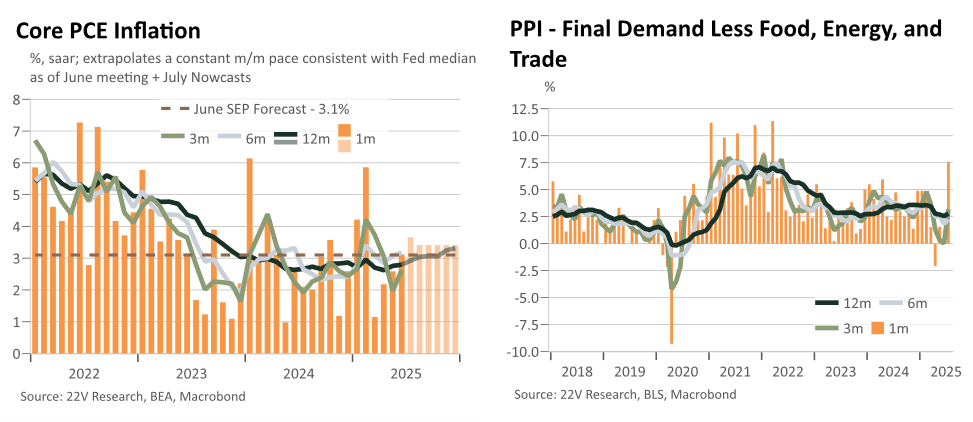
- Most nowcasts of core PCE moved a few bps higher in response to the monster beat in today’s PPI data for July. At ~30bps these estimates seem only minimally changed relative to where we were to start the week.
- Given the surge in portfolio management inflation, the underlying core PCE picture without this is actually perhaps a bit better than expected going into the week.
- The doves can point to this now. However, to be intellectually consistent they would have been fading some of the softness in core services ex housing this spring, which they have not seemed to do (there are also looming revisions higher in some health care PCE series).
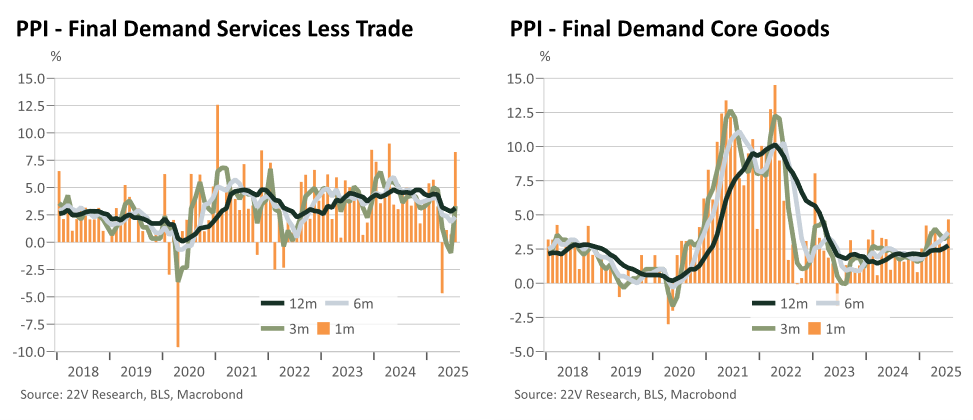
- The broader takeaway from the PPI data, which does not include import prices directly but only as they flow through supply chains, is one of surprising underlying heat across measures. Core goods PPI was up 38bps with heat concentrated in tariff-related sectors.
- It is important to remember too that so much of the inflationary trends in recent years have been driven by the skews and the shocks as much as the medians.
In general, the core PCE nowcast is the best way to approach the CPI and PPI data. Given the July nowcast and recent data we’re tracking roughly in line with, or perhaps a smidge above, expectations from the June SEP. There has been little concrete guidance from the Fed on the expected monthly profile of inflation beyond that the reacceleration has happened a bit slower than expected for some (more of a general point given the above noted forecast consistency so far). The issue over the next few months is that with all the noise and upside pressures from tariffs there may be little ability to distinguish between data consistent with the 3.1% median (2x cuts) and the 3.4-3.5% highest forecasts (0x cuts). This is an environment with some dovish anchors and political pressures but an unemployment rate that is so far easing less than expected.
Today in conversations with a few investors I quipped that far more than the median inflation data, the tails have been the real tell on underlying inflation dynamics during my career. After the GFC, median was reasonably well anchored near 2% surprisingly quickly, but the skew on the shocks was always in a dis- or de-flationary direction. Now one can make an argument about median or inflation ex-all-the-heat being close to 2%, but the shocks keep coming in one way. Today’s PPI and the CPI to a lesser extent both highlight this underlying phenomenon (as have the too often dismissed hot Q1 prints that reflect not so much bad seasonality as infrequent seasonal pricing shifts based off higher lagged inflation and inflation expectations).
Given what we have heard from retailers recently we should expect an additional tariff-related boost higher in inflation over the coming few months as tariffs are more fully passed through to consumers. It remains unclear if the sluggishness of the pass-through to date is due to retailers’ general uncertainty about tariffs, which inventory front-running allowed to be patient in learning about where policy was headed (generally hawkishly relative to the post-liberation day reset), or if they are making more benign assumptions about the IEEPA tariffs ultimately being overturned.
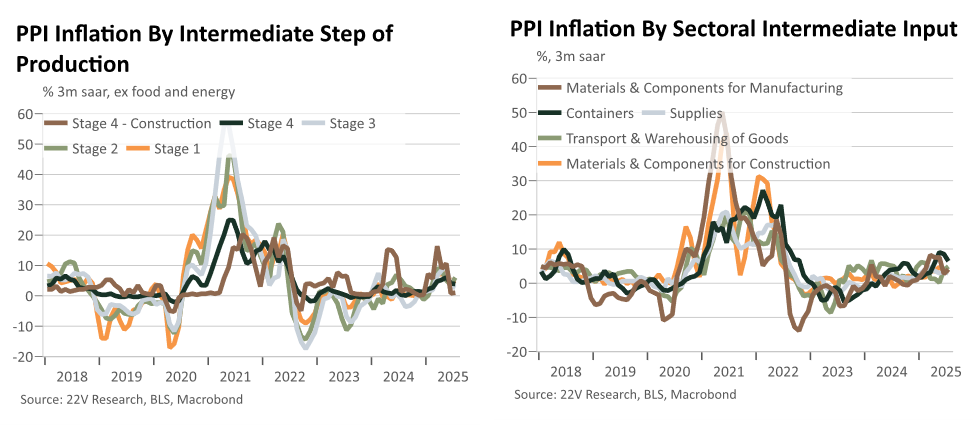
However, it is worth looking at the rest of the PPI data in this release and the picture is a less than optimistic one about current and pending inflation. Core PPI final demand had its hottest print since early 2022. Yes, portfolio management fees were a substantive contributor but even stripping them out the beat would have remained punchy. Core goods PPI have clearly been reaccelerating to start the year as well. Given the magnitude of tariffs this is not particularly shocking but it is interesting to note given that my own prior is that because PPIs do not incorporate import prices that tariff impacts on PPI would lag those in CPI somewhat (the official import price indices explicitly exclude tariffs so their flatness to start the year is telling in the sense that it rebuts the dovish that an appreciable share of tariffs’ costs would be eaten by overseas producers). The speed of pass-throughs here seems to suggest that final consumer retailers are being as patient as possible in shifting tariff costs onto consumers but that price pressures are building. Intermediate production inputs have shown less of a tariff response so far but have also been gradually trending higher, and in modestly positive territory, for much of the past year and a half. This not a backdrop which suggests minimal pricing pass-throughs over the medium-term.