

My first pass at drawing inferences for the various slices of the Core PCE Price Index from the informed consensus suggests that there is no smoking gun in the July goods and services price inflation data. Underlying inflation seems to be quickening from a pace that is already somewhat elevated relative to the Fed’s target. And this does mean that the Fed will be inclined to target below-potential (1 1/2%) growth of aggregate demand during the next few quarters, as I have been emphasizing. In this environment, the recession risk has to be elevated, although it is probably not quite the base case at the 12-month horizon. In pointing this out, I take on board that the Fed will mostly look through most of the tariff impulse. They are not inflation nutters, but best practice is to be careful here.
But this story continues to play out frustratingly slowly, which could mean that tariff passthrough is delayed or that tariff passthrough will ultimately be less than many analysts have expected. I will stick with the notion of a slow passthrough with high conviction, but this would be an easier call if price data were perkier, and not just in areas that are most obviously affected by tariffs. (To point out speaker prices are up because heavily tariffed does not really answer the question that investors face. Slower non-tariffed goods price inflation counts.)
The table and chart below show my first pass. There are two points that seem worth highlighting here. First, the consensus guess for the Core PCE Price Index probably factors in an add from portfolio management and advisory fees. I assume that others assume that the add there will be 4 bps (+/-). And that is why there is a 5 basis points gap between the Core PCE and the Market Price Only (MPO) version of it. Estimates of the portfolio thing will firm up with the detail from the PPI release, and then we will be able to strip them out more authoritatively. Just to refresh, these fees had been a (fake) depressant on measured inflation, and now they are swinging the other way.
Second, I am not confident that I have a very good read on the consensus guess for the core goods component. (Core services would be affected by that, but not by much.) What we can say is that the pop of core goods prices that we saw last month is not being followed up on this month. It still seems very clear that core goods price inflation is accelerating. That seems the easy call. But this month, the inflation is more concentrated on the services side, particularly if we include those portfolio fees, but to some extent also if we exclude them.
I will follow up after the PPI, including with any new inferences I get from the CPI processing. I would just point out that whatever the Core PCE guess is after PPI, it is worse if less of it is financial services, and vice versa.
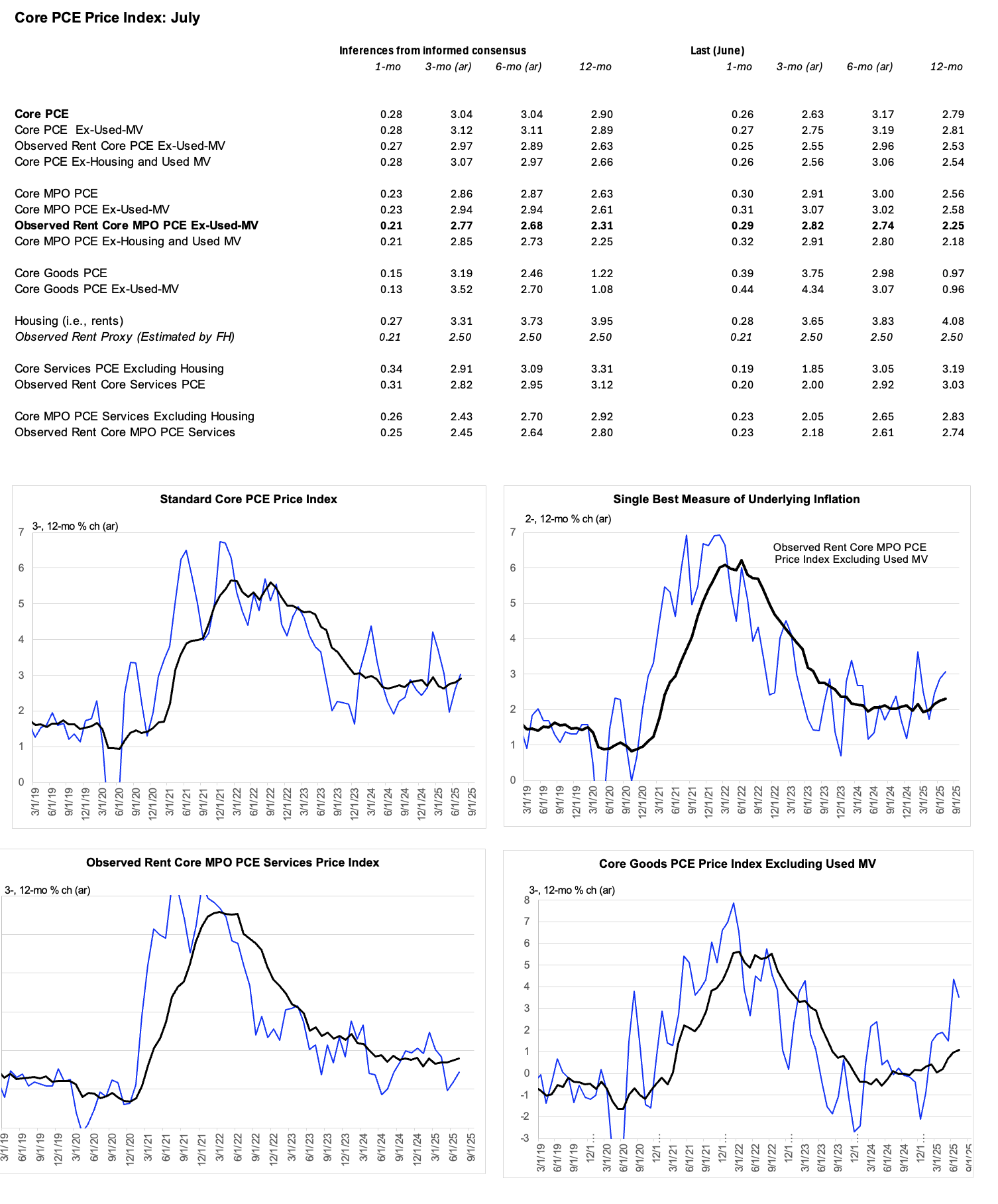
Data are actual to June and tentative inferences from informed consensus for July.

