Q2 GDP “Beat” Masks the Story
- Through Q2, underlying growth has been fairly clearly decelerating since late-2024.
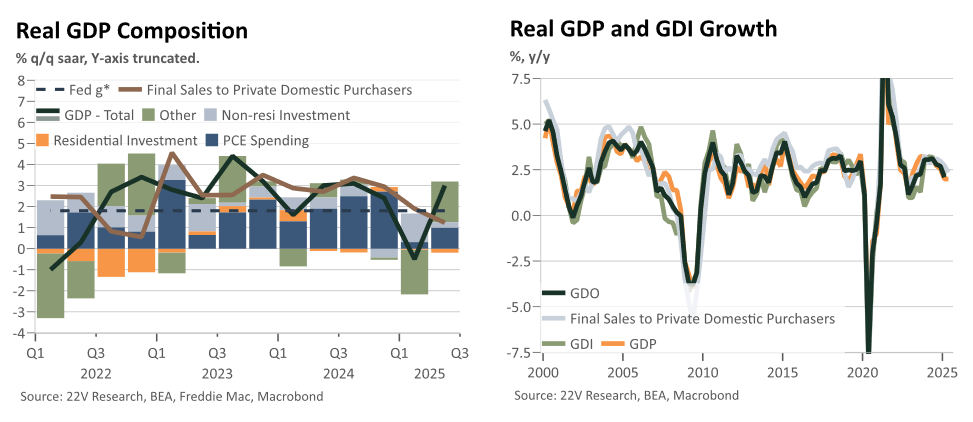
- Despite the beat in topline GDP (3.0% vs 2.6% expected), real private final domestic demand growth slowed sequentially again to 1.2% from 1.9% in Q1 and 2.9% in Q4.
- This is largely as expected given rapidly slowing labor force growth and the demand and supply-side impacts of tariffs. PCE spending grew 1.4% in the quarter while investment was saw negative contributions from residential and non-residential structures, with equipment and intellectual property both positive supports.
- Some high-frequency data suggests that a trough in consumer spending may be in (at least until tariffs really start to show up in consumer prices).
- Inventories and trade flows swung wildly over the past 2 quarters, and federal government spending has been a decent net drag, largely offset by state and local.
- Taken rigidly, which we should not do, the beat in core PCE inflation implies an 0.46% print in June. Revisions can and likely will swamp the read through to June from the quarterly data but not great news regardless.
The continued deceleration in underlying real spending (PFDD) after two very strong years is not particularly surprising but it is happening faster and to a larger extent than expected. Rapid immigration growth and post-covid supply-side healing allowed for very rapid yet-disinflation growth over the past few years. Now immigration flows are slowing very rapidly, and policy is snarling just healed supply chains and imposing upside risks to inflation. The baseline expectation is that GDP growth will, with tariff front-running largely behind us, grow at roughly 1% in the second half of the year before gradually reaccelerating to around long-run potential over the course of 2026.
Recent card data (as seen on BBG and mentioned by some investors) seems to be suggesting that there may be a bit of an upturn in spending momentum over the summer as consumers move past the hits to confidence brought on by peak tariff fears in the spring. Some of this nominal data likely does reflect a quickening of the pass-through of tariffs onto consumer goods but even still, it also highlights a possible mild upside in the back half of the year that with still strong income growth and layoffs remaining low, nominal consumer spend may outperform (when adjusting for changing supply-side baselines).
This seems important to flag on its own as a possible upside and because stronger growth momentum would mean even less cause for preemptive Fed easing, and likely continued pressure on durables and rate sensitive related names if rates stay sticky high. In my Fed preview, I said that “inflation is about to accelerate (how high, for how long, and how broadly are the questions), in an environment of broadly easy financial conditions. That does not usually make for a preemptively dovish central bank.” If we add “consumer spending seems to be surprising to the upside” to that list, the case for preemptive cuts, or that neutral as is as low as the current median at 3.0%, becomes even more tenuous.
For now, the data show a slowing economy with headwinds from tariffs, high inflation and rates, and rapidly slowing supply-side growth. The consumer appears broadly healthy and the labor market has been remarkably stable in its steady-to-mild-easing trend over the past year. These trends make confidence in the baseline forecast challenging given some positive developments and the inherent uncertainty of forecasting the incidence of tariffs on total nominal growth most simply, as well as its distribution across real consumer spending, investment, and inflation.
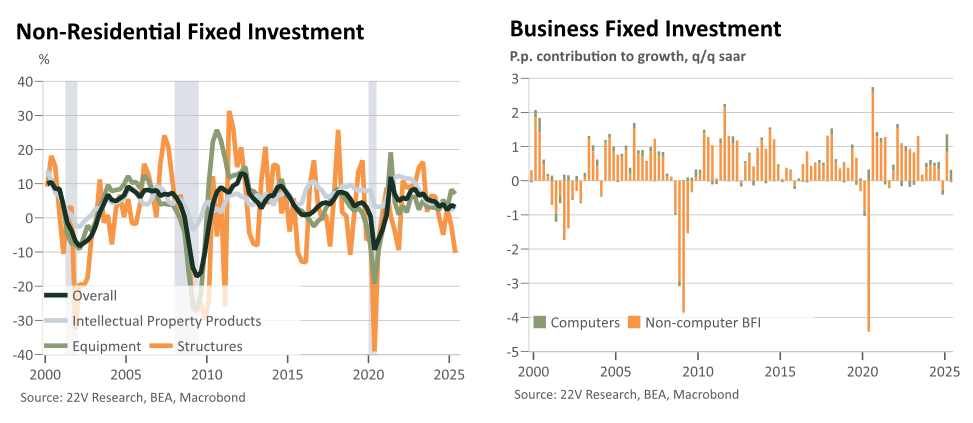
Investment remains a complicated part of the picture. Its long been our view that housing is now acting as a counter-cyclical stabilizer, not ‘housing is the business cycle’ as used to be cannon. This continued in Q2 with residential investment having a negative contribution to growth for the 4th time in the last 5 quarters. Business investment is being led by investment in computer equipment. If not for IT-related investment, business investment would have been negative; this shouldn’t be read literally but it does show that the combined impact of tariffs and their related uncertainty on non-AI investment has been appreciable and that AI investment flows are running relatively acyclically and unquestioned.
Inventories and trade flows have both swung wildly over the past few quarters but there’s little medium-term read-through from those swings.