

July FOMC: No Cut for Waller and Cautiously Waiting for the Rest
- The July FOMC meeting is likely to be a relatively quiet one with much of the press conference unfortunately centered around political, rather than policy or economic, questions.
- While it seems too early for the FOMC to sharply pivot away from the June SEP’s forecasts, the risks from Powell skew a bit hawkish relative to current pricing. Watch his framing of the recent inflation data and the outlook for tariff pass-throughs most carefully.
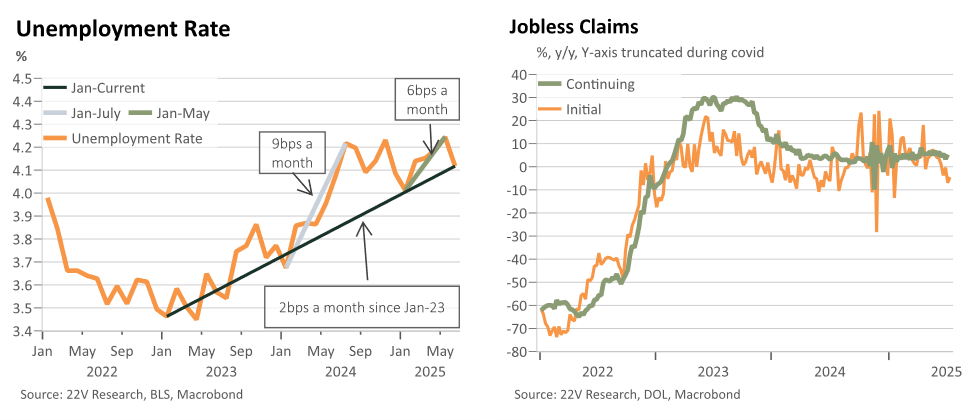
- Since the June meeting, the labor market data has been largely stable (JOLTS a bit better than expected, a mixed employment report, and steady or better jobless claims), consistent with low layoffs and rapidly slowing labor supply growth, and the inflation data has started to slowly show some signs of tariffs’ impacts. Financial conditions, on net, are easy.[1] Not usually an environment that makes
- We are moving past tariff uncertainty and into tariff reality. Seemingly with a high floor (announced around 15-20% so far), they are larger than most expected, implying stagflationary forecast revisions, but not so extreme as to derail the overall business or eventual easing cycles.
- Gov. Waller’s call for a July cut depends jointly on a view of labor market fragility and that no degree of tariff-driven inflation will “affect my view of the implications for monetary policy.” That is not shared by others on the FOMC. Waller likely dissents, perhaps Bowman too.
Tariff Uncertainty Is keeping Most of the Fed Cautious. This was a nearly universal theme across Fed speakers during the inter-meeting period. The Cleveland Fed’s Hammack noted that the initial conditions of this inflationary shock matter as “coming after an extended period of elevated inflation, consumers and businesses may respond differently to this event than might otherwise have been the case.” The Richmond Fed’s Barkin says that there no “urgency of saying we’ve got an economy going the wrong way… one does what one does when you drive through fog, which is go slowly.” Bostic noted that a “resilient macroeconomy… offers space for patience.” This framing seems to extend across the spectrum of those at 0-2x cuts, with forecast dispersion driven by inflation baselines.
There is Still a Presumption of a Bit More Easing to a ‘More Neutral’ Stance. Not surprisingly, if we remember where we were 6-9m ago, during his Congressional testimony in late June Chair Powell made it quite explicit that if not for the expectations of substantially higher inflation due to tariffs its likely “we would have continued cutting.” The reaction function of the median, and more hawkish, FOMC participant seems to boil down to an extended pause due to tariffs until resuming a slow return to neutral or a bit above it, with a willingness to ease more aggressively or sooner if needed or the tariff-driven inflation bounce fails to materialize.
Inflation is about to accelerate (how high, for how long, and how broadly are the questions), in an environment of broadly easy financial conditions. That does not usually make for a preemptively dovish central bank.
Tariffs are Just Starting to Be Felt. So far, the impacts from tariffs have been fairly modest in the sectoral data (the surge in goods spending in Mar-May and the continuing bounce in core goods prices) and the topline activity data seems more in the process of slowing to weaker supply trends than obviously buckling. One explanation, heard more often in recent weeks, is that corporates have been changing pricing only as their inventory’s costs have shifted and that with fall and back to school season about to begin, we are in for a broader set of price hikes. This is happening more slowly than originally expected given uncertainty around the ultimate destination of tariffs and as a result “the diffusion of this through the economy, I think, is going to take a bit longer, and I think longer could be up to a couple quarters even” (Bostic). That slower-than-expected pass-through does not mean there won’t be one though. FRBNY Pres. Williams shared a similar sentiment noting that he expects “those effects to increase in coming months.”
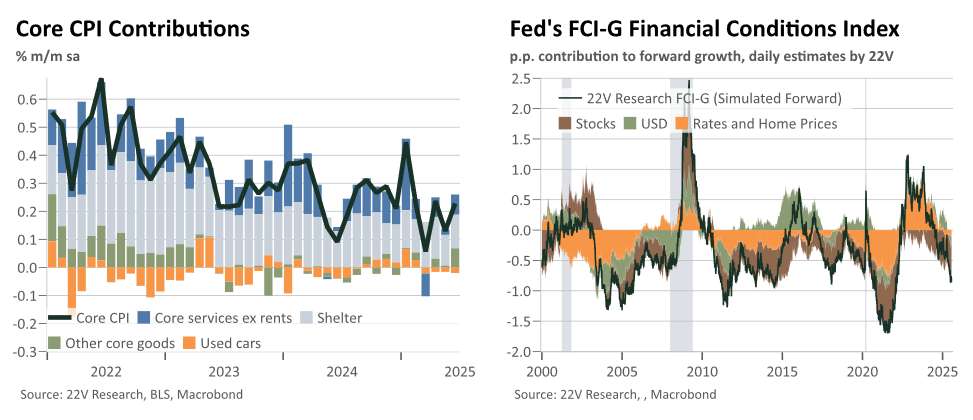
Gov. Waller’s July Cut Call if Far from Consensus. On the labor market, most officials seem to share Waller’s view that any further weakening would be unwelcome. But they do not appear to share his concern that the labor market is now near a tipping point. His comments that, especially after likely benchmark NFP revisions, the economy is close to a stall speed seem to neglect the behavior of labor market slack measures in recent months as well as the rapid slowdown in immigration and thus breakeven NFP growth.[2] On inflation, Waller seems more willing than other Fed officials to forecast a lower impact from a given level of tariffs on inflation and then also be noted less concerned about that price level shock radiating out into the rest of the inflation process. Others are apt to be less comfortable with this given how parts of services inflation (auto insurance, housing) are still just starting to move past the adjustment processes after the initial shocks to good supply chains during covid.
The Seeming Resolution of Tariff Uncertainty Will Help Truncate Tails, even if the Base Case is Still Soft. Outside of the peak tariffs on China, none of the tariff discussions seemed large enough to guarantee a recession but they also are still a dent to growth. That was true in April and has become truer as the post-pause tariffs resolve higher than expected with the administration pushing for 15-20% across the board tariffs. Depending upon exactly how things shake out by early-August, we will likely still see a what amounts to a greater than 15p.p. increase, perhaps up to 20p.p., in the US’ average effective tariff rate relative to where we started the administration. That is a substantial shock to supply chains and most-efficient practices, growth, and inflation.
While we are avoiding the most dramatic outcomes, these shocks are likely larger than those envisioned by most forecasters, including the FOMC. We seem to be resolving in a more autarkic direction relative to expectations. Fed rules of thumb would suggest that this amounts to a 1.5-2p.p. cumulative increase in core PCE inflation (given the timing in the year, blended between 2025-26).
The passage of the OBBA was largely anticipated and so likely is incorporated into most Fed officials’ expectations. This helps attenuate the downside impacts of growth by providing a fairly rapid boost to margins, but doesn’t change baseline growth dramatically (the package is fairly low multiplier in the short-run and even less so in the longer-term as written).
If updating forecasts relative to June:
- The 2025 and 2026 CPCE forecasts would both likely move up at least a tenth or so as higher tariffs, but with some hesitancy to fully put them into the forecast, more than offset the bit better than expected ex-tariffs news. Really, we are waiting to see on July-Sept inflation data and what happens in early August.
- The unemployment rate forecast would likely move down a 1/10th for 2025 given the June employment report and the good recent jobless claims data. To realize the June forecasts we’d need to see a roughly 8bps a month increase in the unemployment rate from here, faster than seen during the easing earlier this year and inconsistent with what claims suggest, given how much faster they were rising in 2022-23.
- The growth forecasts likely wouldn’t shift much. The important part is that the Fed likely see’s them below short-run g* this year (some cyclical and some persistent impacts from tariffs) and an absence of snapback growth next year. That broad contour is unlikely to change in near-term.
If the IEEPA tariffs are Ultimately Overturned, Inflation Risks’ Shift Should Allow for a Quick Cut or Two. Removal of most of the tariffs imposed so far and the longer slower moving and more predictable processes of sections 232 and 301 would substantially truncate away much of the baseline impact given current announced policy and reduce tails. Over time, those non-IEEPA tariff authorities could raise overall tariffs some but the ability to replace where the IEEPA tariffs seem to be heading feels unlikely. Despite the US CIT’s quite definitive ruling that the current IEEPA tariffs, which cover all the bilateral deals being made and reciprocal tariffs being imposed, are far beyond what is allowed by statute or constitutional authority, the ultimate outcome of the case remains up in the air. Any eventual resolution of the court cases is not likely until they ultimately head to the Supreme Court in Q4.
For a general overview of recent developments, I joined our head of financials coverage Bill Hebel for a conversation earlier this week that can be watched here. ↑
See more from earlier in the summer here and here. Depending upon immigration assumptions the very most optimistic baseline assumptions for breakeven NFP growth are near 90k but far more plausible estimates, taking into account a mild degree of hysteresis and soft immigration, would be at or below 50k. ↑

