

There is plenty of room for debate around what the macroeconomic effects of the Trump tariffs will be. Much of the uncertainty here relates to the simple point that we cannot guess reliably what the tariffs will end up being — and then what the carve outs for special interests will be.
And even if we had certainty on the tariff regime and a full understanding of the many exceptions, there would still be a debate over who will pay what is charged. The idea that they will be paid largely by foreign suppliers is widely derided as wishful thinking. Peter Navarro, in particular, should be heavily discounted as bonkers. But we cannot say, on principle, that the tariffs will be paid by Americans. It depends on supply and demand elasticities, which make it an empirical issue. The consensus seems to be that most of the tariff costs will land on Americans.*
Still, which Americans – and how most? The easiest story to tell is one in which American companies pay the vast majority of the tariffs on delivery, i.e., that there is no discounting of the invoice price to importers to soften the blow of the tariffs added on at the border. And then the companies pass the costs on to consumers, if not immediately, then ultimately. One source of delay here might be that local companies will be more inclined to eat the tariffs until tariff policy is clarified – or until companies become so frustrated that clarity will never arrive that they stop delaying passthrough. The option to delay is most valuable when the expected delay is brief.
But there is another possibility now circulating. It involves American companies passing through the tariff costs, but not just to American consumers. Rather, in the wake of the imposition of a 30% tariff, say, Apple might pass on 15 percentage points to American consumers, temporarily eat the remaining 15 percentage points but then pass that on to consumers in third markets, such as Europe. Economics 100, sometimes derided as economism, tells us that this should not happen. But economism can miss the effects of market power and strategic pricing, which might open the possibility for this behavior. And there is some evidence from supply chain consultants that it may be happening.
So, we need to recognize that we don’t know. And while it is not the focus of this note, I do think that such ignorance goes to the Fed hawk, in the sense that an uncertain Fed will be inclined to wait for clarity. And given that the expected direction of the next move in rates is downward, such hesitation ends up being hawkish, at least for the very short run. I hasten to add that this is not best practice monetary policy. The Fed should act on the central case outlook and not worry so much about directional changes in the path of the funds rate, which are much more a PR issue than economically damaging. But I comment here on what monetary policy might be, not what it should be. And in fairness, the issue of the Fed ultimately looking through the peak tariff effect is a separate discussion, one I do not address here.
Add the tariffs to the published import price index
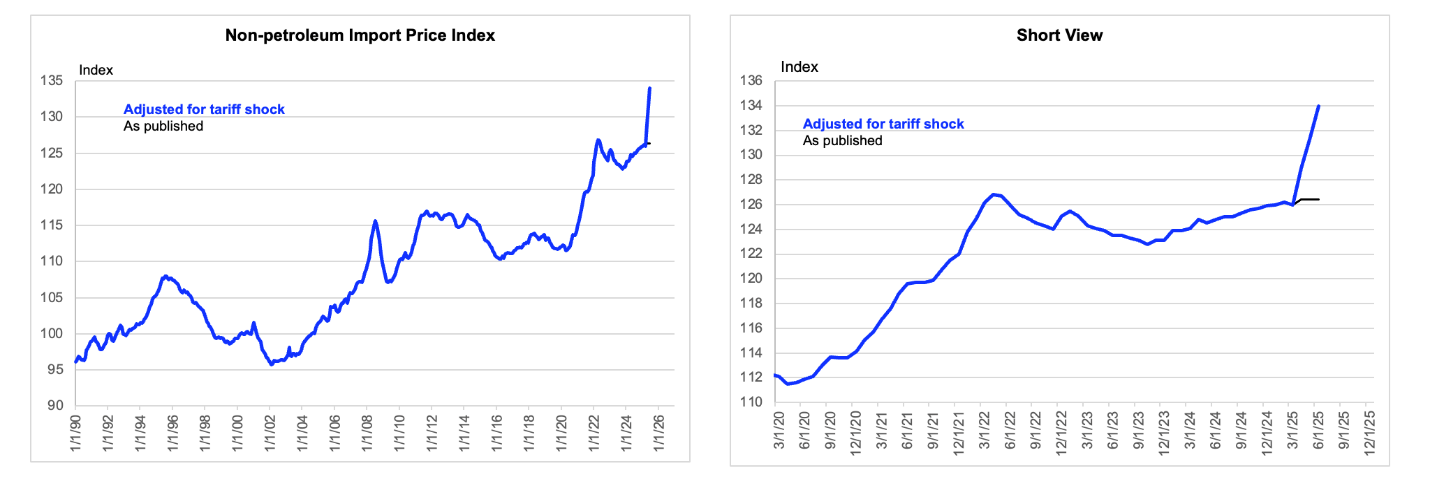
Official data are actual to June, although tariff adjustment is estimated
Having conceded that this is all very uncertain, I want to turn now to the main point of this note, which is to lean into the view that there is no evidence in the data yet that tariffs are having much effect at all. On the evidence, that take seems wrong.
The first place to look for the effect of higher tariffs is on import prices, which were updated to June on Friday. But to do this properly we have to recognize – as some clever street economists reminded us on Friday – that the import price data published by the BLS are exclusive of tariffs. See the BLS’s explanation here.
During the three months to June, the BLS’s index of non-petroleum import prices rose just 30 basis points, cumulatively and not annualized. And that may look comforting. But analysts estimate that the effective tariff rate implied by the ratio of new tariff revenue to nominal (pre-tariff) non-petroleum imports has risen about 2 percentage points a month during these three months. So, prices paid by US importers are perhaps up by just over 6% during the same period. As the chart above shows, that is a fairly steep rate of ascent by historical standards. And with the effective tariff rate having risen by only about 1/3 of what current “policy” implies (as scored by, for example, the Yale Budget Lab), the trend seems likely to continue.
Passthrough from importers to consumers is a separate issue, one that arguably cuts in a less hawkish direction, as I will get to below. Before turning to that, though, I want to address an argument also circulating on Wall Street that suggests that the US importers might be eating the effects of the tariffs despite these data – and that the failure of BLS import prices to fall in the wake of the tariffs is just a reflection of the dollar, which has fallen about 7% from its peak when Trump assumed office.
Occam says don’t try to weasel out by blaming the “weaker” dollar
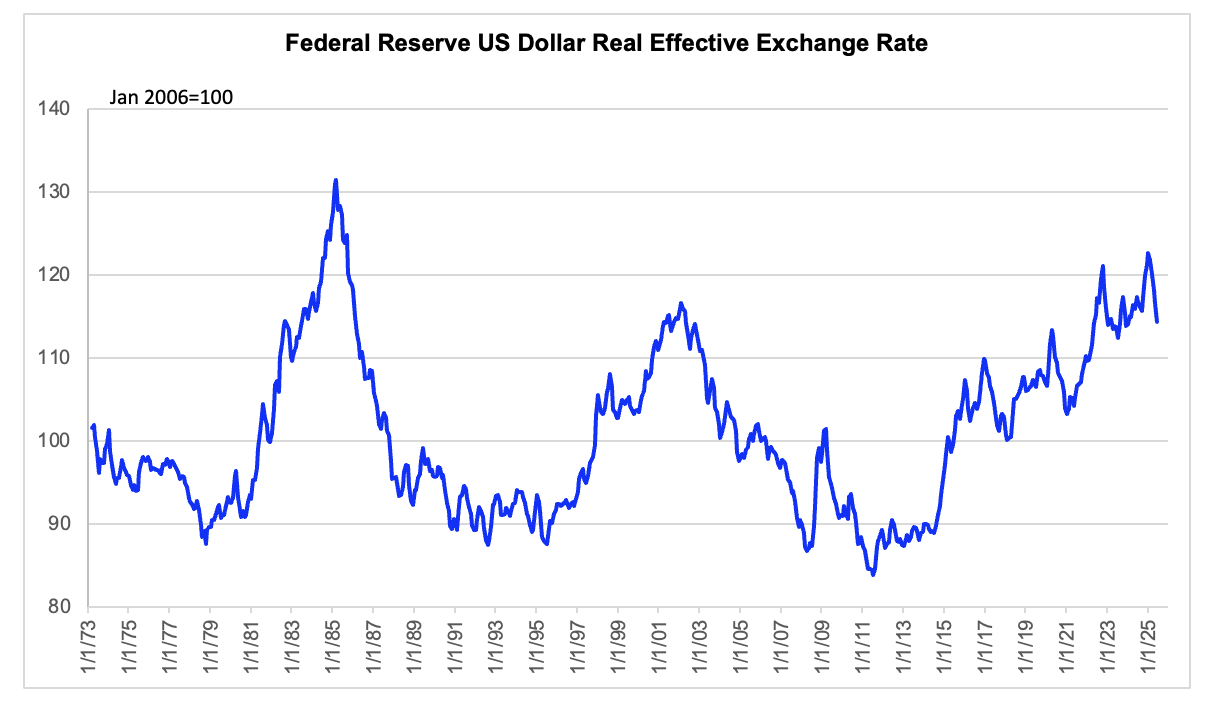
Data are official to May and as implied by nominal exchange rate index to July 14.
If true, that hypothesis would be dovish, because we ought not expect the dollar to fall 7% every six months! But it seems extremely unlikely, for reasons that are basically consensus among analysts who study passthrough of exchange rates into import prices. Because US imports are typically invoiced in dollars, the passthrough from the dollar to US$ import prices should be quite limited, in which case the failure of the BLS import price index to decline is indeed evidence that tariffs are being paid by Americans.
At great risk of wandering beyond my competence, I might quibble with one aspect of this consensus take. I suspect that the consensus overstates the role of the invoicing currency and that deeper fundamentals, such as elasticities, are what really drive things here. I would guess that invoicing is an effect of those elasticities, rather than causal in its own right. But that aside, the consensus is very strongly established that dollar moves do not affect import prices much. And as short horizons, which is what we are assessing here, the choice of invoice currency might be somewhat causal. In any event, the why does not matter. What matters is the empirical regularity.
So, the evidence here from import prices suggests that American importers are paying at least a huge chunk of the tariffs. But evidence of passthrough to American consumers is a separate discussion. Keep in mind that imported goods comprise only about 10% of the US consumption bundle and that importers might choose not to pass on their higher costs – either at all or to US consumers exclusively.
Ok, fair. But take a look also at how the Core Goods PCE Price Index, actual to May and estimated to June, is behaving in the wake of the presumed front running to beat the tariffs. The 3-month rate of core gods price inflation has quickened from a low of -2% in December 2024 to an estimated 4.3% in June. This is cherry picking to get your attention and to snap you out of the street-induced lull that there is nothing happening here so far. Perhaps the following might be fairer. In an environment in which the Fed is hitting its 2% inflation target, we might expect core goods prices to fall at an annualized rate of about 1%. During the 3-months to June they are up about 1 ¼% relative to that presumed baseline. This has directly added just over 30 basis points to the level of the Core PCE Price Index, abstracting from knock-ons to services, etc. That is about 1/5 of how the consensus sees a 20% tariff playing out. There is more complexity here than I am discussing. Not all the excess goods price inflation is necessarily tariffs. But the idea that nothing is happening here seems wrong.
Rates of change are intentionally alarming, but still pay attention
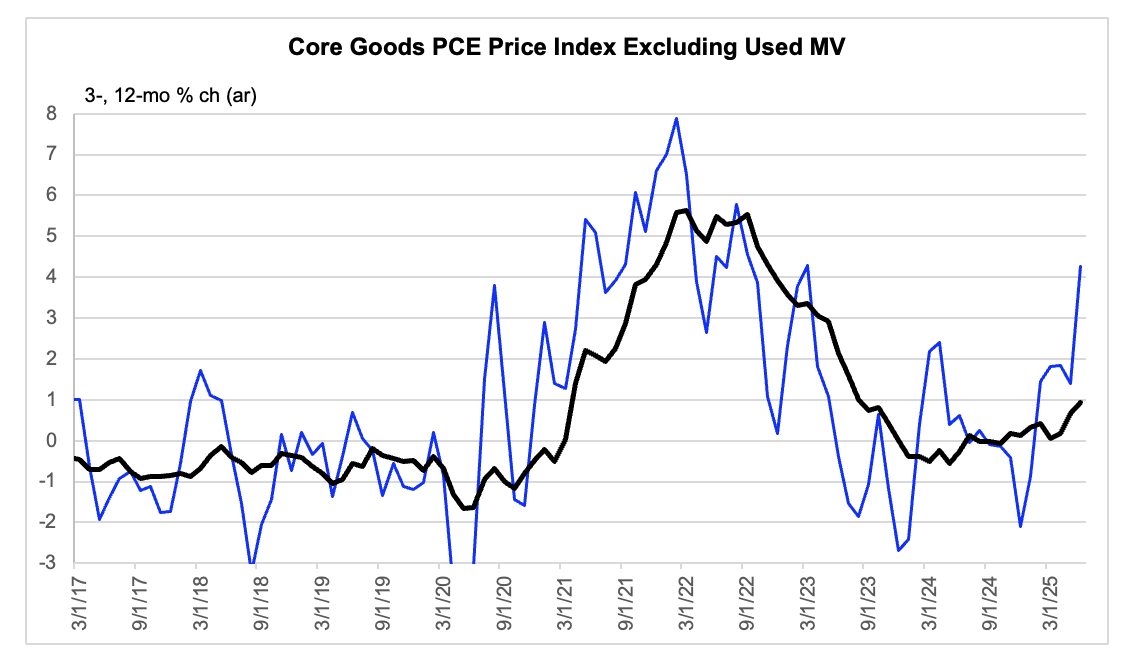
Data are actual to May and estimated to June.
* One argument holds that tariffs cannot be inflationary because the extra money spent on the one item reduces the amount of money left to spend on the other item, to paraphrase Bessent. There are a couple problems with Bessent’s claim. First, empirically indirect taxes raise inflation, at least briefly. Second, they have cut taxes, which leaves actually more money to spend on both items. In any event, Bessent’s argument is that real spending declines. In growth terms, he has that part right. It must, which has been my main emphasis on this issue.

