

Macro Takeaways from Bank Earnings Season Lean to Stability and Mild Optimism
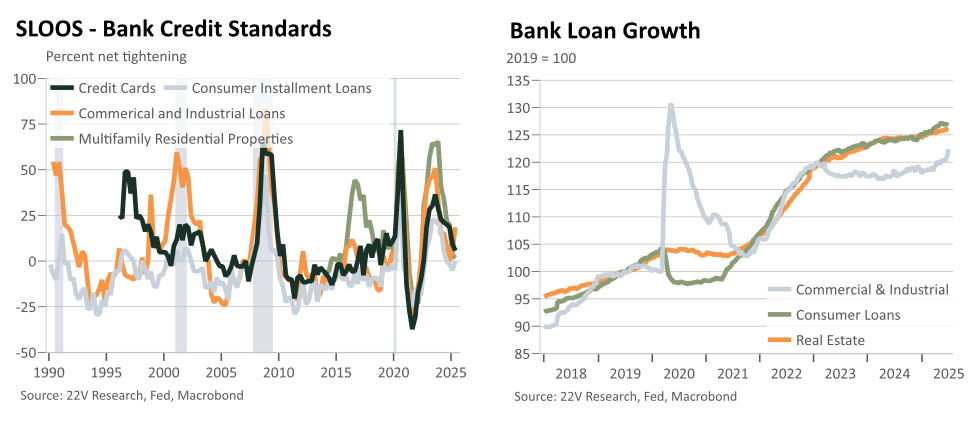
- Bank earnings season so far suggested little cause for macroeconomic concern and continued to highlight that the credit tightening cycle is largely in the rearview.
- Growth in card spending seems broadly consistent with a 4-5% nominal GDP world (volumes at BAC +4% y/y, Citi +3%, WFC +5.2%, JPM +7%, AXP +7%).
- After years of credit standards tightening, consumer credit distress measures generally fell y/y and bank commentary hinted at a steady baseline, even with an embedded expectation of a mildly increasing unemployment rate in most baselines.
- Tariff uncertainty among their clients remains a drag but firms are starting to simply accept the new reality and cost structure and attempt to move on. The passage of the OBBA was partial offset and confidence booster.
Tariffs and Other Sources of Uncertainty Remain, but Firms are Adapting
The volatility of the tariff policy process, and the substantial uptick in average effective rates over the course of the year relative to almost all expectations coming into the year, have clearly weighed on sentiment and led to distortion in 25H1 data. They are also a key part of why y/y GDP growth is widely expected to slow notably in over the next few quarters before troughing late this year or early next.
Citi’s team summed up the current situation well, saying they “expect to see goods prices to start ticking up over the summer as tariffs take effect. And we have seen pauses in CapEx and hiring amongst our client base. All of that said, the strength of the US economy, driven by the American entrepreneur and a healthy consumer, has certainly been exceeding expectations of late.” AXP’s card spending dynamics tell the story another way with corporate card spending at only 2% y/y, soft for some time and down from a 4% bounce in 24Q4, while consumer spending chugs along at 7% y/y.
There is an element of just wanting to move on which is at least partially coming through as well. JPM’s Barnum made clear that “after the initial shock of tariff policy changes, everyone kind of went on hold. But as we’ve noted in our comments a few times today, at a certain moment, you just have to move on with life, and it does feel like some of that is happening just because you can’t delay forever.” BAC struck a similar tone, saying that “our clients continue to seek clarity with the changes in trade and tariffs, and now with the Tax Bill passing, we can see them start to understand the future and expect them behave accordingly. We saw improving market conditions during the quarter.” WFC struck one of the most optimistic (charitable?) tones I caught when describing the impact of tariffs on clients, saying that “they would like certainty, but prioritize a good outcome for U.S. trade above short-term certainty. Many have found ways to avoid passing the 10% tariffs on to their customers. At the same time, they are preparing for the downside.”
There were mixed signals and little certainty broadly about the whether the source of increased aggregate C&I loan demand is coming from underlying needs for longer-term capital or just preventive draws and inventory financing brought on by tariff front running. During their call, FITB mentioned that their clients are finding that “as we continue to navigate uncertainty around trade and the tariff levels that there’s a value to them in running with a little bit of extra inventory and that supports [loan] utilization.”
Consumer Spending Trends Seems Fine but Likely Some Slowing
Depending upon which banks one looks at, topline spending by consumers is growing somewhere between 3-7% a year. Weighting the largest banks somewhat more heavily, this seems consistent with 4-5% NGDP growth at the moment. If sustained in the back half of the year, this pace of consumer spending growth would be, at worst, consistent with roughly 1% real GDP growth. There are plenty of important ‘ifs’ embedded in that sentence but at least for now the trajectory looks solid. A quite positive outcome under the circumstances. JPM spending data is a positive outlier, at 7% y/y and with CFO Barnum noting that “our own data looked sort of in nominal terms on a cohort basis, actually shows spending up a little bit over the same period.” On the other side, MTB mentioned that they “also do see slowing in domestic spending, which is a risk worth watching.” This is probably largely the baseline in the end but was a slightly less optimistic tone than heard from most others.
One interesting sub-trend is that amongst the fairly stable spending topline, there has been a modest rotation away from travel related spending. MTB noted that “consumers are cutting back on service spending such as travel and recreation, reducing price pressure on service side and is the counterweight to tariffs.” This is one way to attenuate the general inflationary impact of tariffs but would be far from an ideal outcome. AXP shows slightly slower travel and entertainment spend growth than topline for both corporates and consumers and noted on their call a bit of a slowdown . Analysis of card spending from other sources seems to support a similar idea, despite the fact that restaurant spending generally seems more robust than airfares. This may be a case of large ticket hesitation but fairly stable nominal topline spend.
Consumer Credit Trends are Steady and Maybe Slightly Improving
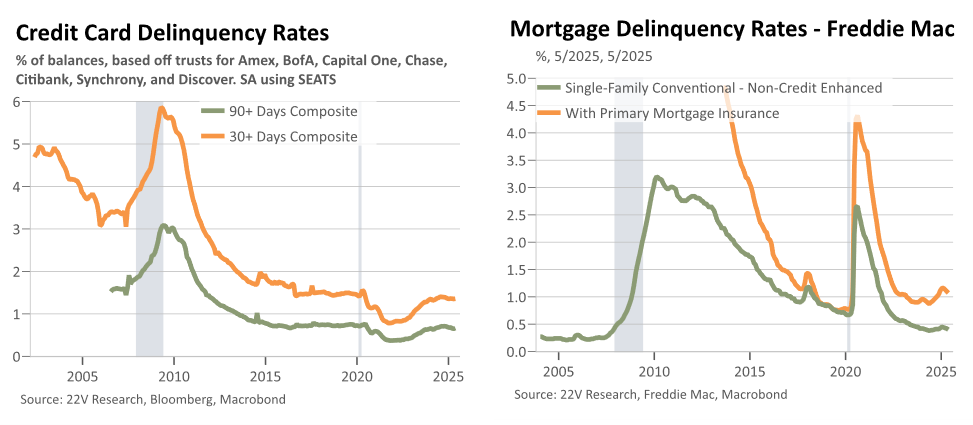
After a few years of consistent concern that the consumer credit cycle was likely to spiral further into a state of deterioration, a trend we strongly cautioned against (here), the news on credit trends this quarter continued to be positive. I caught no appreciable mentions of worsening consumer credit trends or expectations that, even with the wild weakening of the labor market and slowing of growth that most banks have as their baselines, stress measures would turn up. The consumer delinquency and bank credit standards tightening cycle was driven by a combination of consumer income and credit score drift and preemptive rather than reactive bank caution during the rate tightening cycle and earlier recessionary fears, we seem to be on to a new phase of the cycle.
The tone in commentary was similar across almost all banks: “the net loss rate on credit card declined year-over-year for the first time this quarter since early 2016 outside of the pandemic period” (BAC); “consumer delinquencies continued to improve from a year ago and commercial credit performance continued to be relatively strong” (WFC); “rates are at a good level for us. Deal activity is high. Capital markets are very strong. Consumer credit is excellent. Wholesale credit is excellent” (JPM); they “feel good about what we are seeing” (Citi); “regarding credit, net charge-offs for the first half of the year were below our initial expectations” (MTB); and “charge-offs have come in favorably year-to-date relative to our expectations” (PNC).
CRE’s Troubles Seem Largely Reserved For
Similarly, commercial real estate has been a consistent source of concern among bankers and regulators in recent years. High rates and post-covid trends in office occupancy both appropriately fed these concerns. However, I was struck in reading through earnings calls at just how much less frequently and concernedly the subject seemed to come up this quarter. For example, CFG noted on its call that they don’t “think we’ve moved a office property into our workout group in the last year. So, the problem children… are well identified it and well through their restructuring process.”

