The holiday shortened week ended with new all-time closing highs for both the S&P (+1.7%) and Nasdaq (+1.48%), while the small caps also joined the party (+3.53%), as a strong jobs report on Thursday helped continue the upside momentum. Volatility (VIX) ended the week HIGHER, while the VVIX (volatility of vol) was barely down, even as stocks continued to make new highs. This action in vol continues to support my thesis that even if stocks continue to move higher, there is likely a quasi-floor to vol at, or just below, current levels for now (and why I still prefer to own VIX calls to index puts at this time).
As a basis of comparison, I want to point out how the SPY August 40-delta put performed last week versus the VIX Aug 40-delta calls. The SPY Aug 610 put was down 34% just last week as the market rallied, and the delta moved from ~ 40 to a current 29. Conversely, the VIX Aug 24 call was only down ~ 6% and the delta on the call barely changed. As you can see, the VIX calls not only performed much better as a macro portfolio hedge, but with little to no delta change they should now be more sensitive to any market pullbacks given the higher current delta. It is exactly this type of action in vol as to why I continue to stress that VIX calls and/or wide call spreads should be strongly considered here to accompany a long-biased portfolio or book. The VIX Aug 24 calls or the VIX 22/50 Aug call spread still look very attractive to me at this time.
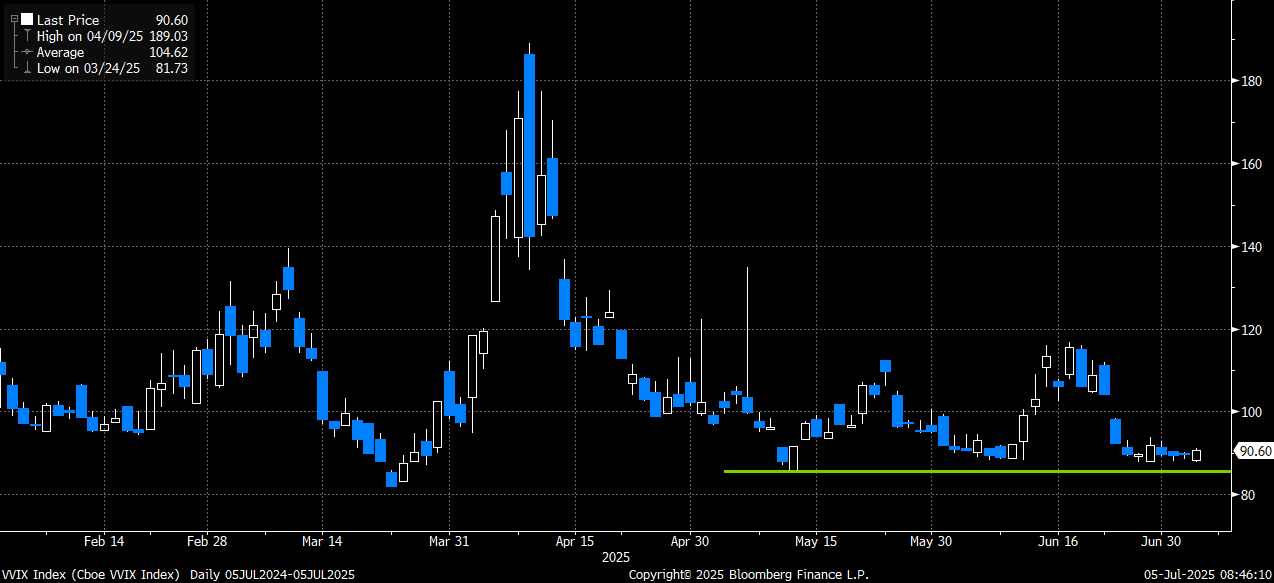
The VIX index continues to “hold” the support lows ~ 15-16

The VVIX index also in unable to make new lows, even as stocks seem to make new highs on a daily basis
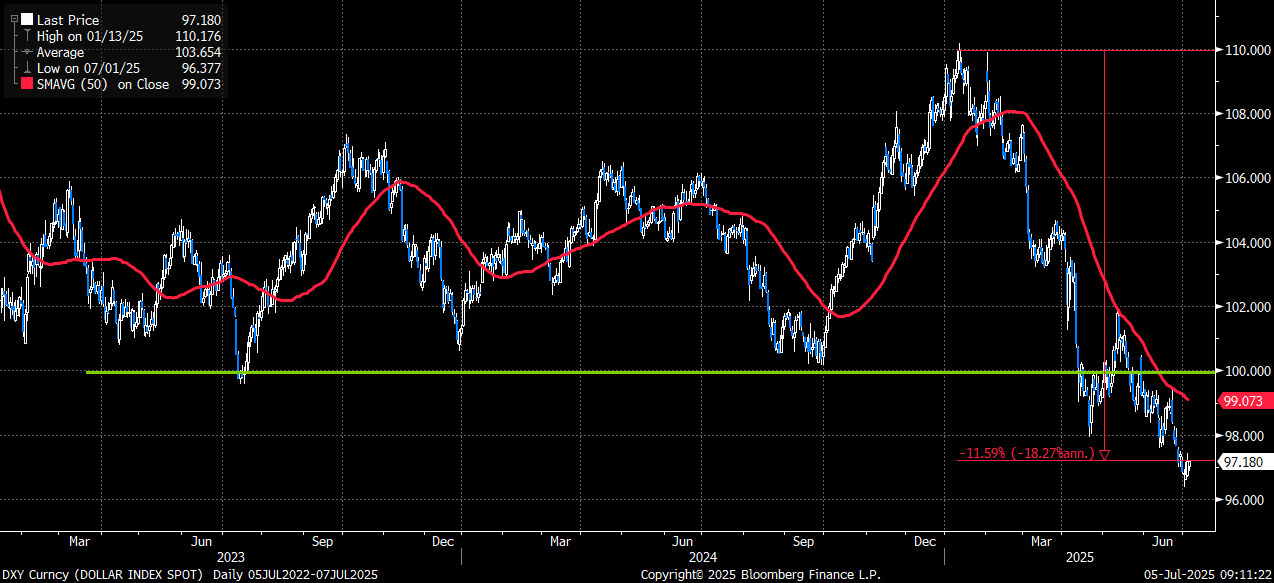
The US$ continues its downward spiral, here is a way to play that theme
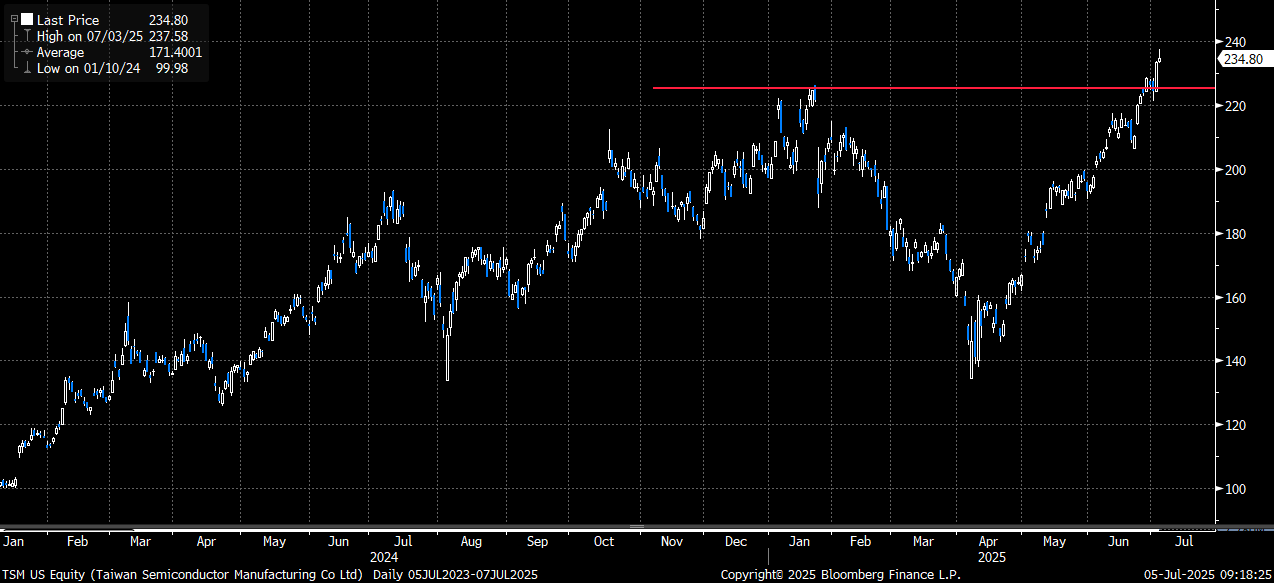
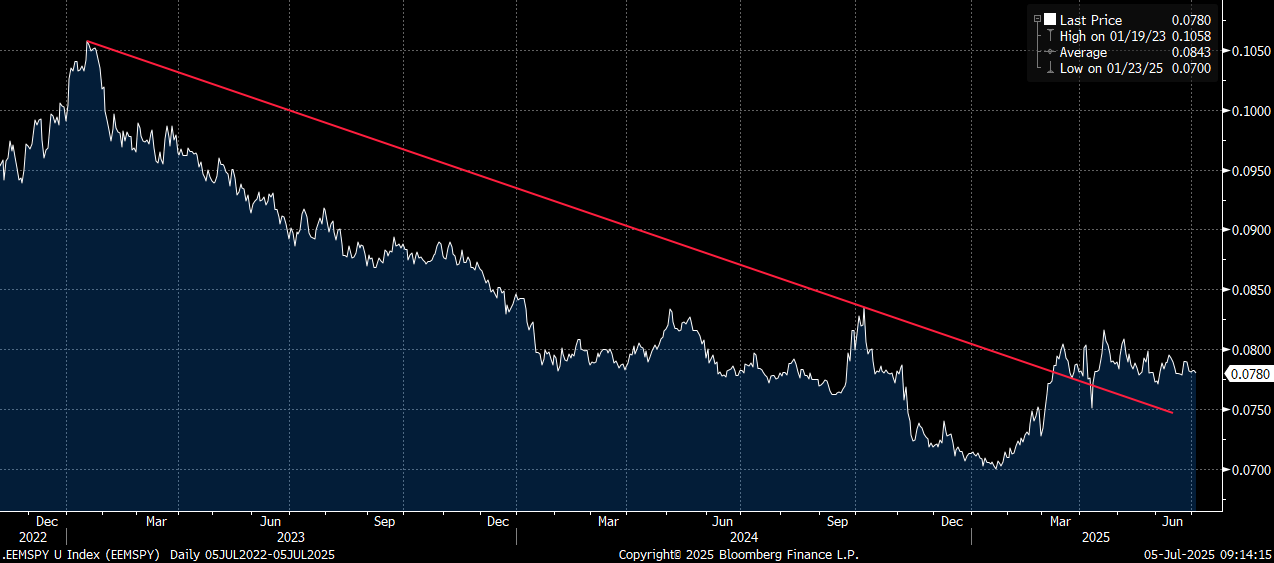
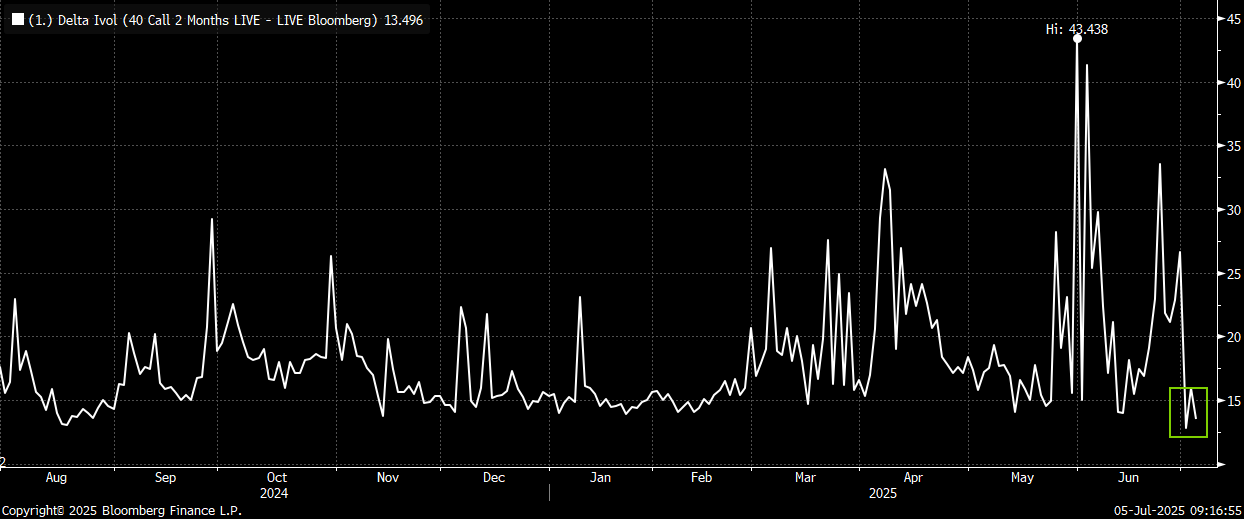
After peaking in January ~ 110, the US$ index (DXY) has declined by ~ 11.6% and has broken below the longer-term support ~ 100 (see below). As the US$ continues to weaken, this should support owning other markets where a rising currency should act as a tailwind for further investment. One etf I want to highlight is EEM, which is the main emerging markets etf. EEM just broke out to new short-term highs, and the EEM/SPY relative spread also recently broke above a longer-term downtrend. What I really like about EEM is that upside calls are CHEAP. The 2-month (Sept) 40-delta calls trade at a 14 vol, down considerably from the highs and pretty much at the lows. What I also like about EEM is you get a nice mix in terms of country exposure (25% China, 19.5% Taiwan, 18% India, etc) so that if one country isn’t “working” the other markets could help offset that. Finally, TSM is the largest weighting in EEM at 10.6% and that stock just broke out to a new all-time high as the semi/AI trade is in full swing.
Trade:
Buy EEM Sept 50 calls for .92 (EEM 48.76 Thurs close ref)
Trade Details:
- Buying the Sept 40-delta EEM calls as emerging markets are starting to breakout
- US$ weakness should continue to give a bid to foreign markets – we could also start to see $$ leave the US stock market after this massive run and be deployed to “cheaper” markets that may have more upside
- EEM vol on the Sept calls is ~ 14. This is basically at/near the lows and well down from the recent highs
- Cheap way to add exposure to other markets on a limited-risk basis
- Please contact me or the 22V sales desk for updated pricing and execution capabilities
US$ index (DXY) down 11.6% from the Jan highs and below the longer-term support ~ 100
EEM with a meaningful breakout on the weekly chart. It still has a lot of room to get back to the 2021 highs (SPX is already at the highs)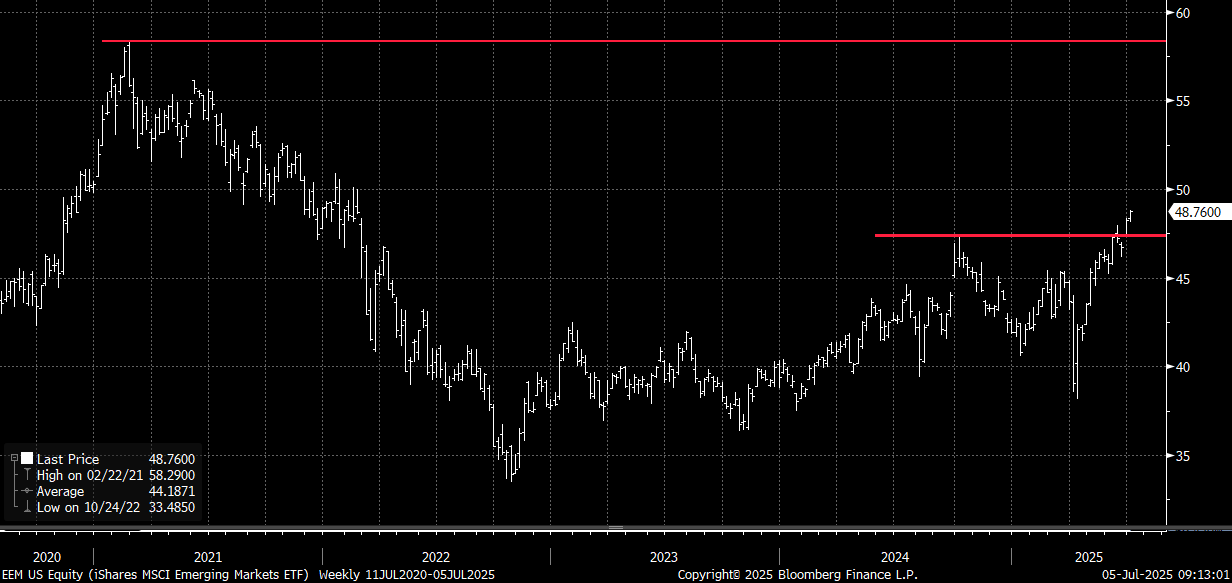
EEM/SPY relative spread has broken above the 2023 downtrend. Could start to see a meaningful outperformance by EEM should US$ continue to weaken from here
EEM 2-month (Sept) 40-delt call vol is essentially at the 1-year lows
Taiwan Semi (TSM) is the largest weighting in EEM and it just broke out to a new all-time high