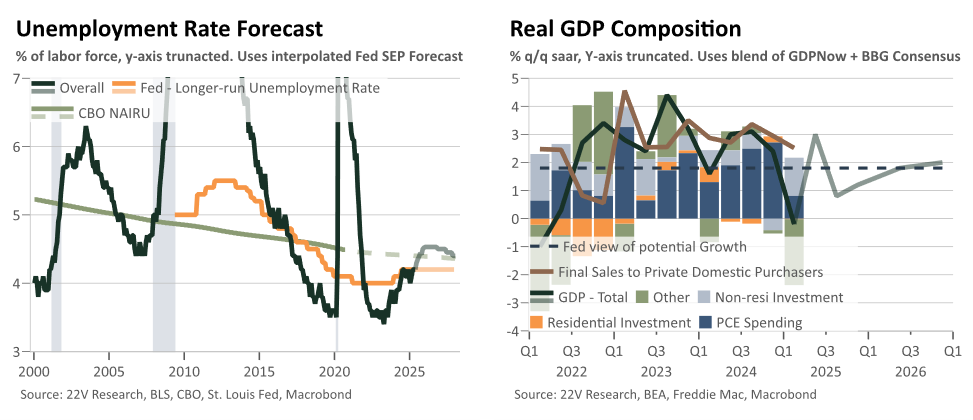
- The Fed and consensus forecasts expect a slowdown in GDP growth and gradual mild further opening up of labor market slack over the summer and fall before steadying.
- These forecasts mix a blend of supply and demand shocks, confounding the true cyclical signals from the slowing topline growth of GDP and NFP.
- Unfortunately, this base case may look observationally equivalent to a pre-recessionary slowdown when experienced in real-time. Front-running related noise due to tariffs and pauses on large scale business decisions add additional downside noise to the data over the next few months.
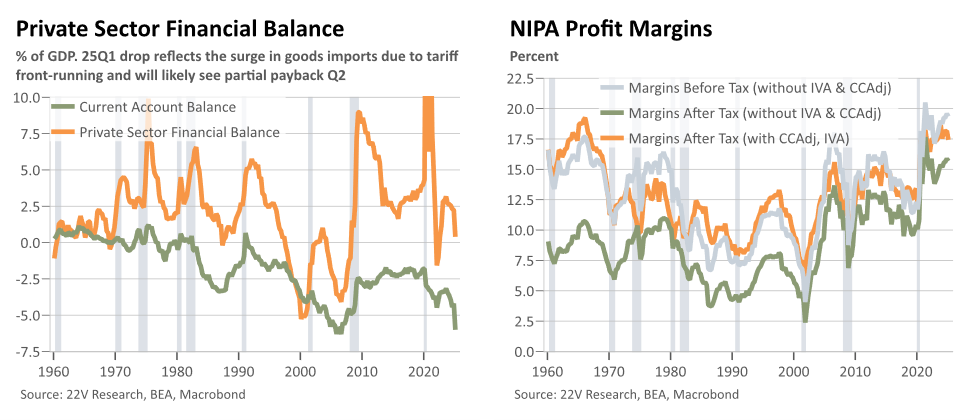
- The US has already experienced substantial recessionary prep since the Fed’s tightening cycle began (credit tightening, housing starts softening, rightsizing headcounts) and has robust private sector balance sheets with margins that remain at or near the highs. This should robustify the economy against potential nonlinear dynamics.
- Over the next few months, we should expect some steadying at sluggish but ok levels of soft-data and some further deceleration in much of the hard data. My suspicion is economic surprise indices will still turn a bit lower, despite consensus, as medium-term expectations are only slowly incorporated into more momentum-based short-term forecasts.
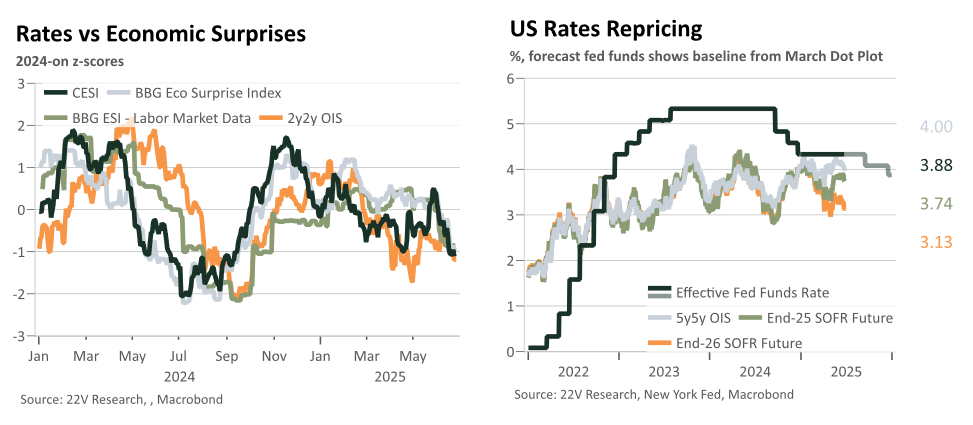
- We run the risk of markets suddenly caring about slowdown risks beyond pricing in a slightly more rapid Fed path but the baseline deceleration seems fairly well understood when looking at internals.
Tariffs have resulted in trade volatility, front-running of some consumer spending, notably autos and electronics, increased uncertainty and largely resulted in firms’ pressing a near-term pause button, and, as Chair Powell said yesterday, made the Fed more cautious about rate cuts than it otherwise would have been. Tariffs are imposing modest hits to productivity growth and investment, and immigration’s rapid decline is slowing trend labor supply growth. These jointly are imparting a downward blip to GDP growth that is not expected to lead to a non-linear recessionary weakening of the economy.
Initially this deceleration will be difficult to distinguish from pre-recessionary concerns. One could argue something similar happened last year as continued doldrums cyclical activity collided with still extremely rapid labor supply growth to spook the Fed and markets.
Over time, if the base case holds and the supply and demand hits move down together, the lack of accelerating weakness in the labor market and continued health in aggregate balance sheets, credit markets, and the private sector financial balance should help put a floor under growth and recessionary fears. While the growth impact from it is quite mild, particularly on a per USD basis, the passage of fiscal stimulus later this summer will also offer firms an improvement to margin expectations in 2026+ and some partial offset to the tariff hit to growth.
Housing remains the greatest endogenous risk and the channel by which too hot inflation, meriting an even more hawkish than envision Fed response, could roll the cycle over. But most of the volume correction has already happened making it difficult to see sharply negative contributions given pent up demand. Now some sluggishness is needed to gradually bring affordability metrics back in line. Fed speak over the past few days, including Chair Powell, has made it clear that the Fed is focused on the topline labor market and inflation stories and some sluggishness in housing and durables is likely a necessary consequence of keeping demand from overheating during the supply-side hits.
For those of us Fedwatching, or anyone rooting for rapid cuts, is essential to note that the SEP’s 4.5% Q4 average level of the unemployment rate is close to a linear assumption of the current avg m/m pace of increase seen so far this year continued until year-end. A more likely path sees a bit more easing front-loaded during peak tariff impact with hiring rates steadying lower later this summer and labor supply growth continues to slow. The story for GDP growth is similar, although with a more sluggish medium-term recovery due to the productivity hits from tariffs. Similarly, m/m core PCE is expected to average roughly 0.29% m/m from June-on, although Powell noted that tariff impacts will likely hit more over the summer. These are the median baselines around which policy makers are arguing: some gradual largely linear easing in labor market slack and a rough summer and early fall for inflation before it starts to return towards target. I am not sure markets have fully internalized the labor market side of this yet, although they do seem to largely have accepted and moved on from most of the tariff noise on inflation (we’ll see if that survives contact with reality later this summer). Last summer also opens up the possibility of the Fed getting spooked by any further increases in slack but the Sahm Rule trigger but compared to last year the breadth of slack measures easing has actually narrowed somewhat, although the supply story (then too much and now perhaps too little) remains an analytical complication.
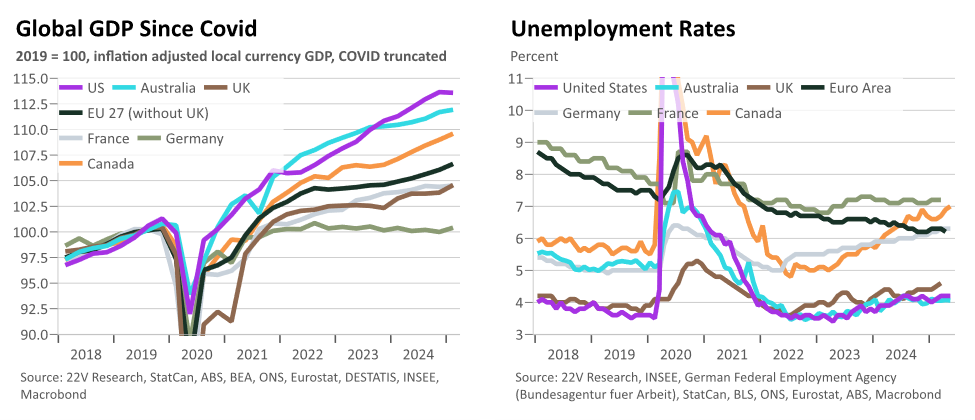
Given the supply-side hits to US growth and rapidly slowing NFP growth due to aging and immigration, we shouldn’t fully dismiss the possibility of a ‘little r’ recession. In this scenario enough of the NBER’s real activity metrics show declines in order to merit the NBER definition of a recession in the US but given the absence of macrofinancial vulnerabilities, credit and housing cycles which have already seen normalization, and still robust nominal income growth, we think that the odds of a spiraling larger, more nonlinear, event remain low. Margins are also still at or near cycle highs, usually there is a notably longer period of deceleration into recession than just falling off a cliff. To some extent, this ‘recession without the spiral’ dynamic, around a sluggish supply-side trend, mirrors the experiences of much of Europe since covid and Russia’s invasion of Ukraine. There we have GDP muddle through due to the energy supply shocks but the labor market easing has been remarkably orderly or not at all.