In this report, we first share our key takeaways from the latest May activity data, followed by an update on China’s outlook based on our China Economic Sentiment Series (CHESS) tool.
May activity data confirm a further slowdown in the Chinese economy
The latest data, though unsurprising in showing a slowdown, raise two key concerns: property sector weakness and softening fiscal stimulus.
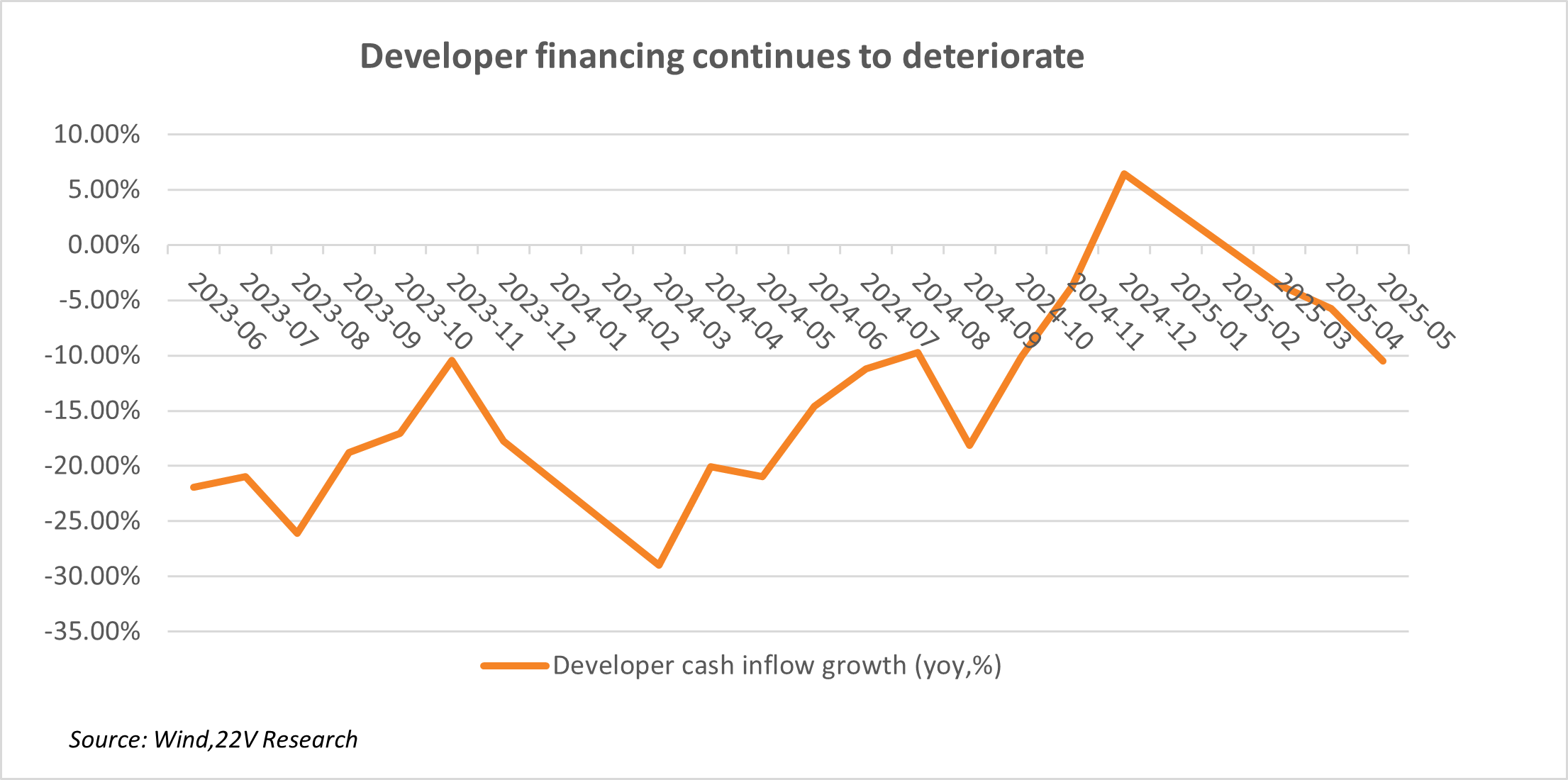
Latest property data reinforce the view that a double-dip is materializing. Only 3 (vs. 5 in April) of the 70 cities covered by the National Bureau of Statistics reported month-on-month increases in prices of existing properties. Developer cash inflow declined -10.5% y/y (vs. -5% in April). Declines in property sales and new starts are similar to those in April (property sales and new starts are down -7% y/y and -18% y/y, respectively, in May). Relatedly, construction materials such as cement and crude steel experienced further declines, both seeing high single-digit year-on-year drops in May. We believe meaningful property stimulus remains months away.
Fiscal investment moderated in May, suggesting a lack of urgency for stimulus. Fixed capital investment m/m growth was near zero, reflecting both the moderation in fiscal investment and the drag from property investment. Year-to-date y/y urban infrastructure investment growth (which can be seen as a proxy for local fiscal investment) fell from 4.9% in April to 3.8% in May. There are also no signs of acceleration in central government-supported infrastructure growth. We interpret this lack of fiscal stimulus as an indication of reduced urgency to stimulate.
As there is usually a lag of a couple of months between investment decision and implementation, the weak May investment data likely reflect modest stimulus urgency before the recent U.S.–China de-escalation. Therefore, we should expect stimulus urgency to be even lower in the coming months. In fact, since late May, many Chinese regions have reported a pause in consumer trade-in subsidy.
On the other hand, May retail sales improvement (May 6.4% y/y, vs 5.1% April) is going to be transitory. May retail sales benefited from the trade-in incentive program, with most trade-in categories (except autos) up by more than 20% y/y. However, recent news indicates that Beijing has slowed trade-in subsidy since late May, and the program has been suspended in many regions. Moreover, this year’s May Labor Day holiday was one day longer than last year’s, which also boosted consumption temporarily.
ECONOMIC SENTIMENTS SETTLES AT NEUTRAL
We conclude with a brief update on signals from our China Economic Sentiment Series (CHESS) tool, which uses ChatGPT to assess sentiment towards the outlook among economists commenting in China’s domestic financial media. There are two main takeaways:
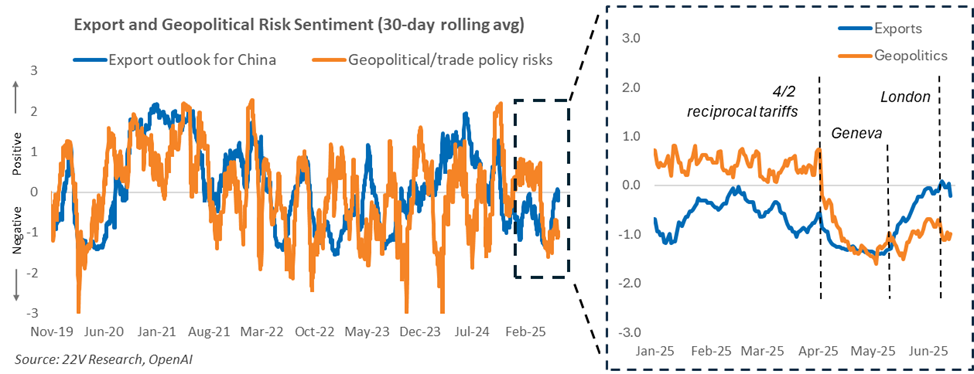
First, analysts have modest hopes for additional export improvement and remain worried about geopolitics. Steps towards a tariff truce in Geneva in May initially led to a notable improvement in sentiment towards the outlook for China’s exports (blue line below). However, those expectations have been largely flat in recent weeks, and thus far have not budged in response to the London meetings last week – consistent with a view that additional tariff de-escalation is unlikely. Meanwhile, analyst sentiment towards geopolitical risks facing Chinese firms (orange line below) remains negative.
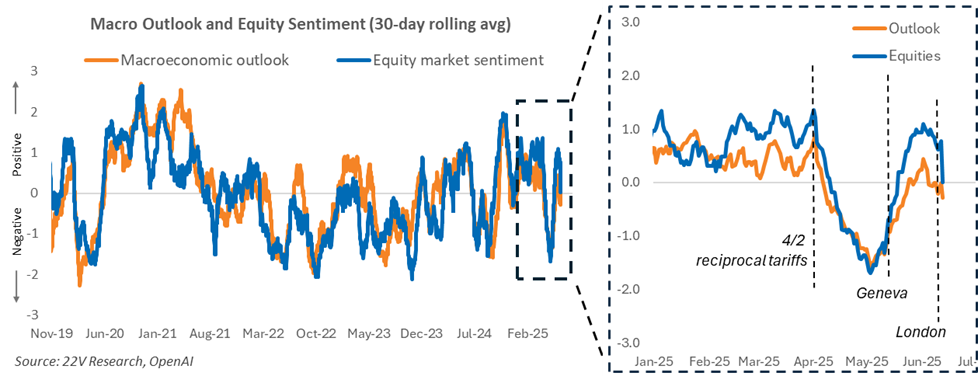
Second, analysts see the economic and equity market outlook as neutral. In recent weeks, sentiment towards the macro outlook (orange line) and towards the equity market (blue line) have both dipped back to neutral. CHESS stimulus expectations (not pictured) are modestly positive, but not positive enough to offset concerns over trade uncertainty, the ongoing property contraction, and subdued consumption and investment.