Back Economics

Considering g* as a LIMIT on r*

Published on June 4, 2025

Download the PDF Report

By

Gerard MacDonell

This issue came up during the webinar with 22V earlier this morning. But time constraints precluded us from getting into it in any detail, so I will elaborate a bit on it here. This is a bit theoretical. NGL.

One possibly fun irony here is that concerns about fiscal sustainability might ultimately put downward pressure on r*.  And the reason for this has nothing to do with the well-worn idea that the Fed will pin rates to zero to assist the Treasury in avoiding a fiscal crisis.  Monetary accommodation of a rising debt would show up first as the Fed guiding actual r below r*. In the first instance that would not be about r* itself.

No, the real reason here, if I have this right, is that r* rising well above g* would generate fiscal strains at some point. And the fiscal, not monetary, policy reaction to that would be a consolidation, which would tend to push r* down, irrespective of what the Fed is up to, and consistent with the Fed itself staying orthodox, i.e., focused on achieving the dual mandate.

The idea that g* might limit the extent to which r* might rise is hardly new.  Economists have long argued that a higher growth rate would incline consumers to try to draw future income into current consumption, by borrowing, to smooth lifecycle consumption. And such behavior would incline r* to rise along with g* via the intertemporal substitution effect.  And vice versa.

Working in the same direction, a technology advance that sped growth by raising the return on capital, would put upward pressure on r* as businesses sought to convert financial capital into real, to put it briefly.  There are complicating factors here for sure. For example, a tech advance that increased market power among dominant players might actually reduce the demand for physical capital.  I concede the complexity. My point is that the idea that these things are connected is not novel. 

But there is a third mechanism that may be newly relevant. In a world of high public debt, a rise of r* well above g*, is more likely to generate fiscal worries that would have two effects, both of which would favor a lower r*. First, risk premia would rise.  This might make, say, 2-year notes less well correlated with changes of r*, but r* itself would fall in response to this.  Second, the fiscal policy response to these strains would probably involve fiscal consolidation, which would reinforce the tendency of r* to fall.[1]

The tendency of r* itself to fall in response to fiscal consolidation is one reason I argue that when the fiscal “crisis” comes, the cure for it might be a fairly minor fiscal tightening.  The fiscal tightening would lower the primary deficit by definition, but it would also operate directly on r* vs g*, pushing it in a benign direction, making any given primary deficit more tolerable, both because the debt / GDP ratio would rise less quickly and because any given path of the debt / GDP ratio over the medium term would be a lesser worry to markets.  And that’s why sitting out an investment strategy until after America has had its Liz Truss moment might not be a good way to go through life. The bump you avoid could be quite brief. 

I think that point is interesting in its own right.  But the part that is “fun” and novel to a high debt environment, is that fiscal sustainability joins intertemporal substitution and the return on capital as one of three ways that g* limits r*!

When that limit begins to bind, you probably don’t want to be long the medium maturities of the US curve. I get that. But if the response is fiscal consolidation rather than fiscal dominance, this limits the extent to which bonds can sell off over time.  

And for the dollar the effect would be more immediate. Fiscal strains would be negative the dollar and the response to those fiscal strains would also be negative the dollar, by reducing r*. If you want to bet on a fiscal crisis without worrying too much about the timing getting back in, the call might be just short the dollar.

 Estimates of r* might be more limited by g* in an environment of very elevated public debt
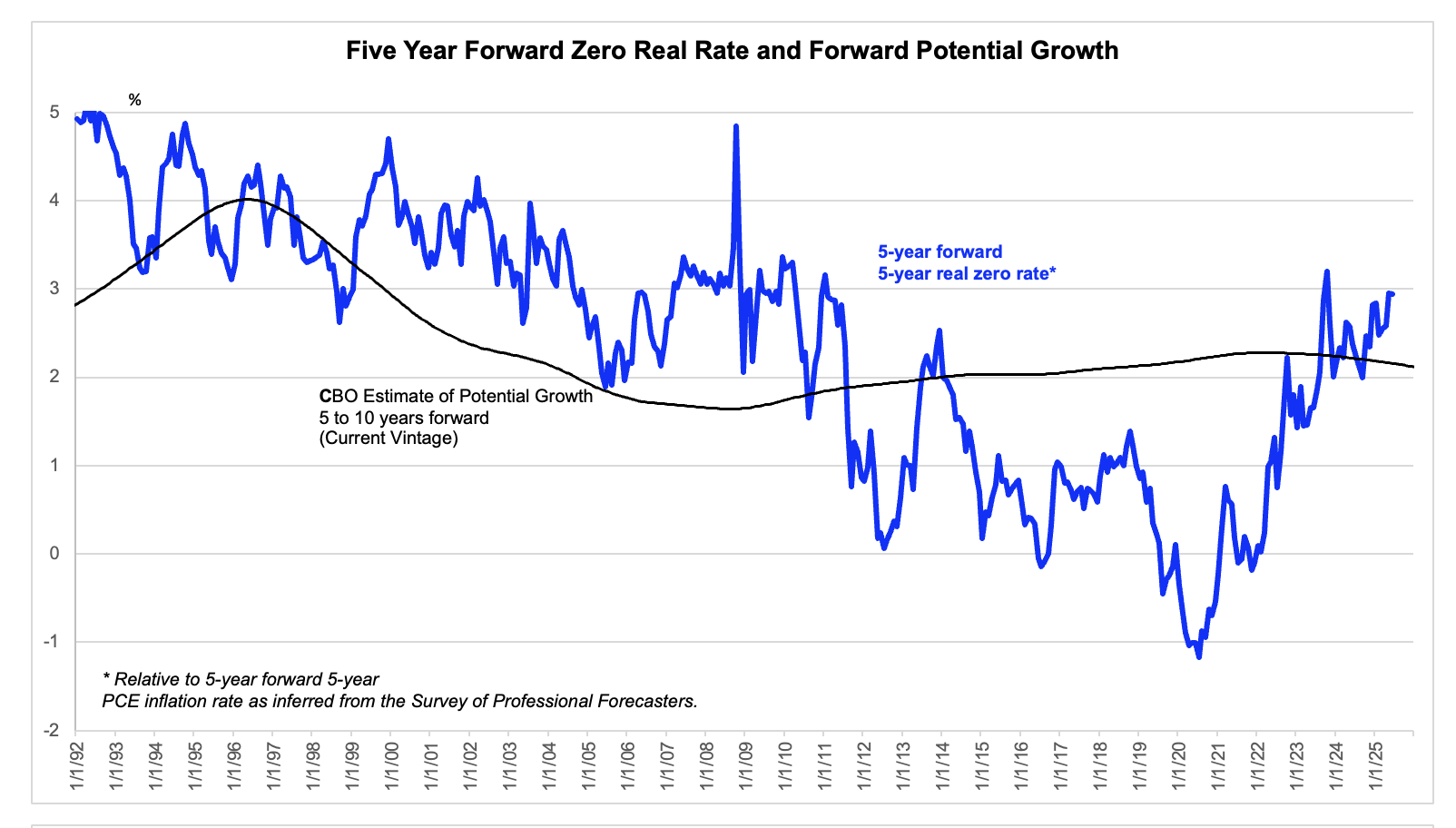

Source: CBO, Federal Reserve Banks of New York and Philadelphia, FH calculations
Pricing data is to the Monday close. 

[1] Incidentally, in the chart I use the 5-year forward 5-year real rate as a proxy of the market’s estimate of r*. I take very seriously the idea that the market has repriced r* relative to g*, that this implies an increase of fiscal worries, and that g* will limit r* via that channel. However, there is a technical complicating factor here. It seems that the term premium at the 10-year maturity is higher than at the 5-year maturity. ACM and KW show a difference of about 50 bps, although both are reliable. If we take those 50 bps as truth, then the 5-year discount factor is too high by 100 basis points. Incorporating that effect fully would drive forward r* back to g*. I am not saying this is obvious. I am saying it is non-obvious.  Also, this has nothing to do with the idea that the Treasury does not need to pay the term premium. When borrowing at 5-years it must pay the 5-year premium. I am talking about a gap between forward rates and expectations, because differences in term premia at different maturities mechanically affect the  forward discount. 

DISCLOSURES AND DISCLAIMERS

Analyst Certification

The analyst, 22V Research Group, primarily responsible for the preparation of this research report attests to the following: (1) that the views and opinions rendered in this research report reflect his or her personal views about the subject companies or issuers; and (2) that no part of the research analyst’s compensation was, is, or will be directly related to the specific recommendations or views in this research report.

Analyst Certifications and Independence of Research.

Each of the 22V Research analysts whose names appear on the front page of this report hereby certify that all the views expressed in this Report accurately reflect our personal views about any and all of the subject securities or issuers and that no part of our compensation was, is, or will be, directly or indirectly, related to the specific recommendations or views of in this Report.

22V Research (the “Company”) is an independent research provider. The Company is not a member of the FINRA or the SIPC and is not a registered broker dealer or investment adviser. 22V Research has no other regulated or unregulated business activities which conflict with its provision of independent research.

22V Research, LLC is a professional services and independent publication organization. 22V Research, LLC is not a securities broker-dealer, not a member of the Financial Industry Regulatory Authority (FINRA), not a registered investment advisor (RIA) and not a member of SIPC.

Securities transactions, when offered, are offered by 22V Securities, LLC through LPS Capital, LLC. Certain employees of 22V Securities, LLC are dually registered as securities representatives of LPS Capital, LLC or Analyst Hub Securities, LLC. 22V Securities, LPS Capital and Analyst Hub Securities are members FINRA, SIPC.

https://brokercheck.finra.org/

Current Ratings Definition.

SECTOR OUTPERFORM: An “outperform” rating anticipates the company will outperform the S&P Regional Banking Index (peer group).

SECTOR PERFORM: A “market perform” rating anticipates the company will perform in line with the S&P Regional Banking Index (peer group).

SECTOR UNDERPERFORM: An “underperform” rating anticipates the company will underperform the S&P Regional Banking Index (peer group).

Limitation Of Research And Information.

This Report has been prepared for distribution to only qualified institutional or professional clients of 22V Research Group. The contents of this Report represent the views, opinions, and analyses of its authors. The information contained herein does not constitute financial, legal, tax or any other advice. All third-party data presented herein were obtained from publicly available sources which are believed to be reliable; however, the Company makes no warranty, express or implied, concerning the accuracy or completeness of such information. In no event shall the Company be responsible or liable for the correctness of, or update to, any such material or for any damage or lost opportunities resulting from use of this data. Nothing contained in this Report or any distribution by the Company should be construed as any offer to sell, or any solicitation of an offer to buy, any security or investment. Any research or other material received should not be construed as individualized investment advice. Investment decisions should be made as part of an overall portfolio strategy and you should consult with a professional financial advisor, legal and tax advisor prior to making any investment decision. 22V Research Group shall not be liable for any direct or indirect, incidental or consequential loss or damage (including loss of profits, revenue or goodwill) arising from any investment decisions based on information or research obtained from 22V Research Group.

Reproduction And Distribution Strictly Prohibited.

No user of this Report may reproduce, modify, copy, distribute, sell, resell, transmit, transfer, license, assign or publish the Report itself or any information contained therein. Notwithstanding the foregoing, clients with access to working models are permitted to alter or modify the information contained therein, provided that it is solely for such client’s own use. This Report is not intended to be available or distributed for any purpose that would be deemed unlawful or otherwise prohibited by any local, state, national or international laws or regulations or would otherwise subject the Company to registration or regulation of any kind within such jurisdiction.

Copyrights, Trademarks, Intellectual Property.

22V Research Group, and any logos or marks included in this Report are proprietary materials. The use of such terms and logos and marks without the express written consent of 22V Research Group is strictly prohibited. The copyright in the pages or in the screens of the Report, and in the information and material therein, is proprietary material owned by 22V Research Group unless otherwise indicated. The unauthorized use of any material on this Report may violate numerous statutes, regulations and laws, including, but not limited to, copyright, trademark, trade secret or patent laws.
