

The nonmanufacturing ISM and the ADP measure of private employment growth for April have both come in on the weak side. And these reports heighten the contrast between some upbeat GDP counts, including that at the Atlanta Fed, and what seems to be a moderating growth trend.
As a result, I want to return just very briefly to the idea that some of these strong GDP bean counts reflect distortions coming out of the data. There is a sense in which that is true, but it may be helpful to be clear on what that sense is. One interpretation of the distortions coming out would be that actual growth was held back during Q1 by an inventory scramble that caused a lot of net exports drag. At least as presented, that theory is certainly false. A scramble for overseas goods to beat tariffs would have systematically no effect on the GDP growth rate, if that were all it was. And so the idea that there was some forgone growth that will show up in Q2 is also wrong.
Instead, two things that differ from one another quite distinctly seem to have happened during Q1. First, it looks like either the trade drag was overstated, or domestic demand growth was understated. We could imagine net exports chopping almost 5 percentage points off total demand (i.e., GDP) growth if domestic demand were booming. But the printed relationship between trade drag and domestic (tradables) demand was the biggest outlier in the history of the data dating back to 1984, which I choose as a cutoff because it marks the beginning of the Great Moderation, which is still roughly with us. So, this is not about the economy behaving oddly. It is about the economy being mismeasured in the GDP. And if that mismeasurement gets corrected in the Q2 data, then the Q2 data will overstate growth. It is not that the economy will quicken. Rather, the data will obscure it’s probably slowing. You can call that a distortion coming out if you like, but just be clear on what is meant by it.
Incidentally, you might wonder what actual evidence I have that the GDP was understated in Q1. I have zero direct evidence. There is nothing I can point to as the smoking gun. It is just that what printed seems implausible. You don’t get that much trade drag outside a massing spending boom. Maybe inventory investment was understated. I do not know.
Entirely separately, we do have reason to suspect that an attempt to bracket this issue by looking at final domestic demand might not work perfectly. The reason is that there appears to have been a scramble for capital goods to put in place, rather than into inventories. And a “distorted” demand for capital goods to put in place would make even final domestic demand growth look stronger than the underlying reality there. And this creates the risk of a pothole in Q2 that the bullish GDP bean counters do not seem to be factoring in.
So the distortion, as I would conceive, as opposed to the straight mismeasurement actually flattered Q1 GDP growth. Go figure. Or better yet, don’t pay too much attention to these GDP bean counts.
Please do not ask for a precise explanation, but this probably did not happen
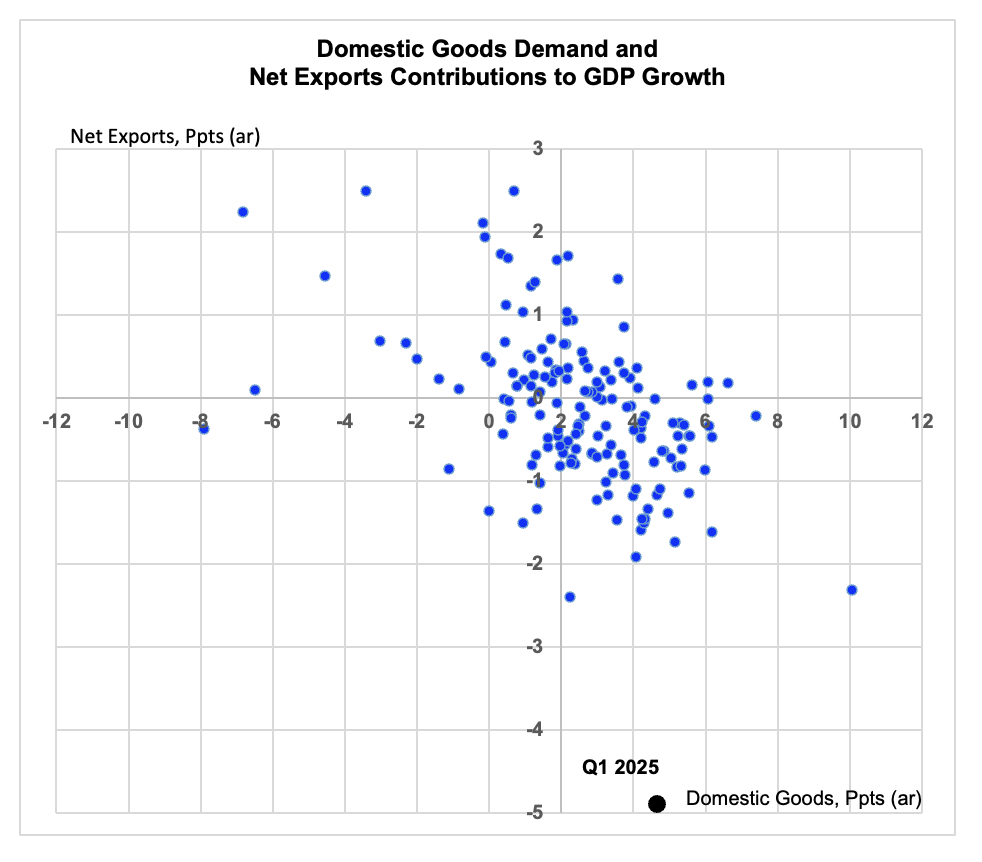
Source: BEA, FH calculations
Data set is from Q1 1984 through Q1 2025. Domestic goods demand is defined roughly as domestic demand (inclusive of inventory investment) less consumer services and non-defense government spending.

