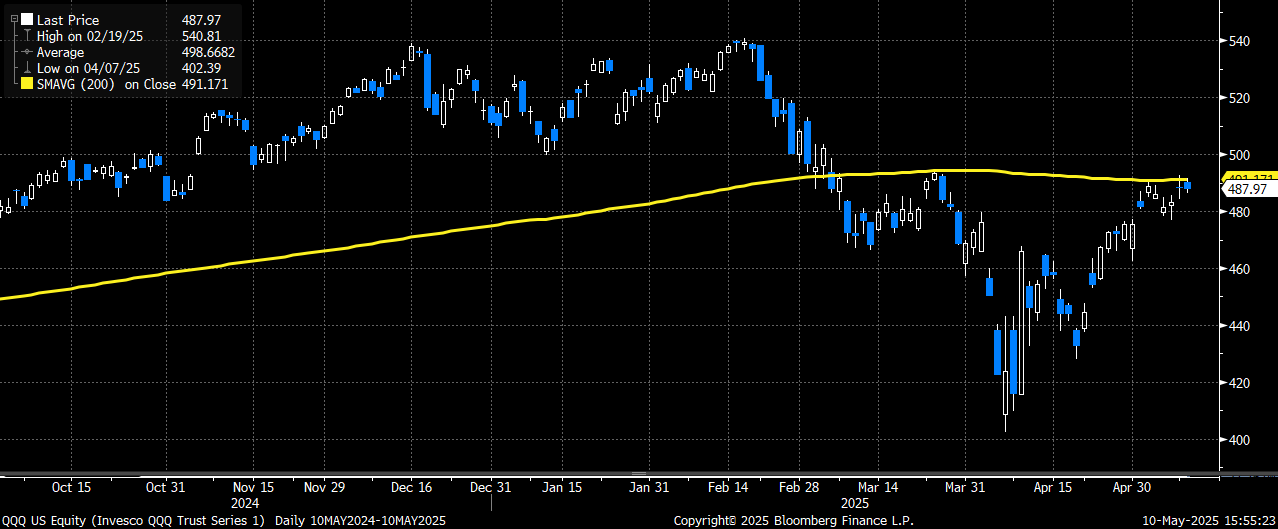
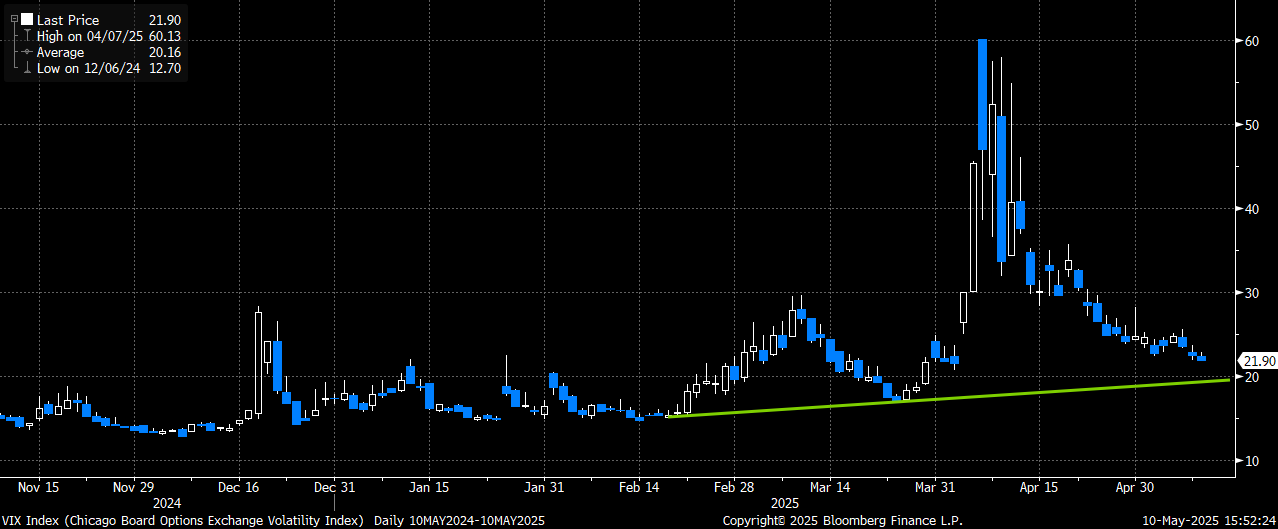
Although there was a fair amount of day-to-day volatility in the markets last week, the main indices all closed relatively unchanged (SPY was down 0.43%, QQQ was down 0.18% and the small caps were up 0.16%). Heading into the start of formal trade talks between the US and China this weekend, all three of the major indices have not only rallied sharply off their lows, but all sit below their longer-term 200-day moving averages (QQQ and SPY are just below that level, while IWM is still well below). The main volatility index (VIX) also had a relatively muted week, with a 3.44% decline to end the week at 21.90 (its lowest reading since right before the tariffs were announced).
The tech-heavy QQQ rallied right up the 200-day moving average and was unable to close above (much like the action we saw in March)
VIX has now declined from a high of 60 to below 22. Might be difficult to see a reading much lower in the short-term given headline risks and realized vol
The inability for the market to rally last week, even with the trade deal with the UK being announced and the fact that China agreed to sit down with the US, could speak to a lot of “positive” news on tariffs already being priced into the markets after the very sharp rally they have had off the April lows? In either case, when we consider where the markets have come from in such a short period of time, coupled with the move lower in vol and the risks of trade talks disappointing from here, I still am in the camp that owning market hedges just makes sense from a portfolio risk-management perspective at this time.
Last week I suggested owning small cap (IWM) hedges as my preferred macro portfolio insurance, and nothing from the action this past week makes me feel any different. Palantir (PLTR) dropped by ~ 12% after reporting earnings, and then GOOGL declined by 7% last week over concerns Apple (AAPL) could be adding AI services to its web browser, and yet there still wasn’t a meaningful spread between large caps (which are more levered to tech) and small caps. IWM now sits at exactly a 50% retracement between the Jan-Feb highs and the April lows, and it has continued to lag the performance of the large-caps (especially when the market has declined). I am still of the opinion that if we see a decided pullback from these levels, I believe IWM hedges offer a more attractive vol-adjusted potential return than large-cap hedges at current vol skew levels (which are still just above multi-year lows). June put spreads and/or puts remain my favorite duration here as well.
IWM now sits at exactly a 50% retracement between the Jan-Feb highs and the April lows

Collar Walmart (WMT) shares ahead of earnings later this week
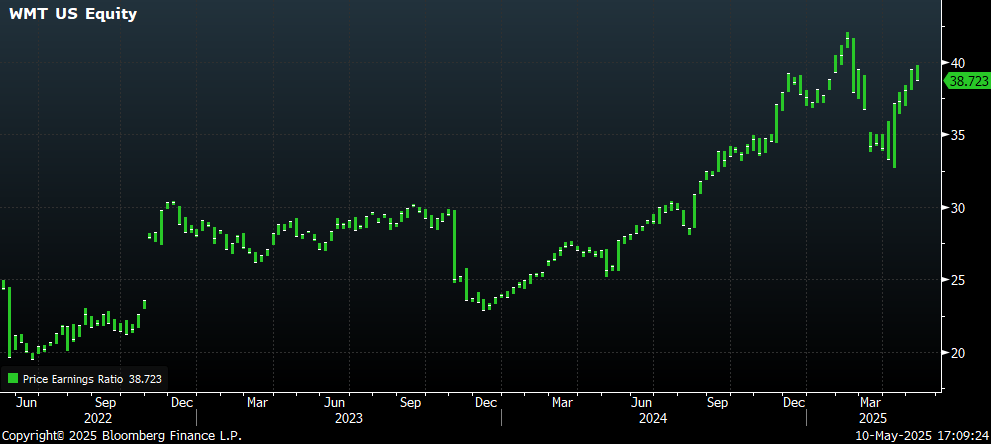
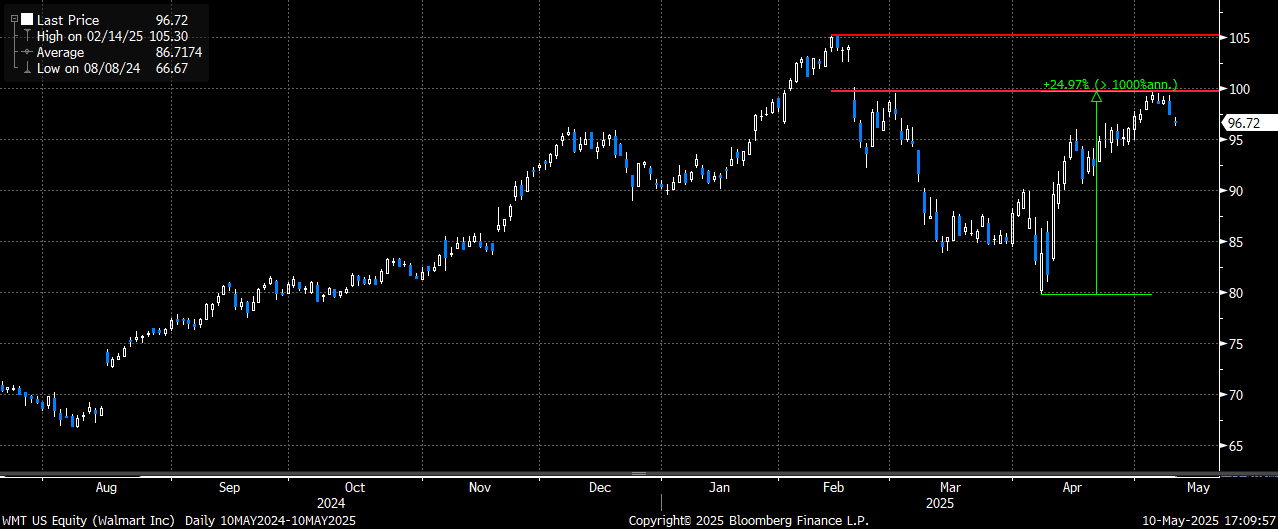
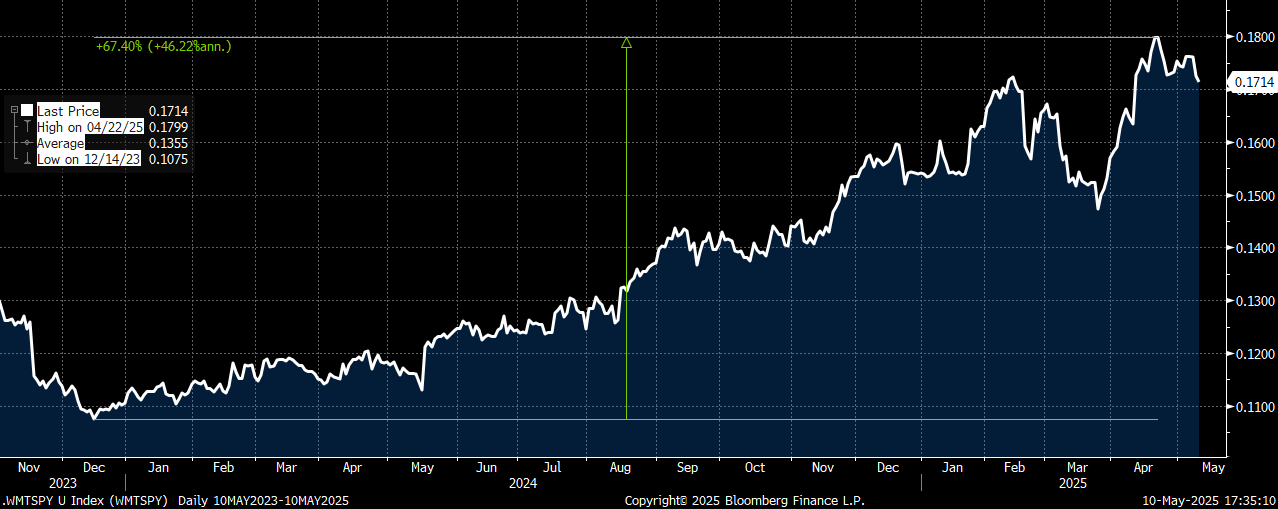
One name I wanted to highlight before they report on Thursday morning is Walmart (WMT). It is obviously widely owned and should be a good barometer for both the consumer and the China tariffs. The stock more than DOUBLED from the Dec 2023 lows thru the Feb 2025 highs, and sharply outperformed the market during that time. Shares dropped by 6.5% when they reported in February and traded all the way down to 80 as the overall market sold off (the first decline on earnings since before the stock bottomed in Dec 2023) . After bottoming ~ 80, the stock staged a sharp 25% rally (along with the market) and topped out right at the 100 level (the level that shares gapped below on their last earnings report). Not only should the 100 level likely continue to act as resistance, but at nearly 39x earnings it may be hard to see shares move up meaningfully from here given the macro backdrop, and downside risks on any earnings or guidance disappointment should be considerable (like we saw last quarter).
Given the earnings reaction last quarter, the apparent technical resistance at both the 100 and 105 levels and the “rich” multiple it currently trades at, it doesn’t appear to be a very bullish setup into earnings now that the stock has rallied sharply off the lows. If long, I think put spread collars make a lot of sense ahead of earnings, especially with implied volatility in the name still well above the 1-year lows. I also like using the Feb highs ~ 105 as the upside call strike I like selling as part of the collar hedge. With May elevated due to the earnings, I also prefer to use longer-dated options as part of the collar trade.
Trade:
Sell WMT July 105 calls
Buy WMT June 95/80 put spread
Costs ~ $1 (WMT 96.72 Fri closing price ref)
Trade Details:
- Selling the 8.5% upside July calls (at the Feb all-time highs and after the sharp rally off the April lows) to buy the 15-point wide June put spread that starts less than 2% below spot
- Put spread is capped to the downside at the April lows ~ 80 and captures ~ 10 points of vol skew (selling 43 vol vs buying 33 vol)
- Favor selling the July 105 call instead of June as vols are roughly the same, and doing so allows overall collar trade to only cost ~ $1
- Sharp rally into resistance as well as high multiple could make further upside in the short-run much harder to come by
- Stock dropped by 6.5% in Feb on last earnings, it’s first decline in the last 5 quarters (after a massive move higher and outperformance since late 2023)
- Please contact me or the 22V sales desk for updated pricing and execution capabilities
WMT shares rallied 25% right into the Feb (earnings gap lower) resistance. The all-time highs ~ 105 also seem unlikely to be eclipsed in the short-term
WMT/SPY relative spread went up nearly 70% from the 2023 lows to the April 2025 highs. Spread got to above the Feb 2025 highs even after the earnings drop
WMT P/E trading ~ 39x and just below the Feb highs