Back Economic Research

It’s Clear ‘It’ Didn’t Start in April, Though the Outlook Remains Murky

Published on May 2, 2025

Download the PDF Report

By

Peter Williams

It’s Clear ‘It’ Didn’t Start in April, Though the Outlook Remains Murky

  • April’s employment report was fairly strong and Fed friendly across the board.
  • Unlike the fears which some soft data prompted, the report is a largely continuation of recent trends. April, and perhaps even May, simply seems too early for firms to have aggressively changed their hiring plans away from prior plans.
  • More sluggish wage growth, combined with an ok Q1 ECI print earlier in the week, show little sign of new inflationary pressures ex-tariffs but given even mild tariffs and hot Jan-Feb data, y/y core PCE will not be declining over the course of the year.
  • Still, by any reasonable standard we can say that, even if only for a time, the economy stuck the post-covid soft-landing. These new shocks land on a different world than pre-covid, one likely less tolerant of further supply shocks or overheating, but that all remains to be seen.
  • The balance between growth risks and inflation ones will be driven tariffs but it is important to remember that right now there is at best a mild amount of slack and inflation remains somewhat above target, moving sideways at the very best and likely bouncing higher over the summer. The next 2-4 months activity data will be very noisy.
  • On net, the current hard data gives the Fed no urgency toward cuts. June pricing back to roughly 45% will likely continue to fall a bit further (the floor is likely ~30%).

If certain parts of the economy just shut down in the next few months because of tariffs, then a broader negative feedback loop could develop in the economy. But that has to happen.

The messier baseline reality, admittedly premised on an assumption that enough clarity on lower China tariffs emerges for the small-to-medium sized firms who will be most impacted and can least easily lobby for exemptions to survive, is that we will muddle through with below trend but still mildly positive growth in 2025.

So far, the soft data remains far more concerning that anything seen in the hard data. Perhaps the most negative spin on the recent hard data would be that topline spending numbers have shown steady trends, implying a potential cannibalization of future aggregate demand given the known pull-forward of some time tariff-related spending. In the near-term, a period of some mechanical payback in activity after tariff pull-forwards will likely noisily depress activity for a few months (more of a May-June data, releases lagging a month or so, story than an April one). After that, and the noise it entails, we will have a much clearer sense of the durable portion of the tariff shocks impacting the economy and begin to get a cleaner look at underlying activity. If all the China tariffs remain in place, we may start hearing signs of stress in some impacted pockets of the economy by Memorial Day but even that likely seems too soon to be a realized, rather than widely discussed source of near-term, stress.

To a large extent, the April employment report is one of continuation. There were no sharp breaks that jump out and the broader trends of stable to mildly easing slack, taken across the swath of labor market data, and solid if less rapid than in recent years hiring seems to still be in place.

Catch-up hiring growth remains fairly strong with a 3mma of 86k, while cyclical hiring has shown some stability since rebounding last fall and has a 3mma of 69k. Perhaps the single most surprising part of the data this morning was the 29k gain in transportation and warehousing employment; we will see if this strength sticks as it the most obvious initial point of labor market pressure, even in a world where tariffs ding but do not fully shut down trade flows.
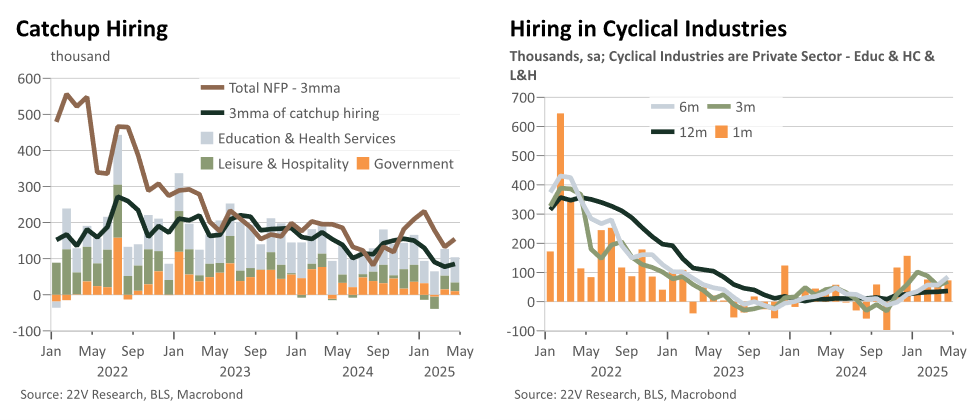
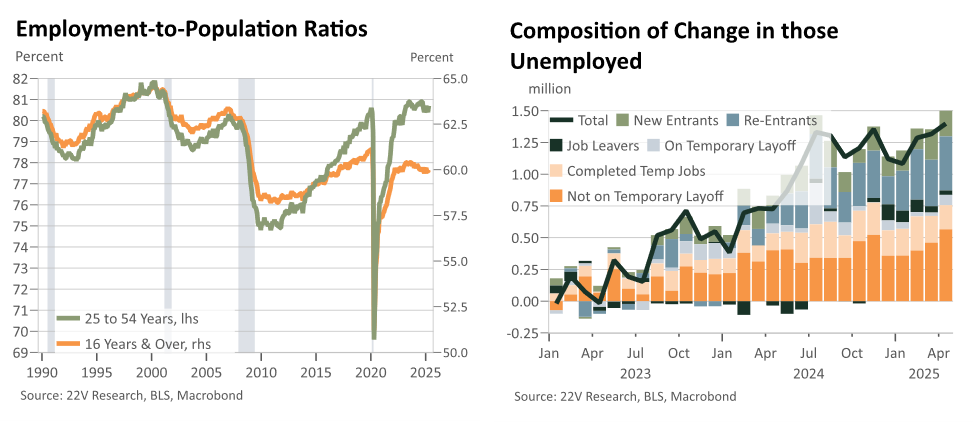
The household survey was broadly strong with sharp jump in the size of the labor force, a tick up in the overall and prime-age labor force participation rates (both still below their cycle highs though), a mild recovery in the prime-age employment to population ratio (similarly bouncing around a bit below their cycle highs), while the unrounded unemployment rate ticked up just a tiny bit.

Taken together with the JOLTS data, claims, and other sentiment-based measures of labor market slack, there is some gradual slow easing of the slack in the labor market. This is being driven not by layoffs but by slower less efficient job search times and a sluggish gross hiring environment (gross hiring flows are at 2013-like levels when most other measures of slack are more like 2017-19). This is a potentially brittle equilibrium, as Fed speakers have noted, but without a layoff wave creating larger jump risks, even a further slowdown in hiring seems likely to lead to a gradual linear easing in slack rather than a large discontinuity (as the Sahm Rule suggested last summer and the same logic does still tend to hold).
DISCLOSURES AND DISCLAIMERS

Analyst Certification

The analyst, 22V Research Group, primarily responsible for the preparation of this research report attests to the following: (1) that the views and opinions rendered in this research report reflect his or her personal views about the subject companies or issuers; and (2) that no part of the research analyst’s compensation was, is, or will be directly related to the specific recommendations or views in this research report.

Analyst Certifications and Independence of Research.

Each of the 22V Research analysts whose names appear on the front page of this report hereby certify that all the views expressed in this Report accurately reflect our personal views about any and all of the subject securities or issuers and that no part of our compensation was, is, or will be, directly or indirectly, related to the specific recommendations or views of in this Report.

22V Research (the “Company”) is an independent research provider. The Company is not a member of the FINRA or the SIPC and is not a registered broker dealer or investment adviser. 22V Research has no other regulated or unregulated business activities which conflict with its provision of independent research.

22V Research, LLC is a professional services and independent publication organization. 22V Research, LLC is not a securities broker-dealer, not a member of the Financial Industry Regulatory Authority (FINRA), not a registered investment advisor (RIA) and not a member of SIPC.

Securities transactions, when offered, are offered by 22V Securities, LLC through LPS Capital, LLC. Certain employees of 22V Securities, LLC are dually registered as securities representatives of LPS Capital, LLC or Analyst Hub Securities, LLC. 22V Securities, LPS Capital and Analyst Hub Securities are members FINRA, SIPC.

https://brokercheck.finra.org/

Current Ratings Definition.

SECTOR OUTPERFORM: An “outperform” rating anticipates the company will outperform the S&P Regional Banking Index (peer group).

SECTOR PERFORM: A “market perform” rating anticipates the company will perform in line with the S&P Regional Banking Index (peer group).

SECTOR UNDERPERFORM: An “underperform” rating anticipates the company will underperform the S&P Regional Banking Index (peer group).

Limitation Of Research And Information.

This Report has been prepared for distribution to only qualified institutional or professional clients of 22V Research Group. The contents of this Report represent the views, opinions, and analyses of its authors. The information contained herein does not constitute financial, legal, tax or any other advice. All third-party data presented herein were obtained from publicly available sources which are believed to be reliable; however, the Company makes no warranty, express or implied, concerning the accuracy or completeness of such information. In no event shall the Company be responsible or liable for the correctness of, or update to, any such material or for any damage or lost opportunities resulting from use of this data. Nothing contained in this Report or any distribution by the Company should be construed as any offer to sell, or any solicitation of an offer to buy, any security or investment. Any research or other material received should not be construed as individualized investment advice. Investment decisions should be made as part of an overall portfolio strategy and you should consult with a professional financial advisor, legal and tax advisor prior to making any investment decision. 22V Research Group shall not be liable for any direct or indirect, incidental or consequential loss or damage (including loss of profits, revenue or goodwill) arising from any investment decisions based on information or research obtained from 22V Research Group.

Reproduction And Distribution Strictly Prohibited.

No user of this Report may reproduce, modify, copy, distribute, sell, resell, transmit, transfer, license, assign or publish the Report itself or any information contained therein. Notwithstanding the foregoing, clients with access to working models are permitted to alter or modify the information contained therein, provided that it is solely for such client’s own use. This Report is not intended to be available or distributed for any purpose that would be deemed unlawful or otherwise prohibited by any local, state, national or international laws or regulations or would otherwise subject the Company to registration or regulation of any kind within such jurisdiction.

Copyrights, Trademarks, Intellectual Property.

22V Research Group, and any logos or marks included in this Report are proprietary materials. The use of such terms and logos and marks without the express written consent of 22V Research Group is strictly prohibited. The copyright in the pages or in the screens of the Report, and in the information and material therein, is proprietary material owned by 22V Research Group unless otherwise indicated. The unauthorized use of any material on this Report may violate numerous statutes, regulations and laws, including, but not limited to, copyright, trademark, trade secret or patent laws.
