

The main forecasts in the April update of the IMF’s World Economic Outlook are effectively dead on arrival, because the April 9 tariff changes came after this forecast round had closed off incorporation of new data. So, for example, US growth is formally projected to be around trend during 2025 and I cannot seem to figure out what their call for inflation might be. There may be some interesting analytics buried in the report, but the headlines associated with its release are fully stale.
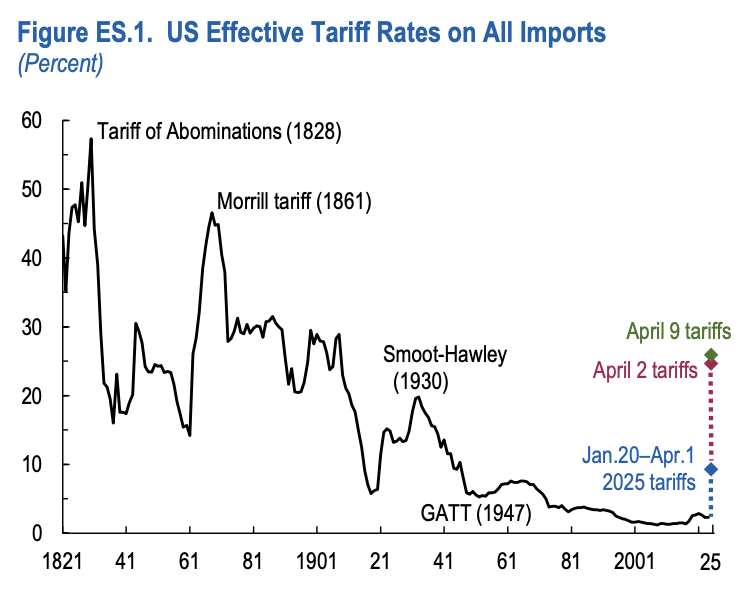
What is worth taking a close account of, though, is their scoring of the effective tariff rate in the United States, inclusive of the pause of the reciprocal (sic) tariffs and the increased tariffs against Americans importing goods from China. The chart depicting that is the only visual in the Executive Summary, which I think can be fairly interpreted as meaning they believe it is quite important – and are perhaps understandably a bit insecure about it.
Tariff freedom (sic) day brought a steep rise in the effective tariff rate for the US as is widely recognized, but the subsequent climb down resulted in no net decline in the effective rate, in fact it rose slightly, because of the extra tariffs imposed on Americans on goods imported from China. And yet observers claim that the tariff issue has become slightly less threatening since April 8. Certainly, April 9 was a huge rally, despite starting in the red. And the S&P is little changed since then. I have characterized the central case impetus to inflation from the tariffs as having been cut in half, although the ports news gives some pause, pardon the pun, about the very short run.
So what is going on here? Let’s start by being honest about the uncertainty here. We do not really know what the tariffs will end up being and the central case is not that this issue is fully resolved. The chart in the IMF report is a sober reminder of that and not at odds with what others have calculated. I guess folks agree on the method here.
Having said that, there are a couple reasons to view the April 9 climbdown as constructive, taken in isolation. First, for any given average level of tariffs, it is probably best that it results largely from a concentrated increase in tariffs against goods from a single trading partner. The supply chain would eventually re-source away from China, moving that effective tariff rate lower, even without new executive orders. (The United States no longer uses legislation per se, because it is a republic, not a democracy!) Analysis from the Yale Budget Lab suggests that this shift of “consumption” could be worth about 10 percentage points, taking down the effective tariff, as they score it, from 28 to 18%. It is true that this shift will take a while, but it is also true that the Fed will anticipate its effects when setting the speed limit. I am not saying the Fed is omniscient. I am saying it incorporates information just as you and I do.
Second, while uncertainty about the US-China relationship abounds, in part because the American side has badly misread their negotiating strength here, the consensus is that there will be a de-escalation on this front.
And finally, there may be some trade deals that reduce bilateral tariffs below the 10% standard rate that was applied during the pause that marked the climbdown.
So, I am for now working with the idea that the inflation threat had been cut in half, subject to that caveat about the ports looking oddly empty, which I do not fully understand. But it is worth emphasizing that there are some arguably optimistic assumptions in that assessment. And even if these assumptions are realized, it is not a case of the cathartic all-clear having been established.
At least it is not abominable
Source: IMF, as linked above

