

I will keep this brief, because the focus is elsewhere and because this effort should be familiar to most of you by now. I read the consensus as expecting the Core PCE Price Index to be up 7 basis points in March, post a slight upward revision of the estimates following the import price index, which implied less deflation of airfares than the PPI had implied. One odd wrinkle this month is that a revision to financial services prices in the PPI implies that the core PCE Price Index for last month will be revised up just over 10 bps. I incorporate that expected revision into the data, including the data depicted on the right side of the standard table below as last month’s “actual.”
The revisions will not affect the Market Price Only (MPO) version of the Core PCE Price Index. So when splitting out the goods vs services piece, I show the MPO versions only, to avoid introducing a calculation error by messing around with a bunch of individual historical price detail. This exclusion should not be a major issue, because we should be watching the MPO versions mostly closely anyway, to net out the effects of noisy financial services prices (especially), even away from the possibility of them being revised.

Source: BEA, FH inferences from informed consensus
Data are actual to February and inferred consensus for March.
As you know, I believe rents are better measured with a proxy of marginal rents, rather than conventionally incorporating the lagging government measures of average rents. This month that matters a bit more than in recent months, because government rents actually reaccelerated a bit. Accordingly, the Observed Rent version of the Core PCE Price Index is estimated to be up 4 basis points less than the standard Core, although both are expected to be weak / good on the month. I do not have an explanation for why disinflation in the government measure of average rents appears recently to have almost stalled. I would just say that such a stalling has occurred before during this general trend to rent disinflation, and I do not think that disinflation is over. I would repeat, just to complete the thought, though, that I have recently revised up my best guess of marginal rent inflation from 2 1/4% (ar) to 2 1/2%, mainly because of development in the Cotality (formerly CoreLogic) Single Family Rent Index. My strong claim is that marginal rents inevitably lead, although not by a fixed amount of time. What marginal rents themselves will do is something I monitor, rather than forecast.
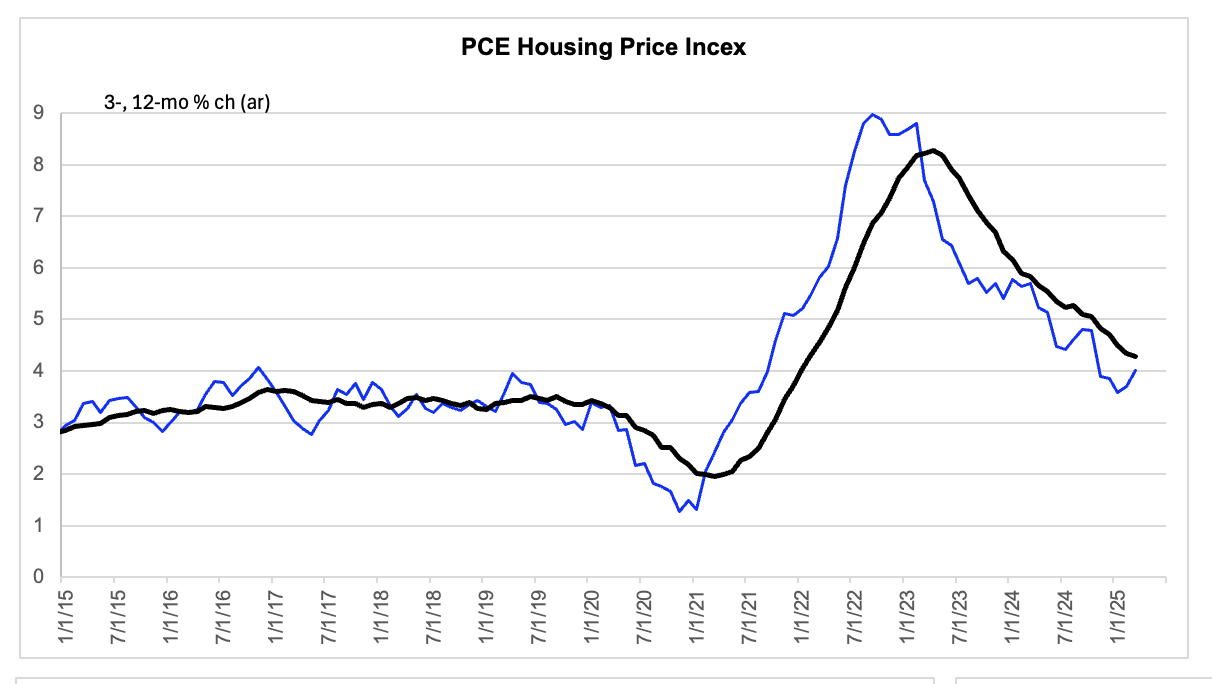
Source: BEA, FH estimate
The data are actual to February and effectively actual to March because the CPI detail are precisely predictive.

