

Bank Earnings Remind that Initial Conditions Were Solid + Pause is the Default Tariff Response for Now
- So far during bank earnings season the most consistent message from management teams has been that while tariffs are injecting substantial uncertainty and downside risks into the economy, the starting point as of Q1 was quite healthy.
- Amid all the market volatility and tape bombs, banks largely noted that their corporate clients are pressing pause to wait and see where the current outlook trends towards. As, or if, activity slows from here, small businesses seem more impacted than do larger ones, with some sectoral variation, and lower income consumers are doing relatively worse and will be more effected.
- This line up with the message we have heard from Fed speakers in recent weeks, unsurprisingly.
- From a cyclical perspective, the relative healthiness of bank balance sheets and credit normalization and tightening already done reduces the plausible impact of tariff-induced shocks to the economy by pre-buffering balance sheets. In a recession some additional tightening would surely happen, but it does not seem likely that that would be one of the defining shocks to be dealt with.
- For the moment businesses are hoping that tariffs will largely be a source of noise rather than changing cyclical and structural fundamentals can be read optimistically or more pessimistically. If tariffs persist along worse, if not worst, possible paths, there is still a lot of downside risk to the economy to be reckoned with.
- Below are quotes from a selection of banks which have reported so far, grouped by the broader themes which were apparent across most all firms.
The broader macroeconomic and profit outlook is obviously much cloudier than it was only a few months ago.
- “Now it’s [aggregate SPX earnings] up 5% as opposed to up 10%. My guess is that will be 0, and negative 5% probably the next month. And then you’re going to hear 1,000 companies report, and they’re going to tell you what their guidance is. My guess is a lot will remove it.” – JPM
- “While there is much we do not know today, we remain optimistic that we can avoid a recession. In my view, the risk of recession is likely to increase the longer current levels of market volatility and uncertainty persists.” – FHN
While consumer spending has remained solid (a reasonable enough prior in nominal terms until or if a larger labor market downturn emerges), corporate clients are largely pressing the pause bottom on any medium- and longer-run decision making. This isn’t necessarily a pre-recession action so much as a recognition that no one really has a sense of how things are going to play out. Of course, enough pauses sustained will be an real drag on growth and employment.
- “ So, it is without question slowed down activity in the near-term as people try to figure this out, but it hasn’t yet turned into any sort of credit deterioration, nor just given the quality of our book, nor do I think it’s a dramatic outcome for our clients unless those very tariffs drive us into a steep recession and then we’re going to have a standard credit cycle.” – PNC
- “They’re basically sanguine on the current environment, but they’re worried about how this will affect their businesses and where they should invest. And I think that’s slowing down some of their decision path right now, because they’re trying to figure out if my goods and services will be able to pass-through the price, do I need to change my business plans in terms of growth, should I buy that piece of equipment.” – BAC
- “Anecdotally, a lot of people are not doing things because of this. They’re going to wait and see. And that’s M&A, M&A with middle market companies. That’s people’s hiring plans and stuff like that. So people have to adjust this new environment. And I think you will see what it is.”- JPM
- “I think smaller clients, small business and smaller corporates are probably a little bit more challenged.” – JPM
- “Our clients… are concerned by the significant near-term and longer-term uncertainty that has constrained their ability to make important decisions. This uncertainty around the path forward and fears over the potentially escalating effects of a trade war have created material risks to the US and global economy.” – GS
- “Given this unpredictability, some clients are deferring strategic activity, while others are proceeding.” – MS
- “I would tell you that in all of our conversations over the last 90 days, the uncertainty has led to not a pessimism in our borrower base, but simply, let’s wait and see.” – FHN
- “I think small businesses might be the ones that would be impacted first. And if you think about our consumers, what our consumers tend to do is what they would tend to do is they spend a little bit less, revolve a little bit less.” – AXP
So far there appears to be little sign of an overall slowdown in consumer spending in the very recent past, although it has been gradually decelerating towards something more normal since reopening. Potential tariff front-running will make the topline data difficult to read in the coming months.
- “In the aggregate, the consumer keeps pushing money into the economy.” – BAC
- “Consumers have remained resilient, and debit and credit card spending patterns have remained stable.” – WFC
- “And to be honest, the main thing that we see there, what would appear to be a certain amount of front-loading of spending ahead of people expecting price increases from tariffs… But I think what I’d sort of highlight is that during this transitional period and this elevated uncertainty, you might see some distortions in the data that make it hard to draw larger conclusions.” – JPM
- “We are watching the downward trend in consumer sentiment, but not seeing that in our spend patterns. Our mix does tilt towards the more affluent customer and towards nondiscretionary everyday spend pattern. So that could be an explanation, but we are seeing steady consumer spend patterns in the first quarter.” – USB
- “If you start with the consumer, from just looking at our debit card activity, our spending patterns are still pretty much intact there, so I think we’re pretty consistent. We are seeing, and it could just be short-lived, but in our indirect channels on the consumer side, a lot of loan volume coming in auto, marine, and RV.” – MTB
- “Just to be clear, from a consumer perspective, we see no pull-forward at all.” – AXP
The one exception to that appears to be travel spending, which airlines and a few banks noted looked relatively weaker in recent weeks, although the effect is not universal so far.
- “I mean we obviously saw the airlines discuss what they are seeing as headwinds for them, specifically in airline travel, and we’re seeing that too through the card spend. It’s not obvious to us that that’s necessarily an indicator for broader patterns.” – JPM
- “We saw spend actually increase in our branded card portfolio up about 3%… We’ve seen a shift towards essentials and sort of away from travel and entertainment.” – C
- Interestingly, AXP is seeing less of this in their card spend, noting that “T&E grew in-line with the steady levels we saw for… most of last year, reflecting continued strength in-restaurant and lodging spending. We did see a deceleration in airline spending relative to 2024 trends.”
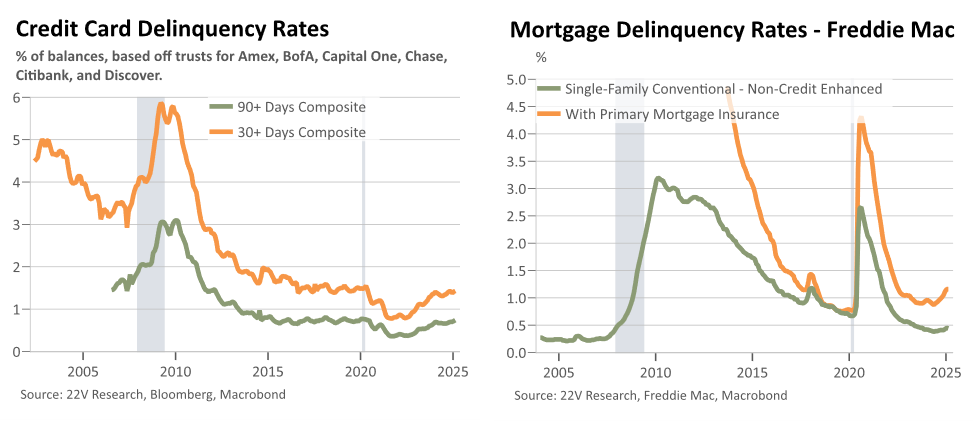
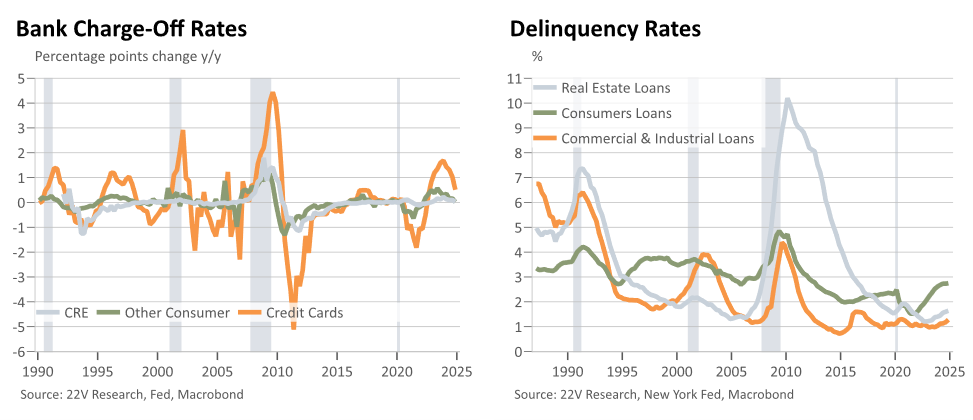
The increases in delinquency rates, particularly for credit cards, over the past few years should not be seen as a sign of stress but rather as normalization. When looking across income cohorts the consumer is behaving largely as one would expect, with weakness concentrated among lower-income consumers, given the backward-looking macro data. Bank charge offs in aggregate appear to be normalizing, with card still looking the weakest, but the y/y paces are clearly decelerating. There may be some mild signs of stress in residential mortgage for some less credit worthy borrowers but that aligns with broader income-based patterns, on a lag.
- “So I think it’s just normalizing more to where, where it was in the relatively good credit times in 2019 rather than any significant movement. And in fact, we said that as we came through last year over and over again, people kept doubting it, and what you’ve seen is delinquency actually have fallen and it’s flattened out in terms of the $1 billion charge-off level in cards.” – BAC
- “When we look at our card data and also our cash buffers and peoples’ checking accounts, of course, it is true that it is relatively weaker in the lower income segment. But when you take a step back and you ask, are we seeing signs of distress in the lower income segment? The answer is no.” – JPM
- “More affluent customers continue to show strength, while less affluent customers show more stress. Consumer credit also continues to perform well. Delinquencies appear to have levelled at historical norms and payment rates on unsecured portfolios have been quite strong.” – WFC
- “Both delinquency and write-off rates were below pre-pandemic levels and flat to the prior year.” – AXP
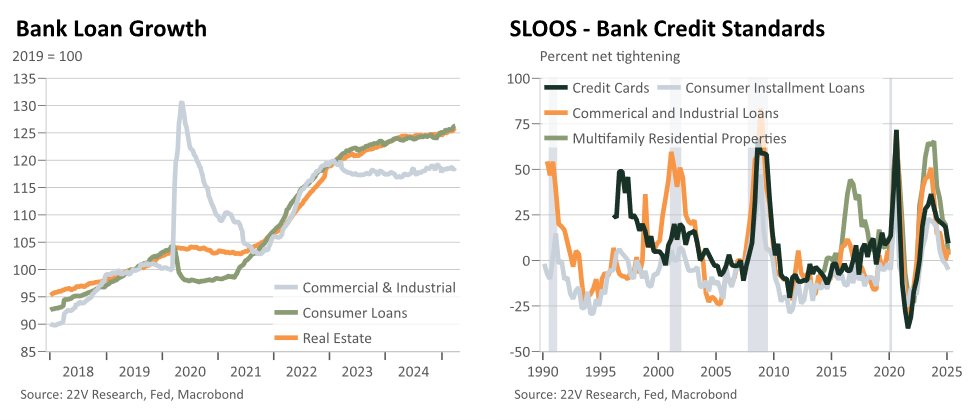
C&I loan growth has been largely flat in recent quarters, with the aggregate Fed data showing little evidence of a real move higher. Banks reported that there have been minimal signs of precautionary loan draws so far with activity fairly normal.
- “And the answer to that question [are we seeing loan draws] was no, at least not yet. So I don’t know what to make of that, but perhaps it suggests that we do not see that level of heightened anxiety, that people are more just focusing on addressing their supply chain issues right now.” – JPM
- “Strong growth in C&I loans was partially offset by continued runoff in the CRE office portfolio and lower consumer balances… This represented the largest increase in C&I balances since the fourth quarter of 2022 and was driven by higher utilization rates and new loan production.” – JPM
- “Nobody is saying they’re purposely building inventory in advance of the tariffs. Having said that, most of our lines finance working capital. So, almost definitionally there is some inventory built going on.” – PNC
- “And it appears like it was mostly just BAU [business as usual] activity out there. We haven’t really seen any evidence of people pre-positioning significantly that caused significant borrowing at least as it relates to their expectations around tariffs.” – WFC
Banks are preparing for some credit possible credit losses on their commercial and industrial loan portfolios while at the same time CRE losses are continued be digested and gradually normalize.
- “We’re not seeing deterioration happen in any meaningful way relative to what the trend that we’ve had over the last couple of quarters, even on that lower end consumer and on the corporate side, same thing, very consistent performance now for a number of quarters. And really, the only place that we’ve seen any systematic stress is still the office portfolio and even there, it’s been pretty stable in terms of the trends and what our expectations have been.” – WFC
- “This quarter, a more favorable portfolio mix and improved asset quality resulted in a small reserve release of $10 million. The allowance this quarter also included some incremental qualitative reserves to reflect increased tariff-induced macroeconomic uncertainty.” – USB
- “As it currently stands, the sectors that we’re paying particular attention to would be our retail trade, consumer finance, manufacturing and construction. You’ll notice that skews more towards the C&I side because that is where we expect to see more of the tariff impact.” – FHN
More broadly, banks are assuming some softening in the economy when making credit allowances and guidance. Given this preparation and the credit tightening which has already taken place since 2022, it seems unlikely that credit tightening will be an additional exogenous source of stress on the macroeconomy, although in the event of a recession there will be some endogenous tightening of course.
- “When you look through to some of the key variables – or one of the variables you referenced, unemployment, the average unemployment rate was 5.1% across those three scenarios. The unemployment rate in the downside scenario, the average was 6.7% across those eight quarters. And so, we’ve assumed some pretty meaningful shifts in unemployment, particularly on that downside in our analysis.” – C
- “It’s got 5.1[%] in the model.” – TFC
- “As far as unemployment, look, we have 5.7% incorporated our macro… even though the unemployment level is that we have in our outlook is higher than it’s been, we feel comfortable with holding the guide…. So the 5.7% represents the peak unemployment rate” – AXP
- “We do have a pretty good weighting there on the downside. It is 5.8% of employment. And then we add more allowance on top of it.” – WFC
- “By the time we then take that modeled answer, and then layer on top of it the judgmental piece all the way through the close, we’re reserved closer to an unemployment rate that’s right around 6% in 2025, 2026 just to give you some idea.”- BAC
- “We’re in the high 4% range as far as the unemployment that’s embedded in our current allowance that we have at the end of the quarter.” – RF

