Waller Lays Out a (the Most?) Dovish Tariff Reaction Function
- Fed Gov Waller, who defies reliable hawk-dove labeling more than anyone else on the Committee in my view, laid out what seems to be the maximally dovish case on how the Fed should respond to the various tariff shocks under consideration.
- He calls for a Fed which becomes more preemptively dovish the larger the tariff shock, given the increasing recessionary concerns that build in response and a willingness to look-through the short-term inflationary costs.
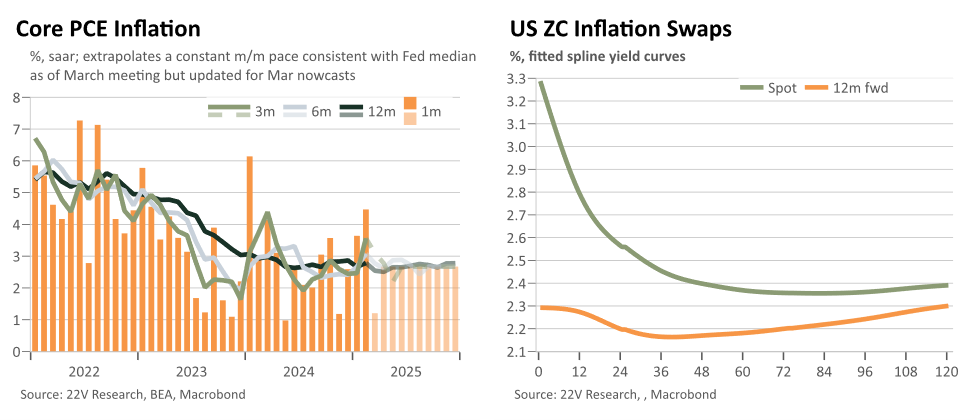
- This view can certainly be the correct one under specific assumptions around tariff’s second round effects on inflation and that inflation expectations will not deanchor due to tariffs or, crucially, due to a dovish Fed response to the tariff supply shock (since covid we have seen expectations respond favorably to hawkish policy announcements, this ignores the policy -> expectations channel). Waller acknowledges the risks of a preemptively transitory framework but seems quite sanguine about them.
- The risk management seems to happen around recession odds and persistent slack more than the second-round inflation risks.
- One could cynically read this is an accommodative pivot in support of the administration but this model-based view, with somewhat riskily optimistic assumptions around medium-term inflation and expectations in my view, seems consistent with Waller’s general approach in recent years. This has served him well in some areas (he got the linear labor market easing call correct) but less well in others (he has lacked upside imagination on inflation), as he has been fully willing to admit.
- My suspicion is that Powell appreciates this view on the Committee but it sounds like Waller has more preemptive and forecast-based reaction function than Powell does at the moment. Powell’s updated thoughts Wednesday (1:30ET) will tell us more.
Some annotated quotes from the full speech below:
- “The new tariffs are hitting an economy in good standing, which leaves me encouraged that households and businesses would continue to spend and hire during trade negotiations.” This is perhaps the key point to keep in mind at the moment. The economy had some generic mid-to-late cycle concerns coming into the tariffs (inflation above target, elevated rates, and a low but slowly rising unemployment rate) but there were few signs of spot weakness.
- “The new tariff policy is one of the biggest shocks to affect the U.S. economy in many decades… the future of that policy, as well as its possible effects, is still highly uncertain. This makes the outlook also highly uncertain.”
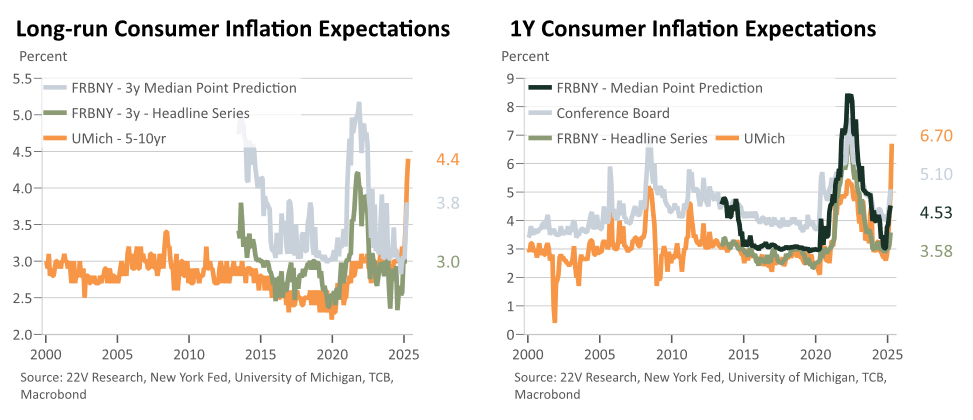
- Waller strongly favors market-based measures of inflation expectations over consumer surveys due to their skin in the game. This neglects that market-based measures have embedded Fed reaction function in them which excessively dependence on them may make moot (a Goodhart’s Law risk).
- The FRBNY’s inflation expectations survey, released earlier today, seems to agree with Waller that inflation will slow notably after the initial impacts of tariffs, and will be accompanied by a substantial shock to labor market conditions, particularly for job searchers. But again the questions of assumed shock size, severity, and duration matter as do an underlying view on how other policies (monetary and fiscal) respond to the inflation and growth hits.
- Waller outlines two illustrative tariff scenarios. In the first (roughly 10% average effective tariffs),), where the growth hit is milder and inflation rises to “around” 3%. In a current policy scenario (roughly 25%), inflation peaks “close to” 5% and even with weak pass through gets to around 4%. Growth would “slow significantly” this year and next and the unemployment rate would approach 5% next year. This is frankly a surprisingly modest labor market and growth hit compared to many other’s expectations in this scenario. Again the embedded risk of fairly linear effects, something he cautions about with growth but largely ignores on inflation.
- In the current policy scenario (25%), “while I expect the inflationary effects of higher tariffs to be temporary, their effects on output and employment could be longer-lasting and an important factor in determining the appropriate stance of monetary policy. If the slowdown is significant and even threatens a recession, then I would expect to favor cutting the FOMC’s policy rate sooner, and to a greater extent than I had previously thought. In my February speech, I referred to this as the world of “bad news” rate cuts. With a rapidly slowing economy, even if inflation is running well above 2 percent, I expect the risk of recession would outweigh the risk of escalating inflation, especially if the effects of tariffs in raising inflation are expected to be short lived.” Growth and labor market dominance due to the medium-term forecast.
- In the more optimistic 10% scenario, “as a result of these limited effects on inflation and economic activity from steadily diminishing tariffs, I would support a limited monetary policy response… With the threat of a sharp slowdown or recession diminished, pressure to reduce rates based on falling demand would diminish also. That is, the policy response in this scenario could allow for more patience. The preemptive policy cuts we did last fall can allow us some time to wait and see if the hard data catch up to the soft data or vice versa and how much of the tariff will be passed through to the consumer. In such a scenario, the outlook for monetary policy might not look much different than it did before March 1.”