

The timeline Trump has set out for Liberation Day makes for a good laugh. He starts by meeting his expert team, then coordinates with business leaders so the implementation is seamless, and finally he lets markets react.
The experts are reviewing it

Source: White House via Bluesky
This all sounds pretty bad, and markets would – I assume – be lower if people took this as the last word. But markets are understandably discounting the reliability of these signals. He could change his mind in a week. Given my dual citizenship, I am perhaps more aware than others, of reporting this morning that Trump has dramatically scaled back his threats to Canadian sovereignty.
One economic risk we face here is that Trump somehow finds a way to make this seamful by delaying implementation or holding out the hope of various forms of exceptions, some of which will be obvious and some of which will further extend uncertainty. Uncertainty is better than firm commitment to delivering a recession. But I argued in my note yesterday that the costs of uncertainty are arguably accumulating into a marked slowdown of demand growth and associated rise of recession risk.
The economy does not appear to be in recession now. And an extension of uncertainty along the lines I fear would not make recession the base case. It would just mean that the risk of recession would remain a couple to three times the base rate for a while. Recession would be the base case only if Trump were to go aggressively tariff heavy. And even then, it would be probable, not certain, I think.
This looks worrying to some
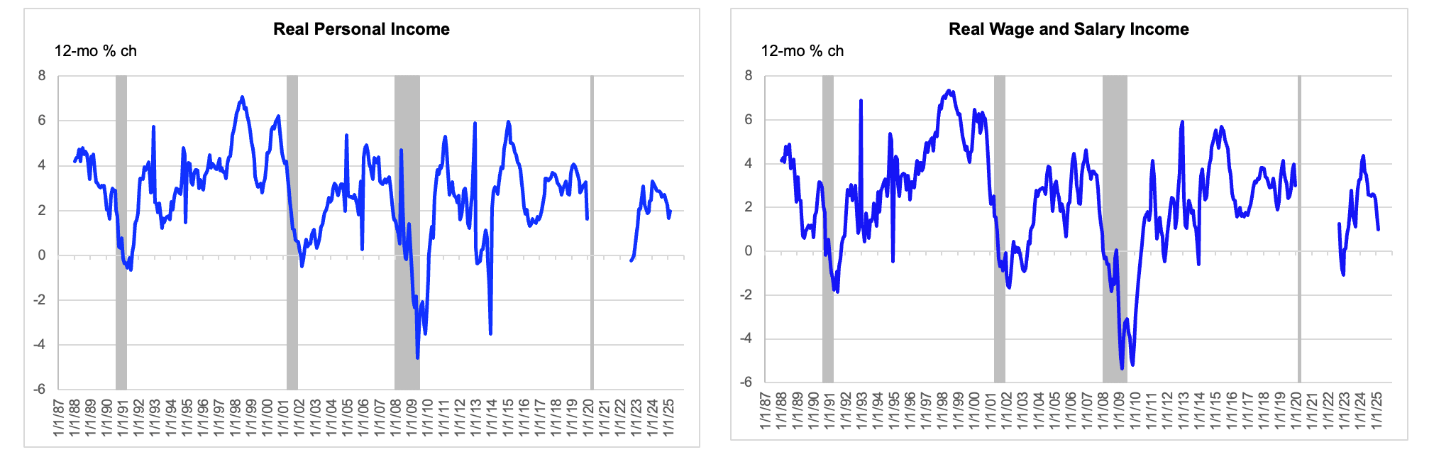
Source: BEA, NBER, FH calculations
Data are actual to February and consensus for March. The October 2024 value is replaced by the average of September and November to smooth away storm and strike distortions involving that period.
As I mentioned in my note yesterday, the state of the labor market and the income flows associated with that are at odds with the notion that the economy is already in recession or right on the brink. Factoring in the consensus for Friday, which has been somewhat supported by the ADP release, private employment growth seems to be tracking at a rate just north of 1%. This is at odds with the view that the economy is shrinking, although more because of the insight it provides into business confidence than because of a link from labor input to goods and services output. (The index of hours worked has been weak.) It is probably also relevant that employment growth has been quickening, rather than decelerating, in recent months, which is contrary to the idea of an economy rolling gently into recession because of a slowly accumulating headwind. The standard here is probability, not certainty. We are probably not on the brink of recession.
I have read that recent developments in income growth can be interpreted as having dialed up the recession risk somewhat. But that would not be my interpretation. As you can see from the chart above, the rate of growth of broad personal income and wage and salary income (the most “core” component) has been slowing in real terms in recent months, consistent with the pattern ahead of recent recessions. But I think that is in this instance a reflection of noise the deflator used to convert the nominal to real. It might be wiser to look at the rate of growth of nominal personal income, and various slices of it, assume that it is the nominal that has the momentum, and then deflate that by our sense of trend inflation to get a sense of the real. When I do this, I find underlying income growth of at least 5% and with a tendency quite recently to quicken, not decelerate. That maps to real income growth easily north of 2%. And the consensus for Friday is that the labor income proxy will be quite strong in March, although largely because the consensus assumes that the workweek deadcat bounces from its recent decline. I hasten to add that the decline itself is incorporated into the data depicted below.
It might be more appropriate to start by eyeballing the levels in nominal terms
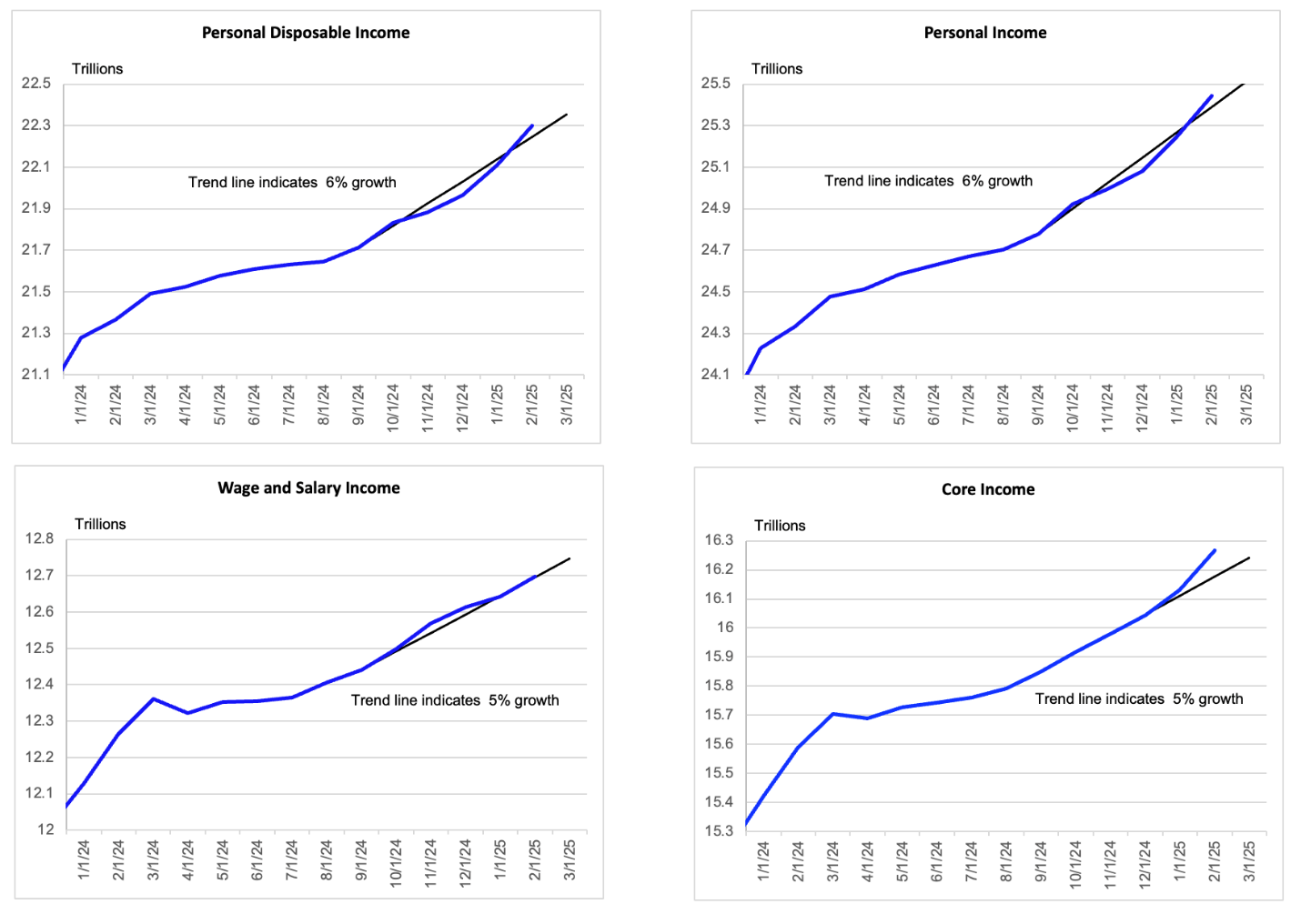
Source: BEA, FH estimate and calculations
Data are actual to February.
So, the tie breaker here remains trade policy. It is not as dispositive as it was a couple months ago, when a heightened recession risk could fairly be described as a policy choice, very easily avoided. But we are probably not in recession now and the next bits of important news on that front are probably going to involve trade policy. Let’s see what the random tariff generator comes up with.

