Feb JOLTS and March ISM Add Little Optimism to Tariff Debate
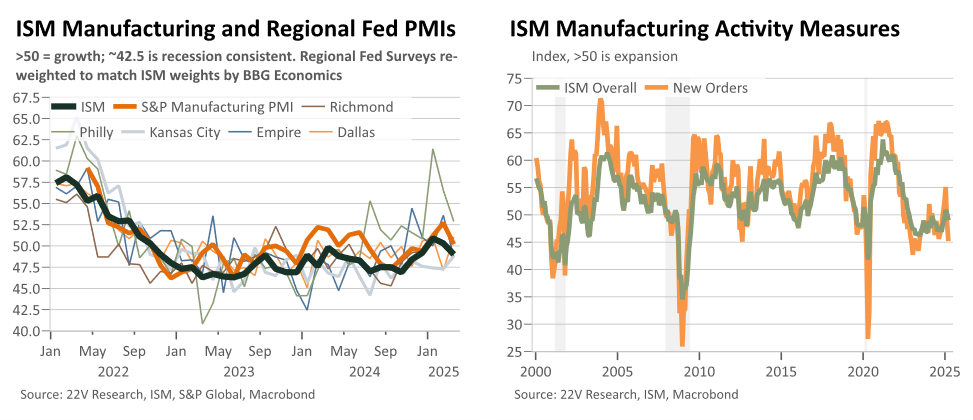
- The March PMI round saw most measures take a turn down and the underlying tone across the PMIs was notably pessimistic, a large swing away from the pro-business optimism of Dec-Jan.
- With tariffs looming, demand seems to have been pulled forward into the front part of the year, but uncertainty is continuing to increase and will ultimately weigh on demand. The outcome of tariffs matters, and recession risks increase somewhat nonlinearly with the size of the tariff shock, but that final resolution is a ways away.
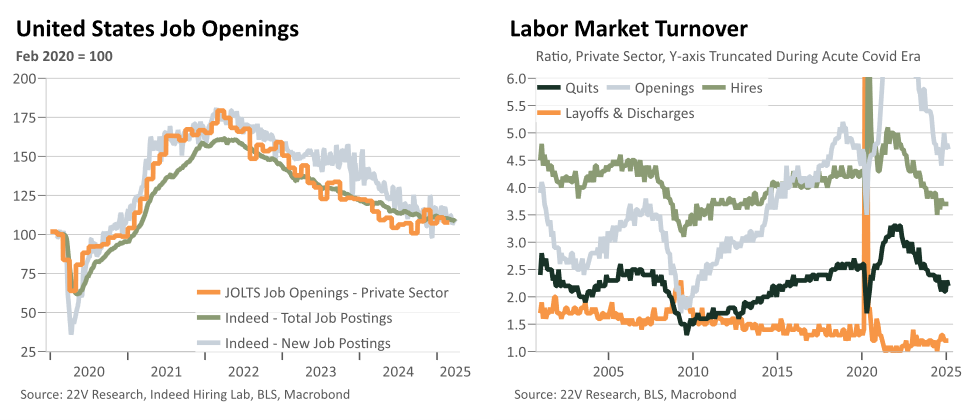
- The Feb JOLTS data remains consistent with the low hiring, low firing equilibrium the economy has been in for years now. For those looking for work it is a much more challenging labor market than most topline measures suggest but your odds of having to look for work are still low.
- Friday’s employment report will be based off surveys taken largely before tariff impacts and fears started to bind more appreciably on markets so it has less relevance on the current debate than it otherwise might. Of course, good data would be a positive but I imagine we see an asymmetric reaction as weakness sets worse initial conditions for the tariffs to impact.
- My medium-term base case is that we will see slack continue to gradually ease through H1 before much slower labor supply growth sees the labor market steady itself with NFP growth of only 75-100k in the back half of the year.
Taken as a whole, the manufacturing PMIs took a notable drop over Feb and March as tariffs came to dominate headlines and actual policy implementation by the Trump administration. Back to the 2023-24 doldrums for now. The components of the ISM manufacturing PMI universally swung in unhelpful directions; perhaps most notably new orders are now back to about the lowest levels they ever get to outside of recessions. The sequencing for the administration, with sour (tariffs and immigration shifts) coming before sweet (deregulation and tax cuts, or at least tax cut extensions), is not what most seemed to expect despite campaign rhetoric.
The deterioration in the soft data seems likely to go on until we reach either the upper-end of recession-like levels where a more notable deterioration in the spot hard data would be necessary to keep sustaining what is, for now, forward-looking pessimism or the tariff news starts to fade away from the top of mind. I do not think that a Wall St-like conception of expected tariff rates is not particularly helpful here in understanding the soft data, as consumers and most managers are “pricing in” tariff expectations, they are just seeing them, at any level, as a disruption to normal business when expectations for the year had been quite positive and a price shock. How much of a drag those shocks are remains to be seen.
If tariffs are ultimately more bluster than bite, the soft data will slowly start to move higher later in the summer and while the hard data will dip some it will not fall off a cliff. The outcomes around expected tariff levels (roughly 20% according to our surveys, in addition to auto and China tariffs, and future sector and country specific ones) seem extremely precarious, not so large a shock to obviously cause a recession but also large enough to really take expected growth quite close to 0%.
In the very near-term, the hard data (at least through the March releases and perhaps beyond) may continue to look surprisingly robust as firms continue to front-run tariff demand. Even if tariffs materially underdeliver, we could see a bit of a mechanical drop in many parts of the goods economy in Q2. This is a bit the opposite of possible mechanical payback mechanisms in housing and retail sales as cold weather and bad flu season seemed to weigh on demand some in Jan and Feb. But if tariffs are sufficiently large the drag and pass-throughs quick, it may fully swamp any possible more mechanical short-term effects.
A few choice quotes from the pessimistic S&P and ISM writeups to illustrate the current issues:
- “Softer trends in output and new orders, plus uncertainty in the outlook, weighed on hiring decisions.” – S&P commentary
- “The strong start to the year for US manufacturers has faltered in March. A combination of improved optimism surrounding the new administration and the need to front-run tariffs had buoyed the goods-producing sector in the first two months of the year, but cracks are now starting to appear. Production fell for the first time in three months in March, and order books are becoming increasingly depleted.” – S&P commentary
- “While business confidence about the outlook remains relatively elevated by standards seen over the past three years, this is based on companies hoping that the near-term disruption caused by tariffs and other policies will be superseded as longer-term benefits from the policies of the new administration accrue. However, March has seen more producers question this belief.” – S&P commentary
- “Demand and production retreated and destaffing continued, as panelists’ companies responded to demand confusion. Prices growth accelerated due to tariffs, causing new order placement backlogs, supplier delivery slowdowns and manufacturing inventory growth.” – ISM commentary
- “Business condition is deteriorating at a fast pace. Tariffs and economic uncertainty are making the current business environment challenging.” – ISM panelist
- “New order levels have increased and are better than expected. We suspect that our customers are trying to build inventory at current prices to get ahead of expected tariff and related cost increases. We expect this surge in demand to be short-lived.” – ISM panelist
- “Bearish market sentiment and tariff applications and costs have dominated discussions over the past month and should continue to dominate markets until a clear path forward is determined. Overall concern is whether or not demand destruction will occur with higher pricing.” – ISM panelist. Unfortunately for this panelist, if there isn’t some demand destruction with higher pricing the Fed’s choice on rates will be much more obviously hawkish than otherwise.
The commentary on the labor market from the PMI surveys matches the underlying tone in the JOLTS data relatively well. ISM noted that, “the Employment Index moved deeper into contraction, as panelists’ companies continued to release workers. Companies continued to cite ‘attriting down’ as the best process, as opposed to layoffs.” This is consistent with the very low hiring rate but the layoff rate as low as ever seen before covid.
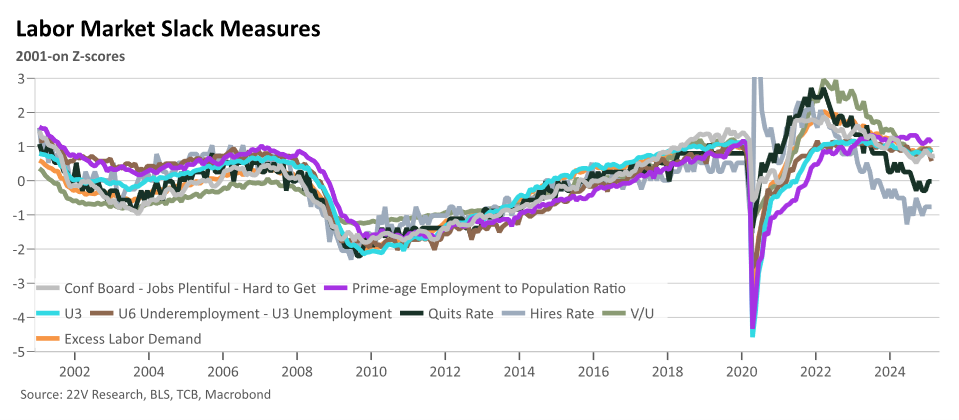
Measures of slack have largely been moving sideways since last fall and pessimistic revisions to the layoff and quits rates suggest a bit less of a retightening had been taking place over the winter. The unemployment and prime age to population rates paint the most optimistic picture of slack at the moment, outside of those dependent on the job openings data whose possible secular trend may distort the picture some. Other flow-based measures generally suggest a labor market much close to that of the mid-2010s than 2019; this also lines up with data from the Atlanta Fed’s Wage Growth Tracker that shows a currently negative premium for job switchers versus job stayers, something usually associated with post-recessionary labor market conditions.
Overall, the labor market is healthy enough in a spot sense for those who are still employed and not looking for work (worth remembering though that the urate, claims, and PAEPOP are all now gradually softening y/y unlike last summer, an unhelpful baseline setup). But for those looking for work conditions have softened notably and this leaves the labor market in somewhat fragile position as its ability to reabsorb any layoff shock seems relatively limited at the moment.
Even in the tentative non-recessionary base case, I expect that labor market slack will keep easing slightly through H1 before the drop in immigration means that the labor market will stabilize, and perhaps even retighten some, with sluggish NFP growth around 75-100k in the back half of the year.