

The sharp rise of single family starts during January meant that this morning’s housing construction report was slightly stronger than expected. However, the more important story here would seem to be the continued lack of volatility or even trend in the housing sector. This fits my view that the cyclical position of the US economy is solid and that the economy is not inclined to dip into recession, although growth has clearly cooled during the current quarter.
Housing will not be a driver of cyclical volatility. It will be inclined to weaken slightly in response to strong activity elsewhere driving mortgage rates higher. And it will be inclined to strengthen slightly in response to weak activity elsewhere allowing mortgage rates to fall. It is, in this regard, a dampener, not amplifier, which is not always the case.
Not much volatility — or trend — recently in the single-family sector

Source: Federal Reserve Bank of St. Louis (FRED), NBER, FH estimate
Data are actual to January.
Note that the rise in single-family starts was not ratified by a spike in permits. Along with the weakness in vendor sentiment reported by the NAHB yesterday for February, this suggests that starts are more likely than not to moderate during the coming months, which will prevent this sector from emerging as a significant source of support for aggregate demand growth. And we might also zoom our focus out a bit to observe just how lacking in volatility the permits data have been. It is somewhat obvious in the right panel of the chart above. And it is more obvious in the left. This sector is simply not the source of mischief it has been on earlier occasions. It got whacked quite hard during 2022 in the wake of the long-telegraphed Fed tightening program. And it subsequently made a partial recovery from that decline. But in recent months, there has been little action.
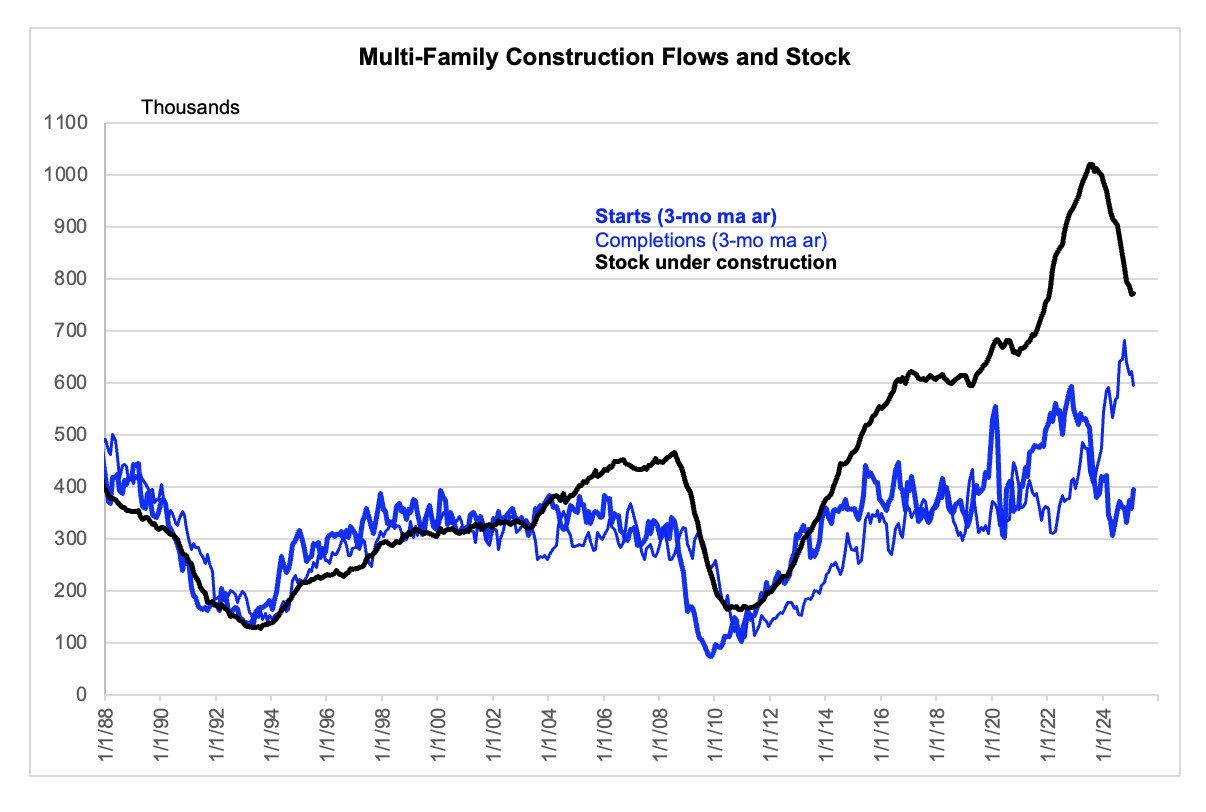
One possibly noteworthy element of this morning’s report is that it may signal that the collapse of multifamily construction is now largely behind us, with the scale of the cumulative decline there turning out to be a bit smaller than I expected. This is not a huge deal, because value added in the multifamily sector is a low share of GDP, meaning it doesn’t matter much, and because it has long been obvious that the speed of decline in multifamily would have to moderate. But in fairness, it is getting hard to deny that the stabilization here has seemingly already set in.
My commentary in the past couple days has been somewhat upbeat because the news flow has been. But the tariff issue continues to overhang the outlook. If Trump goes tariff heavy, then growth will have to slow to reverse the inflation impetus. The absence of major real side imbalances in the economy, including in the housing sector, reduces the risk of that slowdown turning into a recession. But aggressive tariffs would meaningfully raise the recession risk.
This apparent stabilization seems to have shown up a bit ahead of schedule
Source: Federal Reserve Bank of St. Louis (FRED)
Data are actual to January.

