March FOMC Preview: Watching, Waiting, Commiserating… on Tariffs
- The Fed will incorporate additional further supply shocks (tariffs) into their SEP base case in March. Inflation will move higher, growth soften, but rates will be little changed.
- The dot plot is likely to see only modest further changes with the Fed seeing itself as largely stuck in the near-term between the growth and inflation hits from tariffs, and a labor market which is still gradually easing (although the net-net since Dec likely leaves the urate forecast unchanged). The 2025 median likely stays at 2 but will see drift higher which leaves more dots at 1 than in Sept (and the dovish tail fades a bit).
- Powell’s press conference will echo the themes from his and other’s recent appearance, emphasizing the underlying health of the US economy, still too high inflation, and substantial uncertainty, which makes any policy shifts challenging in the near-term.
- Inflation’s unhelpful start to the year combined with tariff risks and realities raises the chance the Fed is not able to cut through the summer and the next easing move happens in the fall (or not at all).
- The distribution of likely outcomes for the Fed is centered around 0-2x cuts for the year, with an uncomfortably large downside tail (6-12 more total cuts through 2026), and a much smaller possibility of stagflationary hikes.
Where the Fed Stands Amid the Noise
The initial conditions for starting the trade war(s) are far less favorable than they were in 2018-19. Unlike in 2018, inflation and aggressive price and wage bargaining power are both well withing recent memory. This substantially raises concerns about the possible initial and medium-term inflationary impacts of any size tariff shock. Unhelpfully, a series of shocks is much less helpful than a truly one-off tariff-led price-level reset even if the direct impacts between the two are the exact same, the risks of second round impacts on inflation and a larger uncertainty drag on growth seem hard to ignore.
Perversely, the larger and longer the tariff shock the more the Fed will be concerned about second round inflationary impacts despite the larger and potentially more nonlinear hit to growth. Given that the tariff shock is currently so unknown it makes sense for the Fed to naturally become more inertial in the short-term; this ‘short-term’ may end up feeling quite long to markets as we are waiting for the data to tell us if inflation will continue to be well enough behaved in y/y terms that the Fed can feel comfortable in the ex-tariffs pace of disinflation and/or if the growth and labor markets risks in the economy are enough to outweigh that upside.
The baseline presumption remains towards so easing to a ‘more neutral’ stance of policy, but tariffs and potential net stimulative tax policy push in the other direction.
Pushing out further easing also opens up a downside possibility that without preemptive, or at least quickly responsive, Fed cuts mean we have a larger gap risk down in markets, and perhaps the economy, if the data in the spring continues to soften. Whether or not Fed policy would be able to catch and prevent further softening depends on the size, sequencing and types of shocks. Monetary policy may be quite effective for housing, if the labor market doesn’t deteriorate too much, but it may not be fully impactful enough for larger shocks (the Fed eases into both recessions and mid-cycle adjustments, with initial conditions and the size and nature of the shocks a key differentiator between the two).
At the press conference expect Powell to note the need to see further sustained (y/y measures going down) progress on core PCE inflation but also a willingness to respond if the labor market stumbles. This will lead to a lot of discussions of gradual patient policy. I don’t expect much explicit analysis in the press conference on tariffs, DOGE, and fiscal policy impacts due to both the inherent uncertainty there and the unstated desire of the Fed not to step on the toes of the administration. The uneven moves up in inflation expectations measures, which the Fed has always seemed willing to use as they fit the moment and realized risks in the hard data, will also probably not merit much comment. If Powell does informatively comment on these issues it will be impactful, and probably not in a helpful way.
It seems plausible that the Fed will at least pause aggregate QT through the debt ceiling later this spring. The odds of an eventual restart in this case, if the economy doesn’t roll over in the meantime, seem high. Regardless the Fed is apt to keep MBS rolling off its balance sheet. It is also important to remember that QE was a tool for the ZLB and certain liquidity shocks and so it may not be used at all, beyond keeping reserves growing appropriately for adequate liquidity, in the next recession.
Summary of Economic Projections and the Dot Plot in Wait and See Mode
With the Fed largely in patiently waiting mode, the changes to the SEP and dot plot will be fairly modest. The data flow necessitates some modest reviews to the 2025 forecasts just on its own, but the key swing factors remains tariffs, fiscal policy, and the responses to those shocks. As during the first Trump administration we already saw some modest shifts in the forecast due assumed placeholder policies but these likely understate the changes and risks somewhat, if we are to realize some of the currently stated policy aims.
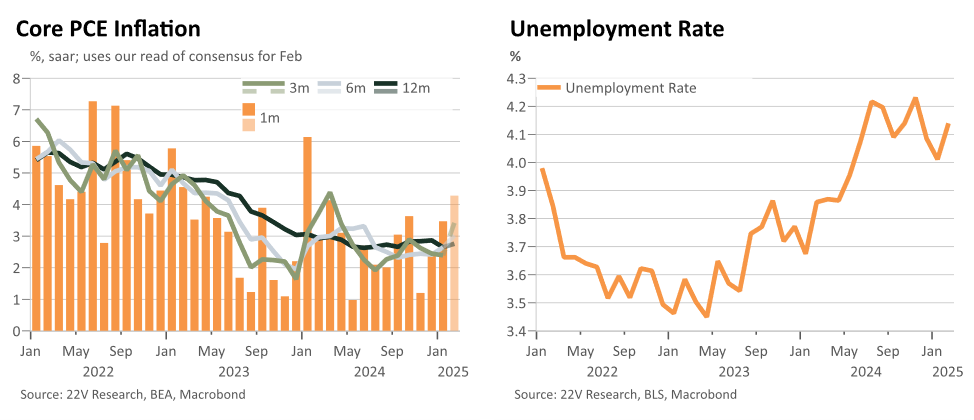
- The unemployment rate forecast will likely be little changed at a flat 4.3% across the forecast horizon. Labor supply growth is falling as is catchup hiring and labor demand both seem to be moving largely sideways. Since the Dec meeting the labor market data had been showing a gradual stabilization and perhaps retightening of the labor market (Jan JOLTS particularly leaned in this direction) but the Feb employment report and soft data since then have suggested that slack is either bouncing around in the low 4s in unemployment rate turns or may be taking a small gradual turn up again. It has been notable to me just how confident most Fed officials now sound about the labor market.
- Given the current data this likely implies an expected mild unemployment rate overshoot in 25H1 before a slow stabilization. The slowing of labor supply growth means that this comes with still soft NFP growth but its good enough to beat the much lower unemployment breakeven pace.
- The GDP growth forecast for 2025 will be mechanically softened reflecting the weaker tracking for Q1. This would probably take the 2025 forecast down to ~1.9% (this assumes something like 1.5% for Q1). The Dec forecast showed an inflationary impact from tariffs but given usual Fed SEP forecasting practices, it wasn’t clear that there was an appreciable growth hit. Given how the Fed thinks about uncertainty shocks they are likely to impose a bit more drag in the rest of the year as well, taking the growth forecast down to 1.8%.
- The core PCE forecast for 2025 is likely to revised up by another tenth to 2.6% given the greater scope and intensity of tariffs taken so far. The risk here is clearly to the upside.
- The 2026 CPCE forecast may move up a tenth as well given additional supply shocks. If 206 moves up more than that and/or 2027’s core PCE forecast is raised, it likely comes with a median that shows only 1x cut in 2025.
- The other outer year forecasts will be only minimally changed. The likeliest shifts here seem to be in the unemployment rate forecasts, which could move up a tenth, reflecting lagged slower growth.
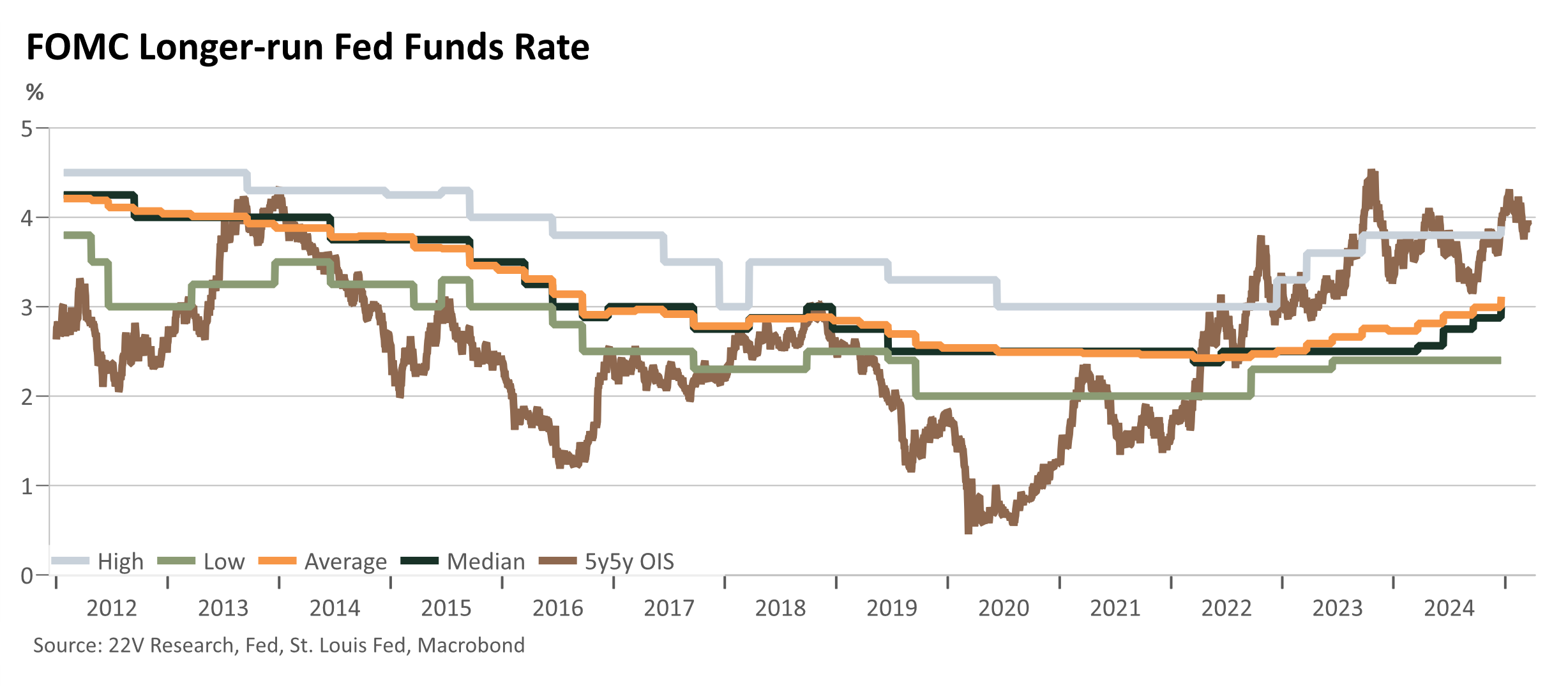
- Over the course of the year the longer-run dot will continue drifting gradually higher towards an eventual final range of 3-4%, rather than the 2-3% it was pre-covid. There is little specific info to suggest another move here, but the trend is in place. For now at least, longer-dated forwards are anchoring to the high end of the dot’s distribution rather than the bottom.