February Employment Report Soft-ish on Net, With More to Come
- On net the report reads slightly dovish compared to my expectations going into it, despite payrolls coming in above the notably more pessimistic than economists’ consensus whisper number.
- The household survey is notably softer than expectations, although the weakness there seems mixed and somewhat concentrated in more marginal parts of the labor market.
- Given so many shocks, it now seems that the baseline should be for at least some modest further easing in labor market slack (urate), although the risk skew is not helpful.
- Still, the report tells us relatively little about the real questions of the day regarding DOGE, fiscal policy, and tariffs. We know that next month will see a notable hit from the direct DOGE cuts, with more plausible over time. Tariffs loom as modest baseline drag if they are targeted but have a much larger cyclical left tail if the continue grow in scope, heavily impacting several industries even if there are societal-wide fiscal offsets in place. The uncertainty drags from all the above may only show up in the soft data as we wait and see, or it simply may not have had time to hit the hard data yet.
- For the Fed, there remains a baseline presumption towards a modest gradual further easing in policy as they assess the direct and secondary inflationary impacts of tariffs versus continued easing of the labor market and attendant risks there.
NFP came in just below economists’ consensus although notably above our read of the whisper number (151k, with minimal net revisions).
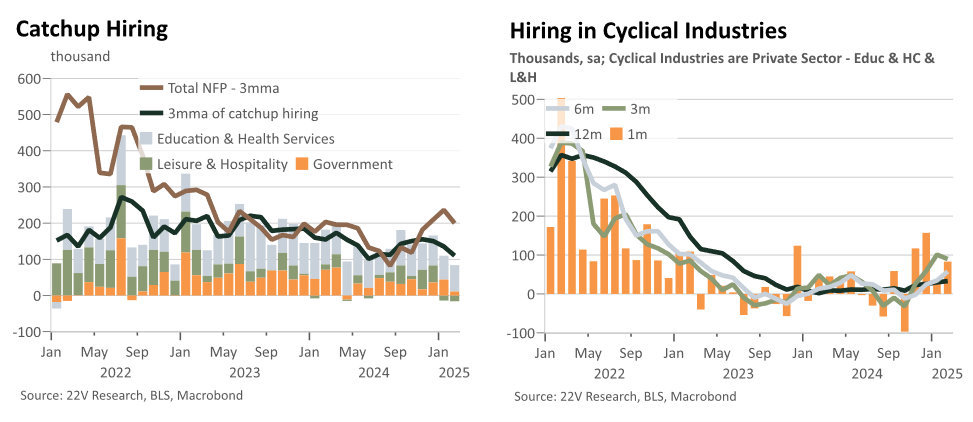
While catchup hiring continued to gradually slow, cyclical hiring in February looked reasonably solid. Government hiring will obviously be a drag in at least the short-term and for the first time since reopening really began leisure and hospitality saw negative payroll growth over the past two months. Education and health care continues to serve the key source of growth accounting for 73k payroll gains, right in line with recent trends. More cyclical hiring accounted for just under over half of total job gains in the month and notched a 4th straight month of positive gains (a low bar admittedly but still relative progress). This seems the most optimistic data point in the release.
Average hourly earnings growth was a bit softer than expectations, nearer-term it looks to be growing in the mid-to-upper 3s, and the workweek saw no appreciable bounce after a dip last month. As a result, aggregate weekly take home payrolls growth is gradually slowing.
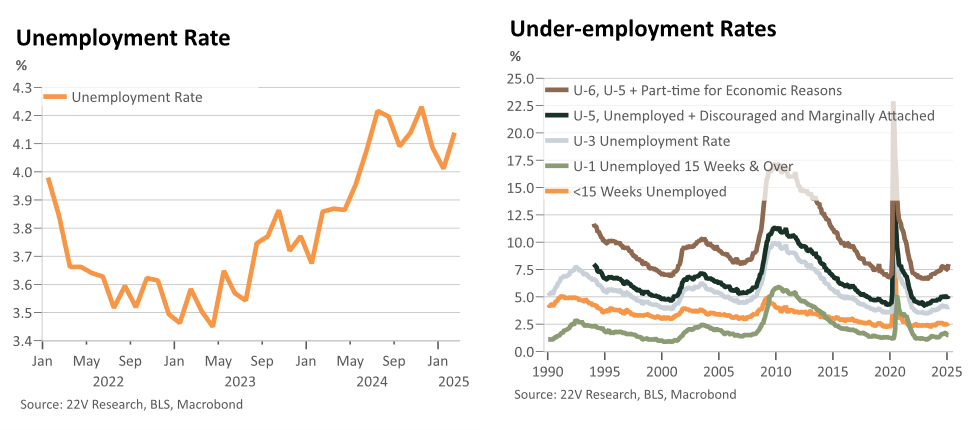
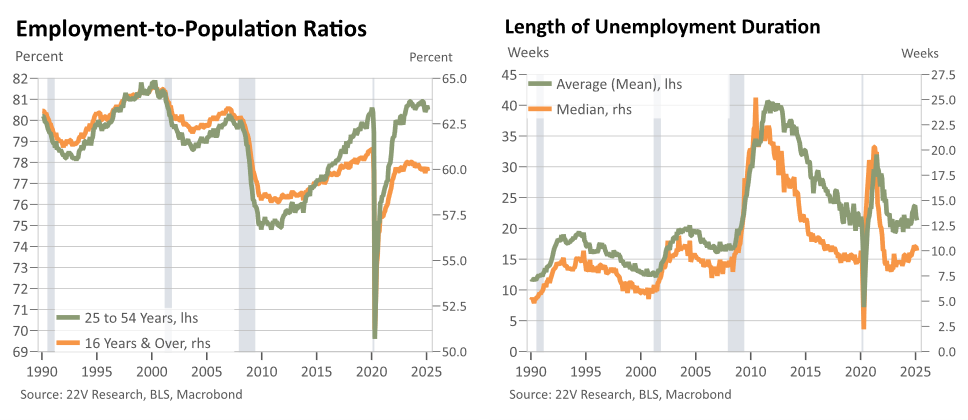
The household survey was notably weaker than employer survey, although it had some mild internal offsets. The unemployment rate bounced from 4.01% to 4.14% (one imagines a much worse initial reaction if that rounded up); this came despite the dip in the labor force participation rate. The U6 underemployment rate moved up more notably as well, hitting a new cycle high. The prime-age employment to population rate (my single favorite indicator of slack) took another mild dip lower, after a Q4 bounce. In contrast to last summer when the Sahm Rule was triggered, PAEPOP is now off its cycle highs as well. The LFPR’s dip came entirely due to non-prime age workers. One can interpret this in a more optimistic way by correctly noting that those components of the survey tend to be more volatile, but the margins of the labor force are also where cyclicality to be most extreme (the non-prime age unemployment rate was within a hundredth of its cycle high from August this month).
There are some more optimistic signs in the household survey but they’re a bit more in the weeds, raising the risks of noise or simply a lack of near-term signal. Reemployment odds for unemployed workers have bounced some in recent months and, quite relatedly, the average and median durations of unemployment have fallen in recent months.
The baseline should be that the unemployment rate, and labor market slack broadly defined, will continue to gradually ease in the near-term. Coming into the year, slowing labor supply growth seemed apt to meet a slower, if more cyclically constructive, trend NFP pace to largely stabilize the unemployment rate. This was an admittedly tenuous setup as slowing demand was met by even slower supply growth. Low hiring, low firing is a bit of a tenuous equilibrium. The DOGE-related layoffs and grant and spending freezes are the primary driver of this shift in the outlook, although the much more rapid and larger scale tariff discussion than anticipated seems likely to weigh on at least some components of cyclical hiring as well. Much the risk skew here boils down to non-Fed policy choices. Whether this amounts to a few tenths of further easing on the unemployment rate or notably more remains to be determined.