

The usual big 4

Source: Bloomberg
Data are actual to February.
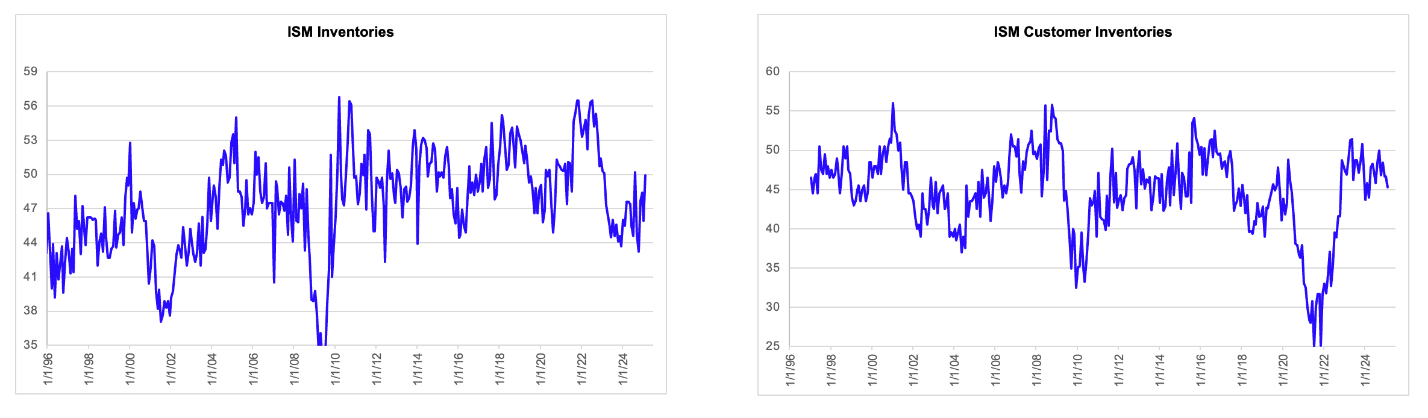
Today’s manufacturing ISM was weak, although not shockingly so. And we can torture it into supporting one or some combination of two stories. The first story is the one I favor. There appears to be some inventory building in anticipation of the imposition of tariffs. If this inventory building were achieved entirely through imports, then it would have systematically no effect on production here in the US and it would be a wash in terms of its effect on GDP, which measures production, although by looking at spending and applying the relevant accounting identity. Indeed, it might not even have an effect overseas. It might just be that the location of the inventories is moved, just like they used to move gold around the central bank vaults during the Gold Exchange Standard era. 😉 Note, for example, in the chart below that the flow of inventory investment seems to have quickened recently, as firms report that their customers believe that they have insufficient inventories. If that were all that was going on, then we would know with high confidence that the Atlanta Fed’s GDPnow estimate is definitely wrong.
Possibly more interesting this month
Source: Bloomberg
Data are actual to February.
Indeed, I am very confident that it is wrong, because it is reacting to seeing the imports before it sees the inventories. Some want to claim the issue here is non-monetary gold, and that may be part of the measurement issue here.* My own view is that there is a more fundamental estimation issue, as described. But it does not matter. In both cases, the Atlanta Fed’s GDP update is simply mistaken. What I am less sure of is precisely how mistaken. Certainly, they should have taken down their real PCE estimate for Q1 on Friday. And they did so by the same amount I did. But the trade side is mostly a mistake. And they even warn us that their approach will systematically generate such mistakes when the environment is unusual, as it certainly is now. See below for their caveat emptor. It is fun to recognize that the non-bolded, non-red part of the warning is most relevant this week.
The second interpretation is that US production growth is actually weakening, because there is more going on that just a surge of imports going into inventories, which – to repeat – would have no direct effect on the business cycle. Within this interpretation, there are two possibilities. The first is that a given pace of domestic demand growth is now being associated with more trade drag because of the high dollar. I think there is something to that. I would guess that underlying aggregate demand growth should run about 25 to 50 bps lower than core domestic demand growth, as I have been arguing. It is just that the Atlanta Fed GDP bean count dramatically overstates that issue and throws it all into Q1, which – to repeat – is trivially wrong.
Another possibility is that the new orders series, in particular, is picking up a downturn in domestic demand growth, perhaps – guessing here – because the uncertain policy backdrop is cutting into capital spending, as businesses effectively purchase options to delay. The premium on such options is the foregone business / profit opportunity imposed by delay, but it is more worth paying if vol is high, which it is now. I would keep an open mind that there is something to this as well, so I think there is some information in the weak ISM.
Separate from that, it may encourage the Atlanta Fed to compound the error they are making in their Q1 GDP bean count. I am not sure. We will have to wait to see it, but if they take down or even fail to take up their inventory investment estimate for Q1, then I think that could be dismissed as a mistake. But even if I am right, my take here will not be the consensus one, just as an FYI, in case you want to play or not get hurt by the greater fool game.
Thank God we have some businessmen in there
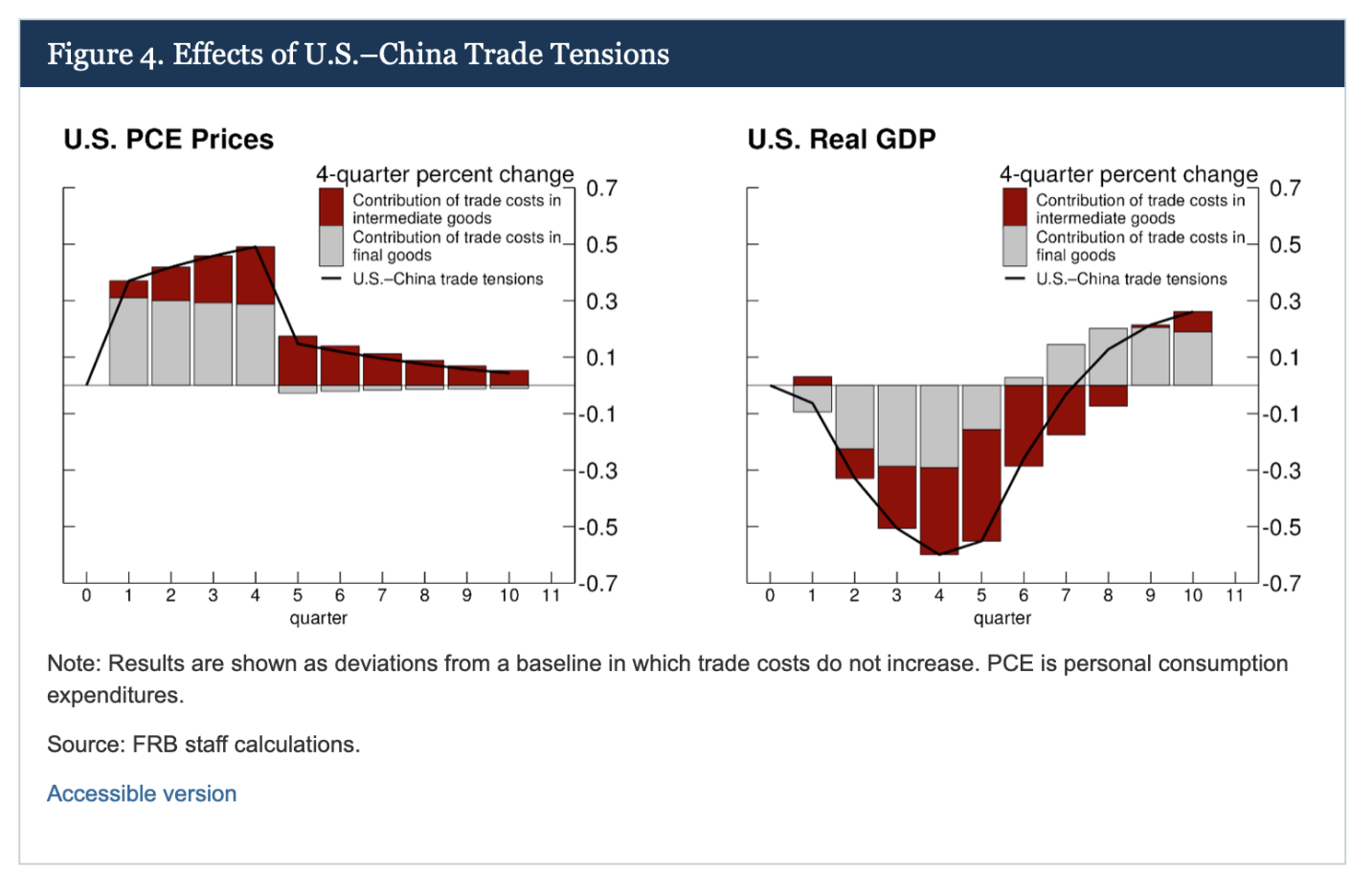
Speaking of the tariff issue, on Friday the Federal Reserve published a FEDSNotes piece estimating the effect, among other things, of the imposition of tariffs against China. As Nick Timiraos mentioned while covering it, the main figure from the report is shown below.
The imposition of a 20% tariff on all imports from China would cause the 4-quarter PCE inflation rate to rise by about 50 basis points above baseline within four quarters. As they note in the report, the 4-quarter change stays elevated for four quarters, mainly because of the jump in the immediate quarter, which is not reversed. Fair point! But as they also emphasize, the effect is persistent in the sense that even that four quarter effect tends to bleed wider for four quarters.
The hit to GDP growth similarly peaks four quarters out at 60 basis points. And this raises a question that I am not quite sure I can provide an answer to. Is this the direct effect of trade restriction or does it incorporates also the effect of the Fed leaning into the inflation. I assume without knowing that it is the first of those two. But it does not really matter. The point is that the inflation pulse is not meant to be entirely self-correcting, even over several quarters. Weaker growth is endogenous to the policy shock and is part of why the inflation eventually impulse dissipates. We could avoid this inference if the GDP weakness was driven from the supply side, but the effect is too strong for it to be mostly that. This is demand.
But here is the kicker that I find most interesting. For some reason, which I will avoid speculating on, the Fed staffers decided to document the effect only of a 20% tariff on China. China accounts for ¼ of the imports that come from the sum of Canada, Mexico, Europe and China. So, as a first pass, we might guess that 20% broadly applied might have effects that are four times as large? I do not know because I do not have expertise in this area. Much depends on the relative substitutability away from the countries whose goods are being tariffed. If it is harder to substitute away from China than, say, Canada, then my factor of four estimate might be too high. But wait. This could easily go the other way too. If Trump imposes tariffs on basically everybody, then substituting to the third country provides less possible mitigation. And in that case, multiplying by four would not be enough. This does not look so good. Wall Street has long dreamt of more business people in government. MISSION ACCOMPLISHED. We now have Hoover, Bush II and Trump. Solid record. Enjoy.
A good social scientist, and I would include lawyers in this group, will respect competitive markets and the notion of mutually beneficial exchange guided by price signals. And they will insist that the profit motive is a socially progressive force. So, there is irony in the fact that the actual people who pursue the profit motive have a weak understanding of the welfare implications of their own instincts. Businesspeople are not wired to understand mutually beneficial exchange in the abstract. They think in terms of crushing the competition, as we are witnessing right now. What a disaster. But I suppose we can enjoy the dark irony.
Source: Federal Reserve as linked above
H/t to Nick Timiraos for bringing this to our attention
* Not to cast aspersions, because different people bring different value to the table. But I have noticed over the years that business economists are often very hesitant to speculate and are more interested in wowing readers with their mastery of technical detail. For example, the BEA treats non-monetary gold differently from how the Census does, as has been widely pointed out. The people writing about this have the advantage of being very likely to be right in their claims. But they may also be missing a larger issue.

