Back Economics

A slightly different spin on Productivity and Cost

Published on February 6, 2025

Download the PDF Report

By

Gerard MacDonell

Perhaps the main point to make about today’s Productivity and Cost report for the fourth quarter is, wait a month.  A couple weeks ago, an analyst at the BLS confirmed for me that the current-vintage productivity data do not yet incorporate the downward revisions to employment — and thus labor input — that are fated to be released in the official employment data tomorrow.  


A month from now, the productivity figures will be revised noticeably higher (1/2 — 3/4 ppts) for the four quarters through the first quarter of 2024. That will not affect our sense of the very recent momentum, but it is relevant anyway, because when it comes to productivity our sense of the underlying trend is conditioned by the longer run of data, which will certainly look stronger. 


As for this morning’s data, they were benign in the sense that productivity growth was reported at the consensus value, with a tiny upward revision to Q3, and unit labor costs were both lower than expected, although firm outright, and revised downward for Q3. In principle, the downward revisions to Q3 might have been expected. I don’t know, but they were not large enough to matter anyway, given the typical volatility in these data.


The outright advance of productivity during the fourth quarter is reported to have been mediocre, 1.2% in the recent quarter vs 2.3% in Q3. But these data, such as they are, remain consistent with my sense – based purely on eyeballing – that there has been an inflection higher in the underlying rate of productivity growth post Covid. I am not saying Covid was the cause, although it may have been, by stressing corporate satisficing. I refer there only to the timing. And remember, the productivity numbers are going to get revised up in level terms for the period seven quarters ago to three.

This looks ok, and it will look better on revision
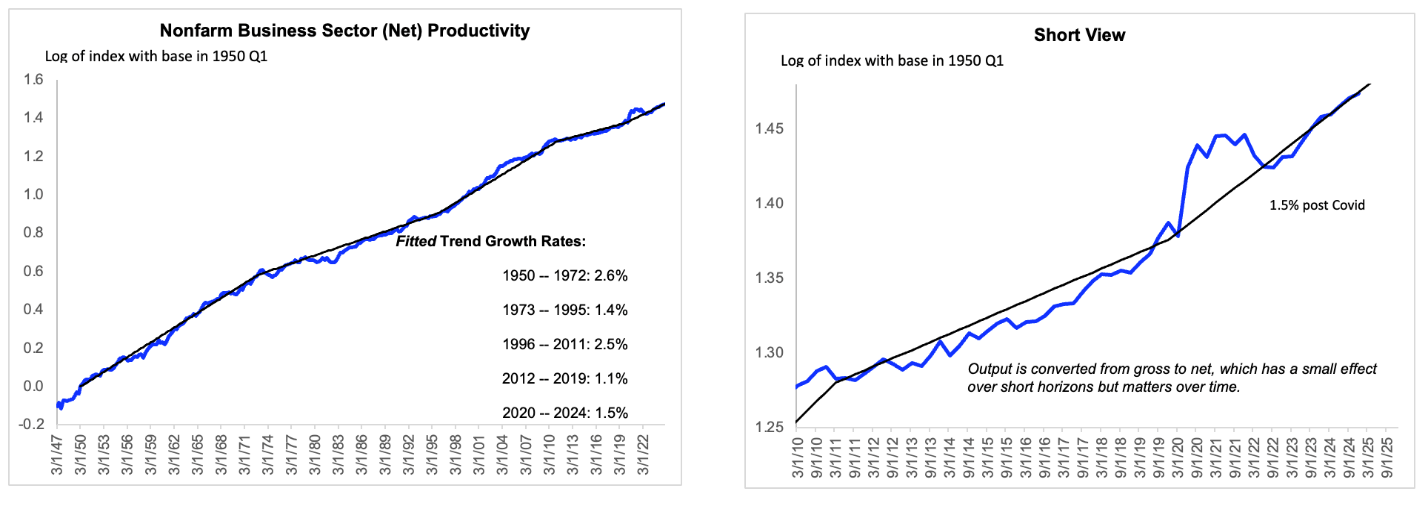

Source: Federal Reserve Bank of St. Louis (FRED), BEA, FH calculations and estimates (of recent depreciation)
Data are actual to Q4 but are subject to upward revision, as discussed in the text. 

As mentioned, short run trends in the data from the Productivity and Cost report can’t tell us much about what is going on right now, because the two main inputs there, productivity and average hourly compensation (AHC), are far too noisy. For example, if you want to discern the underlying trend of unit labor cost (ULC) growth, you should skip right past the ULC data. They show a trend of about 2%, which seems representative, but only coincidentally. No, we try to get a sense of the underlying productivity trend growth rate, particularly as perceived by wage setters, and then compare that with the Employment Cost Index (ECI) duly adjusted for its various (hopefully roughly stable) biases, suggests for the underlying trend of compensation.  That gets you to about 2%, but nor for reasons I need to update much today.


Having said that, there is one figure from the productivity and cost report that we can take roughly at face value, at least absent expected data revisions.  And that is the labor share of value added (best measured as net, for reasons I need not get into here), which can be inferred from the ratio of (net) unit labor costs to the value-added deflator for the nonfarm business sector. Note that if you multiply both ULC and prices by real output, you get an index of the ratio of total labor compensation to value added, i.e., the labor share.


The labor share was revised downward slightly for Q3, and it rose slightly less than expected during Q4. But that is not the point. The point is that the level of the labor share is very low, which supports the view that there may be room for labor compensation to pick up a bit here as part of a restoration of normal profit margins, rather than as part of an inflation process. I would not lean very hard on the view that analysts know what the “normal” level of the labor share is. And graveyards are full of strategists previously looking for a mean reversion of profit margins. DO NOT DO THAT. But for those concerned with this issue, a labor share pinned to the lows is better than one that looks elevated.

Incidentally, I should mention that the coming upward revision to productivity growth does not necessarily mean that ULCs will be revised lower or that the implied labor share will be so. The reason is that the source data implying a downward revision in labor input also found more income! But even a slight upward revision in the reported labor share would not change the fundamental point raised above. 

Internalizing that this is very low in level terms will not steer you wrong


Source: Federal Reserve Bank of St. Louis (FRED), BEA, FH calculations and estimates (of recent depreciation)
Data are actual to Q4.


DISCLOSURES AND DISCLAIMERS

Analyst Certification

The analyst, 22V Research Group, primarily responsible for the preparation of this research report attests to the following: (1) that the views and opinions rendered in this research report reflect his or her personal views about the subject companies or issuers; and (2) that no part of the research analyst’s compensation was, is, or will be directly related to the specific recommendations or views in this research report.

Analyst Certifications and Independence of Research.

Each of the 22V Research analysts whose names appear on the front page of this report hereby certify that all the views expressed in this Report accurately reflect our personal views about any and all of the subject securities or issuers and that no part of our compensation was, is, or will be, directly or indirectly, related to the specific recommendations or views of in this Report.

22V Research (the “Company”) is an independent research provider. The Company is not a member of the FINRA or the SIPC and is not a registered broker dealer or investment adviser. 22V Research has no other regulated or unregulated business activities which conflict with its provision of independent research.

22V Research, LLC is a professional services and independent publication organization. 22V Research, LLC is not a securities broker-dealer, not a member of the Financial Industry Regulatory Authority (FINRA), not a registered investment advisor (RIA) and not a member of SIPC.

Securities transactions, when offered, are offered by 22V Securities, LLC through LPS Capital, LLC. Certain employees of 22V Securities, LLC are dually registered as securities representatives of LPS Capital, LLC or Analyst Hub Securities, LLC. 22V Securities, LPS Capital and Analyst Hub Securities are members FINRA, SIPC.

https://brokercheck.finra.org/

Current Ratings Definition.

SECTOR OUTPERFORM: An “outperform” rating anticipates the company will outperform the S&P Regional Banking Index (peer group).

SECTOR PERFORM: A “market perform” rating anticipates the company will perform in line with the S&P Regional Banking Index (peer group).

SECTOR UNDERPERFORM: An “underperform” rating anticipates the company will underperform the S&P Regional Banking Index (peer group).

Limitation Of Research And Information.

This Report has been prepared for distribution to only qualified institutional or professional clients of 22V Research Group. The contents of this Report represent the views, opinions, and analyses of its authors. The information contained herein does not constitute financial, legal, tax or any other advice. All third-party data presented herein were obtained from publicly available sources which are believed to be reliable; however, the Company makes no warranty, express or implied, concerning the accuracy or completeness of such information. In no event shall the Company be responsible or liable for the correctness of, or update to, any such material or for any damage or lost opportunities resulting from use of this data. Nothing contained in this Report or any distribution by the Company should be construed as any offer to sell, or any solicitation of an offer to buy, any security or investment. Any research or other material received should not be construed as individualized investment advice. Investment decisions should be made as part of an overall portfolio strategy and you should consult with a professional financial advisor, legal and tax advisor prior to making any investment decision. 22V Research Group shall not be liable for any direct or indirect, incidental or consequential loss or damage (including loss of profits, revenue or goodwill) arising from any investment decisions based on information or research obtained from 22V Research Group.

Reproduction And Distribution Strictly Prohibited.

No user of this Report may reproduce, modify, copy, distribute, sell, resell, transmit, transfer, license, assign or publish the Report itself or any information contained therein. Notwithstanding the foregoing, clients with access to working models are permitted to alter or modify the information contained therein, provided that it is solely for such client’s own use. This Report is not intended to be available or distributed for any purpose that would be deemed unlawful or otherwise prohibited by any local, state, national or international laws or regulations or would otherwise subject the Company to registration or regulation of any kind within such jurisdiction.

Copyrights, Trademarks, Intellectual Property.

22V Research Group, and any logos or marks included in this Report are proprietary materials. The use of such terms and logos and marks without the express written consent of 22V Research Group is strictly prohibited. The copyright in the pages or in the screens of the Report, and in the information and material therein, is proprietary material owned by 22V Research Group unless otherwise indicated. The unauthorized use of any material on this Report may violate numerous statutes, regulations and laws, including, but not limited to, copyright, trademark, trade secret or patent laws.