

During the past couple weeks and especially over the past few days, the US political environment has deteriorated dramatically, to the point where we are now arguably in a constitutional crisis. Such a crisis does not need to involve fireworks, although it could.
In this environment, it is difficult to focus on conventional business cycle analysis, although I will conclude this note with a brief aside on how anticipation of tariffs seems to have dragged additional demand for consumer durables into the fourth quarter. Unfortunately, we must confront politics, even though that can be grating. I will do so in as few words as possible in order not to lose too many readers.
Let’s start with the relatively mundane issue of tariffs. Like many, I had worked on the assumption that Trump would avoid imposing aggressive tariffs, for two reasons. First, the assumption seemed correct, on the grounds that tariffs are obviously self-harming, not just to the country but to Trump’s own self-interest as well. And second, making that assumption just seemed like the easiest way to organize my thoughts. Set out how the economy would likely proceed without tariffs. And then use that outlook as the base case against which to assess policy shocks, which obviously could not be excluded. To the extent the market seems to have taken the same approach, this was not harmful, just mistaken.
But the tariffs are now slated to take effect in a couple days, so what can we say? Obviously, the tariffs are inflationary, but I defer to those skilled in econometrics to assess by how much. That piece I circulated from the Peterson Institute last week estimates that the tariffs on imports from Canada, Mexico and China will add just over 50 bps to the inflation rate during 2025, although the effect is meant to fade quickly thereafter, even without a response from the Fed. I am not going to second guess that estimate.
On the real growth effects, though, there might be a stronger case for challenging the informed consensus. The reason is that the North American auto sector is placed at risk of an immediate contraction, in a way that the econometric modeling does not likely pick up, perhaps because it cues exclusively off price signals and ignores implementation issues, such as those involving the multiple taxation of intermediate inputs crossing borders.
When the tariffs are being implemented, it is probably best to set the econometrics aside and just read news stories about how businesses are reacting in real time. And this does seem to be setting up as a contractionary shock. So, what is inflationary is not necessarily Fed hawkish. I guess the other point on tariffs would be that it would probably take a market reaction to get Trump to reassess them.
There is a broader issue involving the market here as well. The symbolism of Trump assuming the presidency is past, and we must now confront the fact that Trump is actually doing things. Gun to head, that transition is probably not bullish, because what he is doing is not constructive. For example, deregulation sounds great. But imposing massively burdensome regulation on the auto sector, among other sectors, with no warning is less good.
This transition relates to a point I made shortly after Trump became elected. From a markets perspective, Trump could be viewed as a negatively-convex, positive-carry trade. The positive carry comes from the promise of tax cuts, deregulation, and increasing corporate concentration, which would favor wider profit margins. And the negative convexity comes from staffing the government with amateurs and in some cases outright criminals. So long as there was no major disturbance, we just collected the carry. But now there are disturbances, so the negative convexity looks more dangerous. Ok, that’s it for politics, for those of you still with me. Sorry it was so qualitative and conclusory.
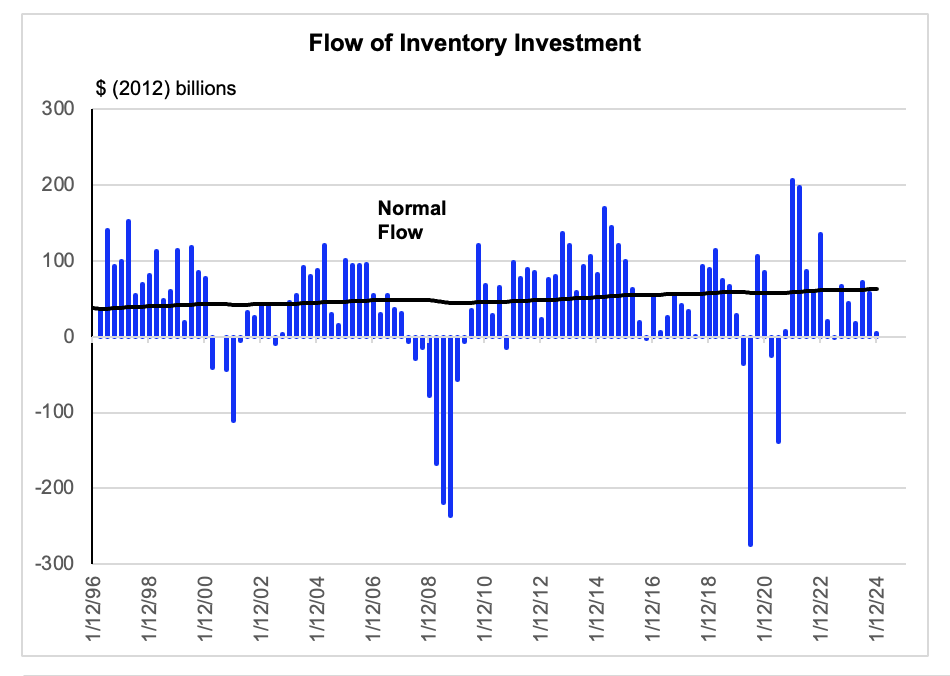
The broader inventory investment, depicted below, was almost entirely in consumer durables
Source: BEA, FH calculations
Data are actual to Q4
The “normal” flow of inventory investment is defined as what would keep the economy-wide I-S ratio falling gently in an environment of what we might call potential growth in final demand for goods and structures.
Some economics
I will conclude here by returning to the comfort of my own knitting. The main surprise in the Q4 GDP release last week was the large beat in real PCE growth, even relative to an upbeat consensus estimate. The main driver of that strength was a 12.1% (ar) gain in durable goods purchases. Services and nondurables were also strong, each growing by more than 3%. But the durables component explains the outsized strength and beat.
People reasonably suspect that the strength in durables involved some pull forward of demand in anticipation of tariffs, in part because October was weak and the surge was concentrated entirely in the last two months of the quarter. So, an obvious question is whether this might create a pothole in durables demand, and thus broader consumer spending, going forward. The short answer is that this is not likely to be an issue for the overall economy, although real PCE may be soft in the current quarter.
The simplest way to describe the fourth quarter dynamic is as a transfer of inventories from the business sector to the household sector. And the numbers fit this template quite well. It is not science, but we can define “excess” demand for durables during the fourth quarter as all the growth beyond, say, 3%. That works out to $44 billion “real” dollars, which is very close to the $40 billion deceleration in the flow of business investment in inventories, which swung from +$20 billion in the third quarter to -$20 billion in the fourth quarter.
From the perspective of GDP and income, the overhang in real PCE looks to be just about perfectly offset by an “underhang” in the flow of inventory investment. We can see this in the broader inventory flow data as well, as indicated in the chart above. But all the action in the fourth quarter was in durables.
So, even if we think of the durables strength during the fourth quarter as being largely a tariff-related distortion, there is no real pothole set up for the overall economy. Real PCE is inclined to slow about as much as inventory investment is inclined to recover, although the timing of these two things need not be coincident.
There is, however, an issue with how to treat growth momentum from the fourth quarter. It has become standard in recent years to define “core” aggregate demand within the GDP release as final sales to private domestic purchasers (FSPDP). During the fourth quarter, FSPDP was up 3.2% (ar), markedly exceeding the 2.3% gain in broader GDP. But we should probably correct that figure for the estimated durables demand drag forward, as in the chart below. If we chop $44 billion off Q4 FSPDP, we get a 2.3% growth rate there. That is in line with the headline GDP growth rate, largely because that growth rate is systematically invariant to a transfer of inventories from business to households described above.
So, the net net here looks pretty simple to me. There is no general pothole set up here. But underlying demand growth in the fourth quarter was moderately firm, not boomy.
A corrected estimate of “core” aggregate demand

Source: BEA, NBER, FH calculations and correction
Data are actual to Q4. Final sales to private domestic purchasers are adjusted down by $44 billion as described in the text.
[1] Of course, we will have to mark this thought to the market open, not the Friday close.

