

The income and consumption report for December will be released tomorrow at 8:30. It will include the monthly detail on the paths of the already-known Q4 results for consumption, income, saving, prices, etc. So, we will not learn a lot new, although people are understandably interested in the monthly detail, because an inflection this way or that at the end of the quarter matters more than one at the beginning.
As I mentioned in my note earlier today, the quarterly rates of inflation in the Core PCE Price Index and its market-price-only (MPO) component are very closely in line with what I infer from the informed consensus estimates for December. That is, if there were no revisions in the monthly data to November and if consensus were right on the December advances, then we would roughly get the Q4 numbers that just printed. So, there is not much news there. Of course it is possible that there will be news tomorrow. For example, maybe the October numbers get revised up, which would imply that the December figures would have to be weak for things to add up to the known quarterly result, or vice versa. We don’t know. But as of now, there is no news here today.
One thing that might be worth keeping in mind when interpreting tomorrow’s news, if any, from the Core PCE price data is the role of airline fares. Different analysts take different approaches to relating the air fare data in the PPI to the PCE, partly because of a debate around the seasonals, which is beyond my competence. But I think the typical assumption is that air fares will have been up 4% in the PCE during December, which means that the price figures excluding airlines will be lower than those including air fares. Whether we get to take air fares out is a separate issue. And I will not try to resolve this issue here, beyond reporting that I will stick with my usual take on the single-best measure, as discussed below. Instead, I will just give you a heads up about how important the issue is. Stripping the consensus estimate of air fares out of the consensus take on the PCE reduces underlying inflation by about 4 bps on the month. That is my read of the consensus take. Tomorrow, we will get the actual print.
This month airline fares are a special factor

Source: BEA, FH inferences from informed consensus
Data are actual to November and consensus for December.
While we are on the subject of inflation, I would like to make a quick comment on the shortening of the inflation discussion within the FOMC Press Release issued yesterday. As Powell suggested, the shortening of that language was not meant to signal that the inflation story had deteriorated or that the Fed had become more worried. Rather, the description of inflation as having recently been falling was made no longer appropriate by the mere passage of time and the fact that the 12-month rate of inflation, which the Fed tends to emphasize, was moving sideways at best. Separately, I agree with the analyst at Employ America who suggests that the Fed wants to have maximum flexibility to deal with new “policy” initiatives from the new Administration. And to achieve that, it makes sense for the Fed to just pare back its emphasis on recent historical trends, which are now particularly ill suited to extrapolation.
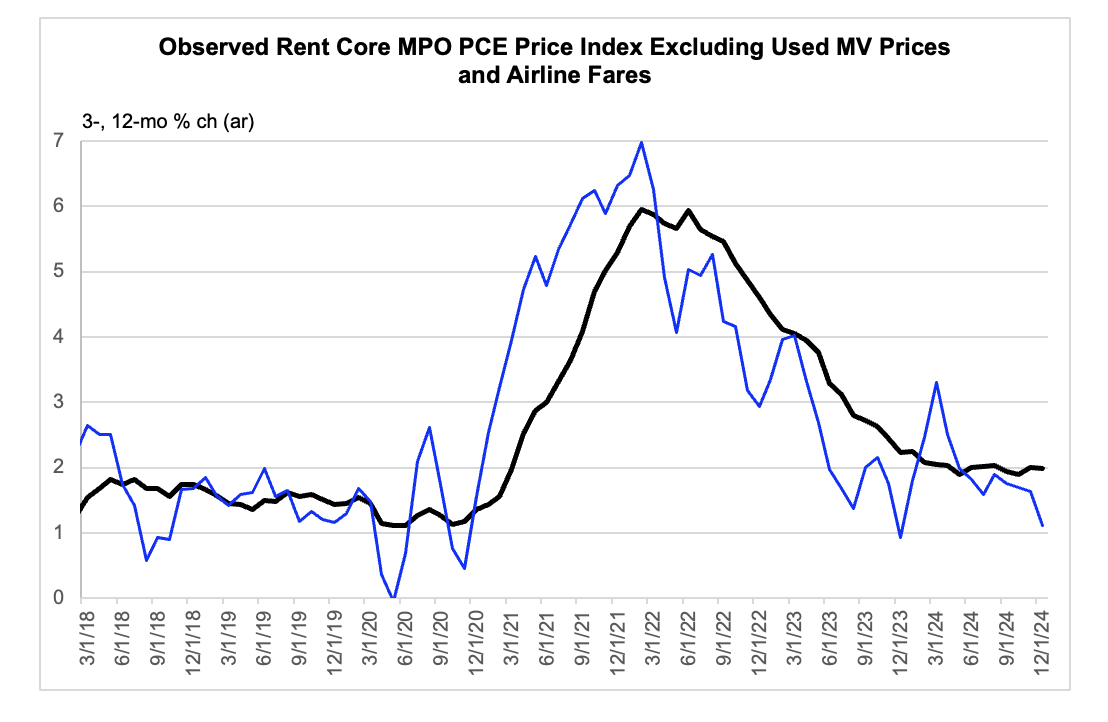
In the chart below, I show what I take to be the single-best measure of underlying inflation. It eliminates much noise, which is an advantage. But one cost of that is that it has a hopefully-roughly-stable downward bias, which we need to correct for. So, the 12-month rate there is actually consistent with underlying inflation above about 2 1/4%. Separately, while this is the single best measure, in my view, it does spot all the benefit of the doubt to the doves, in the current environment. So maybe the mean of the distribution for underlying inflation would be about 2 1/2%, when taken at a 12-month rate, which is conventional.
More to the point, though, note that the 12-month rate in the single-best measure has been going sideways, consistent with the shortening of the inflation language as mentioned. But that does not necessarily mean that the inflation news recently has been troubling or even as bad as neutral. It just means that we have been adding in monthly advances that are close with the monthly advances that are dropping out of the 12-month rate. Typically, we would get a better sense of the recent news by calculating shorter term inflation rates, which have indeed been quite low. But people suspect that there is residual seasonality, which might make that misleading. That is a fair point, but the odds do seem to favor the 12-month rate falling when the January data print around this time in February. The reason this is the case is that it is probably not all just seasonality.
Of course, this is not the only thing going on. By a month from now, we may also have some news on tariffs. Who knows?
IMV, the single-best measure still probably includes air fares
Source: BEA, FH inferences from informed consensus
Data are actual to November and estimate for December.

