

January FOMC Preview: Wait and See Which Way the Trade Winds Blow
- The Fed is currently in wait and see mode. Much of this is due to the election and uncertainty about looming policy shifts and risks, but also the surprisingly steady strength of the economy.
- Having paid back 100bps of insurance hikes and with inflation still somewhat above target, the Fed is losing the preemptive incentive to keep easing but most still sees it as having a bit more room to gradually move to a ‘more neutral’ stance of policy. The recent data shows less urgency to cuts going forward and that neutral is still somewhat above where the median participant currently puts it (3%).
- At the press conference, Chair Powell is likely to focus on the gradual progress towards target-consistent inflation which has been while emphasizing that that process is incomplete, the economy is holding up well despite higher rates, and the election has injected substantial inflation uncertainty into the outlook.
- Modest, placeholder-like, fiscal and tariff policy could allow for another cut or two this year, as the Dec dot plot showed, but that requires supportive underlying data and has a clear risk skew.
- All things considered, 2 cuts this year still seem like the modal outcome, but the expected value, given the risks of 0 or 1 cuts even in baseline-like macro outcomes, is closer to 1x cut. The tails to the upside and downside are wider than consensus currently seems to think on an end-25+ horizon. .
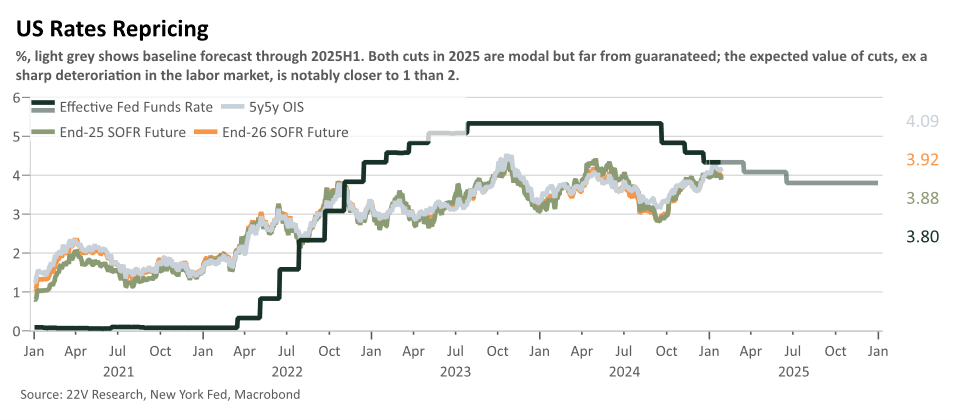
In recent weeks Fed officials have largely shifted towards a more gradual and cautious approach to further rate cuts.
There remain some more dovish officials keeping the window for more hikes and a dovish outcome open in 2025; most notably this includes Gov. Waller who said that if the data cooperates 3-4 rate cuts are possible in 2025 and that even “if the data doesn’t cooperate, then you’re going to be back to two, maybe even one if we just get a lot of sticky inflation.” While this is clearly inside the range of views articulated at the December meeting, when the FOMC’s baseline core PCE forecast lurched surprisingly higher to a central tendency of 2.5-2.7% and still showed a 2x cut median in 2025, this dovish viewpoint feels a bit a dated. The takeaway from Waller and Dec is that even in a world with some modest tariff and fiscal shocks, there could be room for a bit more easing.[1]
Still, the recent data flow and policy signals have been showing less of a dovish pull towards further preemptive easing and an increasing hawkish caution. This has been driven by three basic facts:
- The labor market has not weakened nonlinearly as the Sahm Rule trigger over the summer suggested. The recent data flow suggests that the labor market’s gradual easing may be, or near, coming to an end.
- While interest rate sensitive activity is sluggish in level terms it is less clear that the current level of rates is actively weighing on it on the margin, although risks remain present here.
- While the Dec inflation data was quite good, the overall trends remain noisy and a bit above target with the policies of new administration imparting a set of upwardly skewed risks to the forecast, which have seen partial incorporation into the baseline.[2] Sub-2.5% core PCE max be tolerable and allow for a bit more easing but at this point lower inflation needs to be obvious, not carefully curated, and longer-lived (even with a solid 6m saar pace, the 2.8% y/y expected for core in Dec is too high).
One way of framing all this is that current hawk-dove axis has less to do with policy makers’ assessments of the appropriate reaction function to the incoming inflation data (the labor market being settled enough at the moment that it is only driving policy for a few of them on the margin) and more to do with their views on monetary policy transmission and the level of neutral rates. The more dovish one currently is the more apt they are to focus on the real fed funds rate versus LT rates and broad market conditions and the lower their estimates of neutral. Nothing says these two views should be correlated but they seem to be, with the more academic economists typically in that camp.
A Press Conference Where the Key Actor is Offstage
As happened in December, the press corps is likely to aggressively push Powell on how the Fed is incorporating tariffs and fiscal policies into their thinking. Powell may provide a bit more detail on the Fed’s assessments of the but realistically he is likely to note that they continue to use modest placeholders in their baselines which incorporate some but far from a maximalist view on what could possibly happen given the wide range of policies which have been discussed at various points. This approach gave them a more symmetric baseline which can allow for a shift in either direction as the policy outlook and data shift, rather than assuming a current law-like baseline which would have imparted a sharp upside skew to the forecast that would have left them seeming non-credible. The risk skew is still to the upside given tariff and trade uncertainties and pro-cyclical fiscal policy risks and the difficulty in assessing how those shocks may filter through a close to equilibrium labor market (i.e. one with little aggregate slack) in an economy with a recent legacy of high inflation.
While the Fed has insisted that strong growth and a healthy labor market are not impediments to further easing but the data there does continue to surprise to the upside, suggesting less dovish pull down. The soft inflation data since the December meeting is not enough on its own to get further cuts greenlit; for that Powell will remind us that the Fed needs to see sustained further progress on inflation and an inflation outlook which suggests that that the progress is apt to continue. The Fed does not want to cut into the trough of underlying inflation.
Powell is likely to continue noting that inflation expectations remain well anchored,[3] giving the Fed medium-term comfort in the policy-shock-free outlook (a large asterisk of sorts but one worth keeping in mind as a baseline which then has various policy scenarios layered on top of it) given their assertion that the labor market is back at equilibrium. Afterall, if one believes the modern Phillips Curve, so long inflation expectations are well anchored and the labor market is close to equilibrium, inflation being a problem over the medium-term is more or less precluded. I’ve harped on this before but this quote from former KC Fed President Esther George[4] last week brought it back to the top of mind “I see policymakers really hanging their hat on inflation expectations being anchored. That can be fleeting, you don’t know they’ve moved until they’ve moved.”
The Start of Another Framework Update
At the press conference Powell may provide some early guidance on the Fed’s 2025 strategic review. This will be year-long process taking into account public input, academic conferences, and plenty of public debate among the FOMC itself.
While the exact specifics are hard to know at this point it seems like that the Fed will try to steer itself closer to a middle ground from the lessons learned after the GFC and the challenges the post-covid environment provided. In 2020, the Fed was still fighting the last war of the GFC, focused on trying to remedy the challenges posed by low neutral rates and persistently below target inflation.[5] Having escaped the zero lower bound and with an inflation outlook that seems to have, at very minimum, a symmetric and possibly upside skew now, the Fed faces a much different set of policy concerns and constraints.
Quite tentatively, it seems likely the Fed will move towards a more symmetric interpretation of the inflation target, jettisoning the intentional overshooting of flexible average inflation targeting, while keeping the emphasis on maximum employment rather than a target equilibrium level of the unemployment rate. Maximizing employment subject to a symmetric inflation constraint seems consistent with the Fed’s dual mandate while also adapting away from the inflation overshooting embedded in FAIT, which was a legacy of the GFC-era and seems unnecessary now.
There is always a risk, highlighted at the September meeting that the relatively less frequent public communications from a number of the FOMC doves, notably those Biden appointees at the Board, leaves us with a relatively hawkish information set that leads to somewhat incorrect updating. ↑
To the extent that fiscal policy imparts minimal shifts beyond the current policy baseline and tariffs end up being more bluster than persistent policy, the baseline could shift down but I doubt either of those risks skews can really change until 25H2 in a convincing way. ↑
The increase in the UMich data is likely not going to be taken at face value given the hyper-partisanship evident in some of that data (the more concrete questions about household spending seem more correctly linked to the macro data) and the fact that it has so far not been corroborated by the Conference Board or FRBNY surveys. ↑
Someone with whom I’ve often found myself on a different side of optimal policy views over the years. ↑
The 2020 framework reviews shifts can be boiled down to: an embrace flexible average inflation targeting (FAIT) which aimed to ensure inflation was not kept chronically below target, and an interpretation of the employment mandate from symmetric “deviations” to asymmetric “shortfalls.” ↑

