

I am working with a fairly small sample of the informed bean counters, so I will probably fine tune this in the next couple days. But so far, the consensus estimates for the core PCE deflator for December are shaping up to be quite constructive. I read the median guess at around 17 basis points, despite adds from the following three considerations:
- Used car prices were up by enough to add a bp to the Core PCE Price Index, which we probably ought not take as a trend, given the behavior of the Manheim used vehicle value index.
- There is another 2 basis points contribution from the fact that average rents are rising sequentially more quickly than my proxy of average rents. And it is my judgment call that we should mostly swap out the average in favor of the marginal, for reasons I have been over in earlier notes, including one this morning.
- There is a further basis point contribution from portfolio management and advisory fees. That is not a big deal relative to the noise from this source in earlier months, but it is incremental.

Source: BEA, informed street consensus, FH calculations and inferences
Data are actual to November and implied consensus for December.
Accordingly, what I take to be the single best measure of underlying inflation in the goods and services market is implicitly expected to be up just 11 bps. There is a slight downward bias in this estimate, which is worth putting up with because the measure eliminates a lot of noise. The source of that bias is the exclusion of non-market prices, which is relevant even when there is not a particular source of noise there. So, that 10 bps maps to about 12 bps of underlying inflation. And the three-month rate of change there of 1.3% (ar) maps to about 1.5% for underlying. The 12-month rate of 2.05% (false precision) implied underlying inflation of just over 2 ¼%.
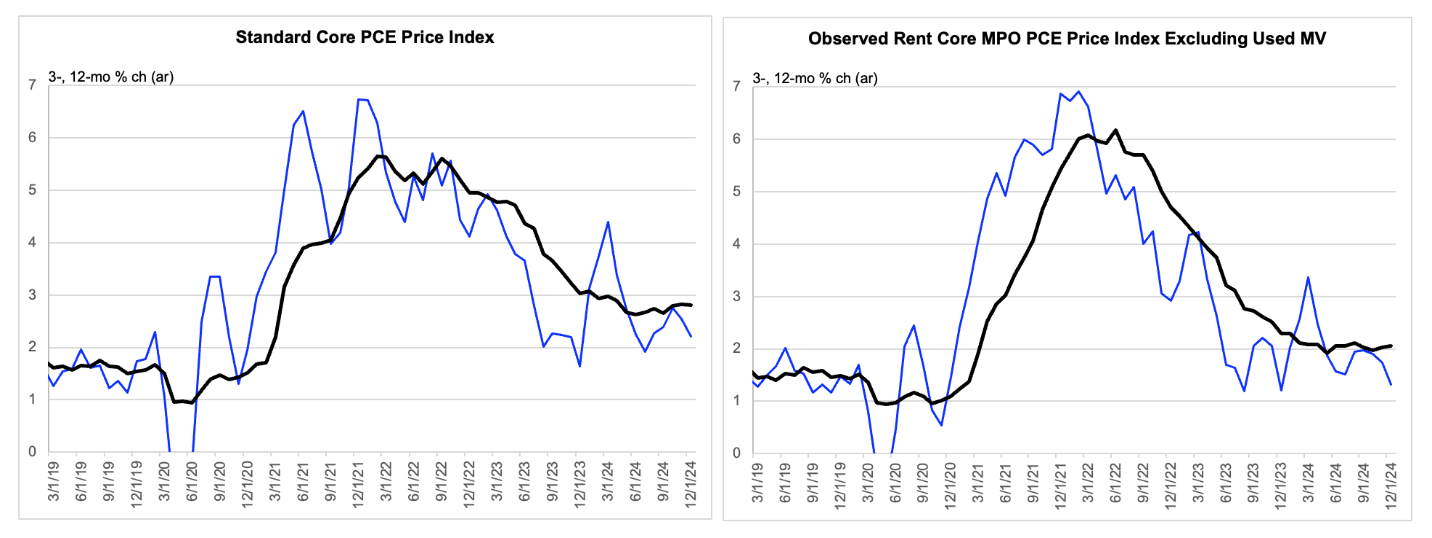
Source: BEA, informed street consensus, FH calculations and inferences
Data are actual to November and implied consensus for December.
Within this, core goods price inflation looks particularly weak and supercore services inflation looks slightly elevated. At the margin, the concentration of recent disinflation on the goods side does slightly weaken the disinflation signal here, because goods prices are more volatile and less linked to domestic economic considerations, even setting aside the issue of tariffs, which cannot be informed by these data. But that is a modest offset to a generally quite constructive set up for the PCE Price data during December. And this will not change if I am misreading the informed consensus for the core by a couple bps, although I will revert when I have a larger sampling.
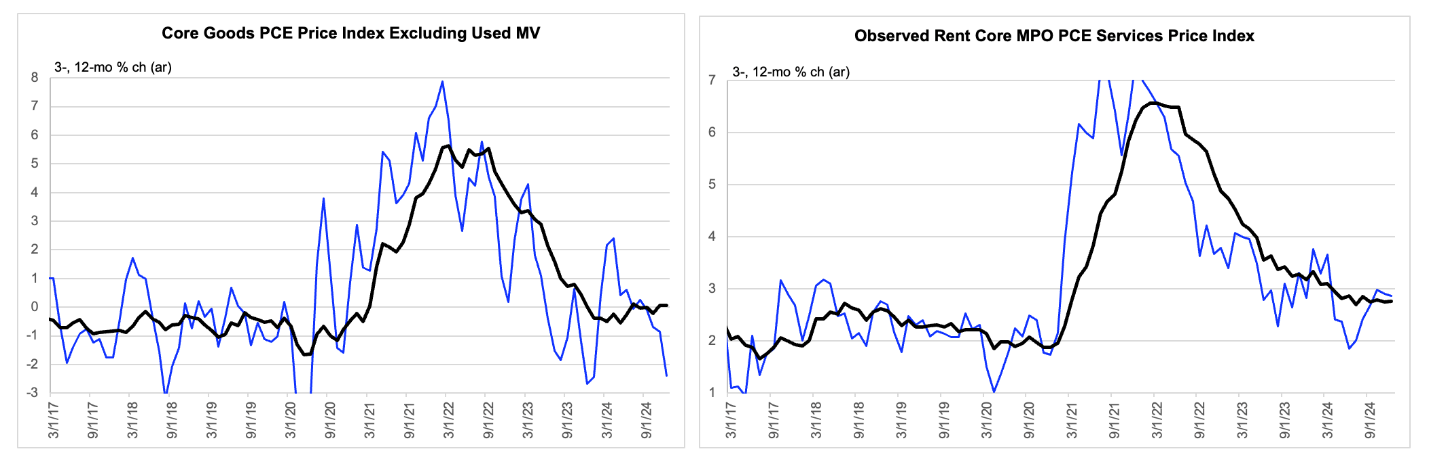
Source: BEA, informed street consensus, FH calculations and inferences
Data are actual to November and implied consensus for December

