

What’s Driving the Momentum in Rates Markets?
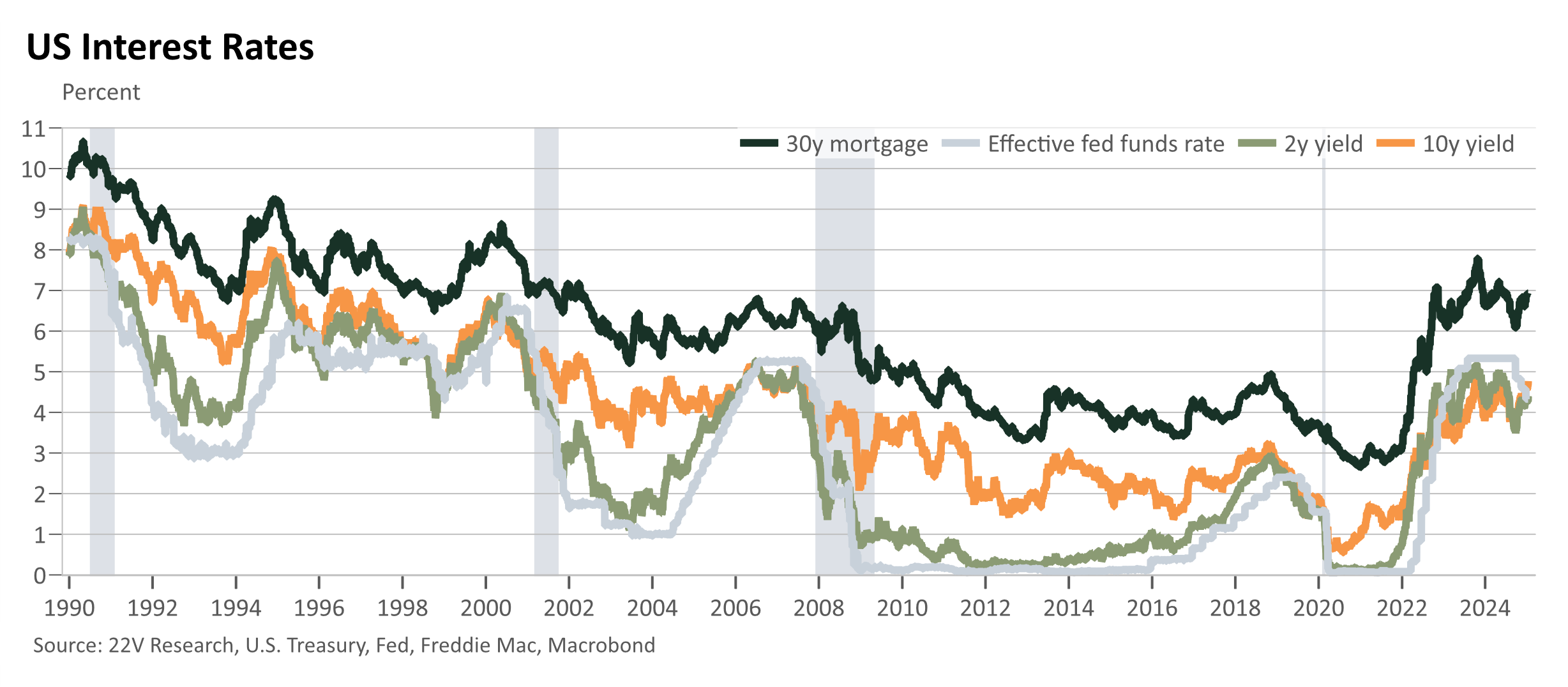
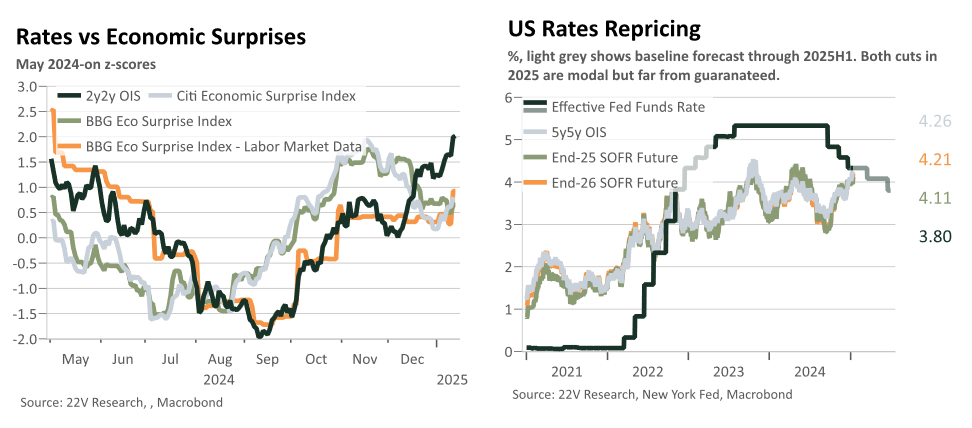
- The primary cause of the past 8 months’ moves, in both directions, in rates is the rise and fall of widely held recessionary concerns, along with the upside inflation surprises of the fall.
- The realization that the incoming administration has substantial discretionary authority over tariffs and labor supply shocks, through immigration and deportations, is likely playing some role. Here the skew matters more than the moderate base case macro impacts.
- While fiscal policy also looms large in the discourse, it seems quite unlikely the US is headed for a UK-, or EM-, like moment where rates, risk assets, and the currency all come under stress at once. Rather, with a healthy, and perhaps a bit overheated, economy, procyclical fiscal policy is likely to have a very small net impact on growth as rates and the USD offset most of the multiplier that would be seen during a slacker macro environment.
- The market may also be starting to grapple with the possibility that after preemptive Fed easing a few rate hikes could plausibly be in the cards later this year or next, as happened during the 1990s mid-cycle adjustments.
- My assumption has been that the housing market will serve as a soft cap on longer-term yields, leading to 3-6m mini cycles in LT rates as we get rate-sensitive spending led rebounds and drags with overall activity remaining solid. The risk, initially narrowly for those in the housing-adjacent economy and perhaps more broadly on a somewhat longer time horizon, is that the heat of the consumer and AI spending sustains rates higher and sends housing and goods employment down.
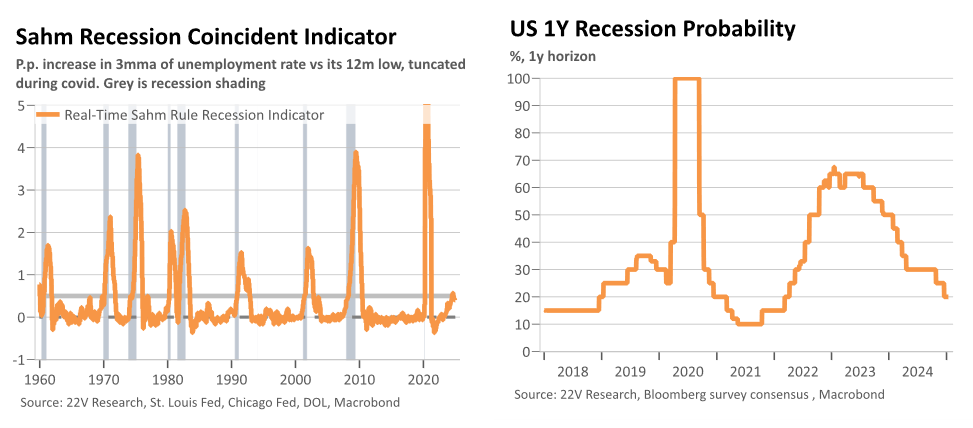
The spring and summer saw ever increasing salience of Sahm Rule driven recession pricing pulled rates notable lower. These rising concerns ultimately led to the Fed’s 50bps cut in September which marked the approximate bottom in rates for the year. The preemptive dovishness certainly helped steady markets but more importantly was the labor market data’s failure to keep validating recessionary concerns. Rather, we have seen the data on net improve slightly with some measures showing still gradual easing but none confirming a looming recession as had been feared.
Tariffs and immigration policy concerns are clearly playing a role and the Fed has started to incorporate some of these supply shocks into their baselines. The Minutes were quite clear on this (more here). The importance of these risks lies less in their base case impacts but rather that the skews are large, and the administration’s underlying aims difficult to assess, leaving certainty around scope, timing, and intensity wide open (this current open-endedness may allow for a “ready, fire, aim” approach on the part of markets seeking to preempt and perhaps prevent some of this risks from emerging).
Despite orthodox fiscal policy advice suggesting it is a risk, it seems highly unlikely that the US is headed for a UK-, or EM-, like moment where rates, risk assets, and the currency all come under stress at once. Rather, with a healthy economy, inflation above target, and rates well away from the zero lower bound, the likely multipliers on any pro-cyclical fiscal expansion are likely to be extremely close to 0 as rates (Fed policy or market to be determined) and the USD offset much of the potentials boost to growth. In the first order, I think the market will do much of this work for the Fed as the Fed has likely long been assuming something much closer to a current policy, where the TCJA is largely extended, versus a current law baseline. Canonically[1], easy fiscal policy and fairly tight monetary policy is an environment which has generated strong USD gains. This will weigh on both the global and domestic manufacturing economies, leaning against the overheating impulse from fiscal policy.
The ending of the secular stagnation and increasing globalization worlds (related but not exactly the same) will change markets tolerance for, poorly designed and timed, fiscal policy along with shifting the stock-bond correlation, among other things, but this is a gradual process not best leaned on for explaining a month of price action.
I will admit, it does not seem obvious that there is a level of rates which is compatible with inflation sustainably returning to 2%-ish (or close enough for Fed dual mandate indifference) and rate sensitive spending, particularly the housing market, not being weak. Over the economic medium-term, late 2025 and on, this poses a notable cyclical risk as too hot spot data force rates higher before leading to notable weakness in the goods’ sector’s labor market which could lead the rest of the cycle down.
The bursting of the tech bubble stands out as the one modern non-covid recession where the housing market did not play an appreciable role and so this risk is the key one I see heading into this year (in an eponymous 2007 paper, Ed Leamer noted that “Housing IS the Business Cycle”). But it may the case that with the AI boosting corporate valuations and investment, the largest ever non-recessionary credit tightening cycle having already taken place, and consumer balance sheets strong, there is not enough current excess and vulnerability for weakness in the goods economy and labor market to spiral out; rather the chronically asynchronized post-covid cycle may continue along (likely a theme of the year regardless). A rebound in white collar hiring is likely the key tell to how robust the overall economy would be to greater weakness in the goods economy.
Another possibility is that with the economy not having broken over the past few years due to asynchronous supply disruption and normalization and demand cycles, the market is gradually coming around to the possibility that after some preemptive easing the Fed will end up overdoing the easing slightly and ultimately hike a time or two more. This happened during both 1990s mid-cycle adjustments, but it is less clear to me if, with neutral likely in the 3.25-4% range, whether eventual hikes might require a few more cuts to the get the fed funds rate closer to neutral, then necessitating eventual more restrictive policy.[2]
See Akinci et al (2021) at the FRBNY for a discussion of these historic USD dynamics going back to Soros (1984) in the Reagan years. ↑
Of course, there is a possibility that short-run neutral is higher than my above consensus read and even the 100bps of cuts seen so far have taken us close enough to nominal neutral (given elevated inflation) that with so much momentum in the economy policy rates are not an appreciable drag. ↑

