

A client contacted me over the weekend mentioning that he was “surprised” that my recent note on employment growth did not take account of the likely steep slowdown of population growth now that there is bipartisan agreement that the recession-avoiding surge of immigration needs to be fixed. He used the term “surprised” in the Larry Summers sense of I think it is stupid that.
My attempt at an excuse here is that supply constraints are not likely to be binding at the short-term horizon. However, my note looked forward a few quarters, so the client’s criticism is very well taken. And it has inspired me to put together some numbers to scale the importance of his point, which does seem high. The breakeven employment growth rate has been very high, presumably because of the undocumented immigrant suge. But that is about to change, which is not good.
There is a ton of uncertainty around the immigration numbers and whether or not to treat the new immigrants as part of an enclave or having the same macro relevance as a native-born worker who is employed, unemployed, not part of the labor force etc. And I concede that my approach here does not fully bracket that concern, because it does take a key result from the household survey at face value.
Old school labor market ease has not required recession

Source: Bloomberg, CBO, FH calculations
Data are actual to November.
But we must take some sort of stab at this, so I proceed with two assumptions:
- While the BLS’s published figures on employment and the size of the labor force are unreliable because they have almost certainly been using the wrong population scalars, the surveyed labor force and employment rates are roughly correct and representative, subject only to a seasonality issue I will address below.
- We know from the data published in the (headline) Establishment Survey and our best guess of likely revisions there what actual employment growth has been over the past couple years. Specifically, the Establishment data are accurate to March 2023, overstate growth by (a constant) 68k a month in the twelve months to March 2024 and by half that in the subsequent eight months to November. This assumption is bold, but the key advantage of the Establishment Survey data is that they will not systematically miss immigrants by relying on faulty demographic assumptions, as the aggregates from the household survey do.
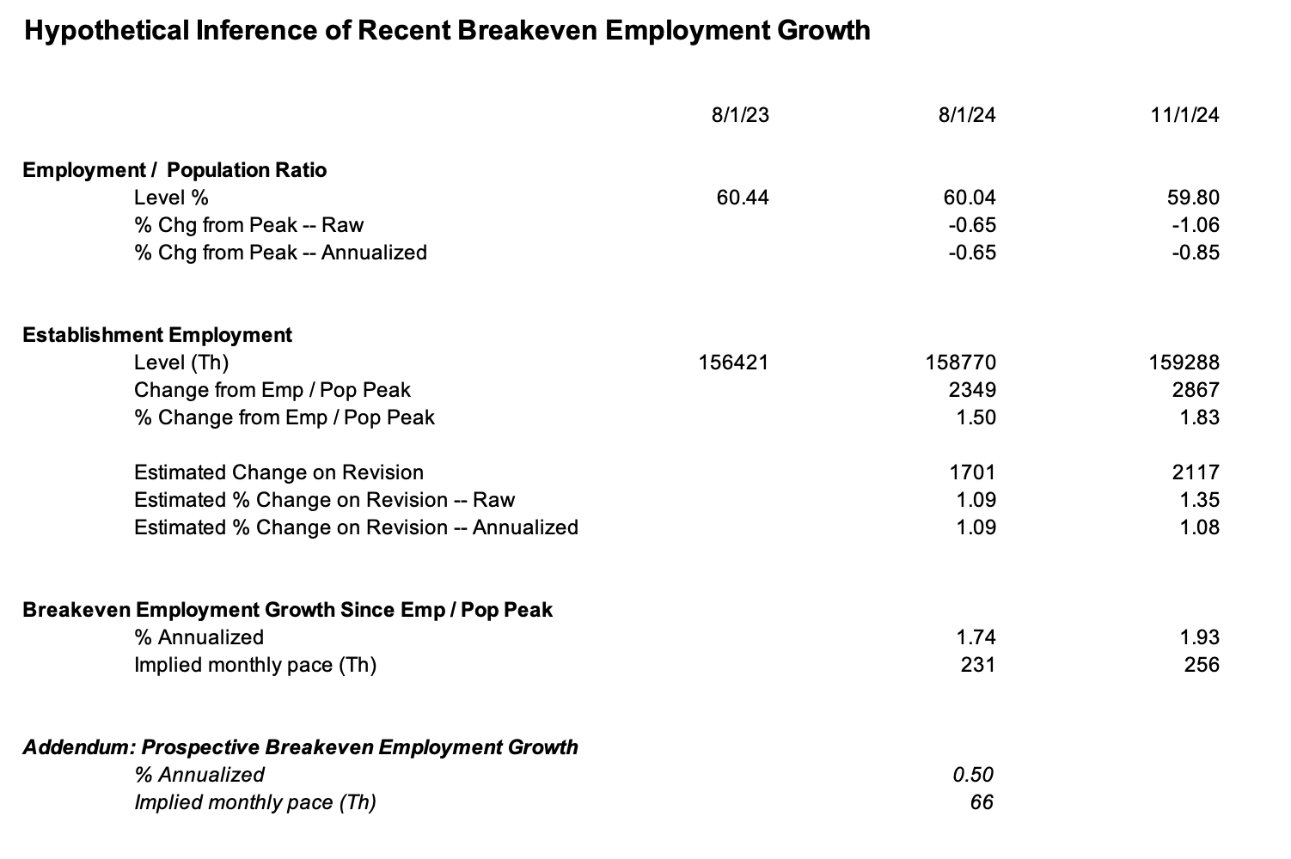
Ok, so with the key assumptions made explicit, let’s take a stab at estimating just how high the employment “breakeven” rate has been recently. What we mean by recently is itself subjective, but for me, measuring things since August of 2023 seems very natural. That is the month that the employment population ratio peaked for this episode, and it marks the beginning of the old-school (non-immaculate) easing of the labor market, which – I would claim – has been a prerequisite for the Fed shifting its approach from max hawkish to more dovish. Since August 2023, the employment / population ratio has fallen by 1.06 % (not ppts) or at an annualized rate of 85 bps. This implies actual employment growth has been 85 bps slower than the breakeven. However, there may be some residual seasonality in the seasonally adjusted employment / population ratio. So, as a robustness test, I will also look at the change from August 2023 to August 2024, which works out to be 65 bps (ar). The annualization is redundant because I measure the change over exactly 12 months, but I am just sticking with a common metric here.
Actual employment growth meanwhile has run at an annualized rate of just under 1.1% during the relevant 15-month and 12-month periods. In conjunction with the arithmetic above, this means that the breakeven employment growth rate, the rate that would hold the employment / population ratio stable, has been either 1.93 or, more conservatively and perhaps more fairly, 1.74%. Expressed in jobs, rather than %, that would currently map to monthly employment growth in a range of 230 to 260k. When the breakeven is that high, it is no great mystery that we could get the required easing of the labor market without treading close to recession.
The most recent projection from the Census has the population rising 55 bps during the coming year. That figure is not directly comparable with the population figure used in the employment / population ratio but attempting to control for that is not a great use of time, relative to the huge change relative to recent history implied by this estimate. If factor in the CBO’s assumption that the potential participation rate still has a slightly downward trend, owing to demographics, we come up with a breakeven employment growth rate of about 50 basis points or just 66k a month. This is indeed an important and newly emerging constraint on demand growth. It does point the unemployment rate lower, for any given pace of employment growth, although we need to recognize that labor demand is itself to a large extent endogenous to population growth. And it does raise the recession risk relative to where it would be in an environment of faster population growth.
So, good point, client. H/t also to Bill McBride who had primed me to be receptive to the pushback from the client. Word to the wise. And none of this has anything to do with mass deportations. They would be in addition.
The breakeven rate is probably about to collapse
Source: Bloomberg, FH calculations
Data are actual to November and incorporate expected revisions as discussed in text.

