2025 US Macro and Fed Preview: Calm Waters for Now, but the Horizon’s Cloudy
- At the moment, the US economy has a healthy, if no longer overheated, labor market; growth which has consistently come in above expectations and estimates of longer-run potential; and substantial but incomplete disinflationary progress. This is a solid jumping off point for the new year.
- Assuming mild versions of possible policy shifts, the tentative base case looks like growth continuing to come in around 2.5%; core PCE inflation at ~2.5-2.7% which will be too high for much further easing but not hot enough for an aggressively hawkish policy (baseline-like tariffs adding 20-40bps); and a labor market which will continue to gradually ease early in the year before starting to slowly retighten as immigration’s slowdown meets with hiring at an ok-but-not-great pace. These initial conditions, and the legacies of the past half decade, though are likely to be less accommodating of any pro-cyclical fiscal policy or larger supply-side shocks (tariffs, stark immigration shifts, etc) than was the economy during the first Trump administration.
- Compared to this time last year, the tails are wider now. There is a tension between strong growth, a lack of many obvious immediate vulnerabilities, and fading headwinds versus the slowing pace of catchup hiring, higher-for-longer rates, and risk that the supply-side gains of the past few years peter out (perhaps due to Trump admin policy shifts).
- Tariffs, immigration shifts, and potential pro-cyclical fiscal policy loom as classic known unknowns. As markets have seemed to be digesting over the past few weeks, the new administration has substantial discretionary control over the supply-shocks (tariffs, immigration) while the demand and sentiment shocks (fiscal policy, much of deregulation) will see substantial input from Congress and the Courts and be much slower to be realized. Tariffs will add some modest pressure to inflation in most mild scenarios (+0.2-0.4%). It is certainly possible though that the administration underdelivers on tariffs, reducing inflationary risks somewhat. While the base case policies seem unlikely to take growth below trend, more extreme outcomes and escalation ladders pose notable upside inflation (adding a full percentage point or more to 2025 inflation with appreciable second-round effects) and much sharper downside growth risks. Pro-cyclical fiscal policy is unlikely to have large growth multipliers at this point in the cycle (assuming we are at a similar point in the cycle upon policy implementation) given that rates and the USD will offset much or all of the growth effect.
- The AI boom is becoming more macro-relevant. With capex numbers growing rapidly and expectations for future earnings moving higher and higher, along with their contributions to overall wealth gains, the boom is primed to be a key contributor to growth and growth risks. This adds to mid-to-late 1990s feel, although the comparison is highly imperfect given that globalization and free trade were running full steam ahead then.
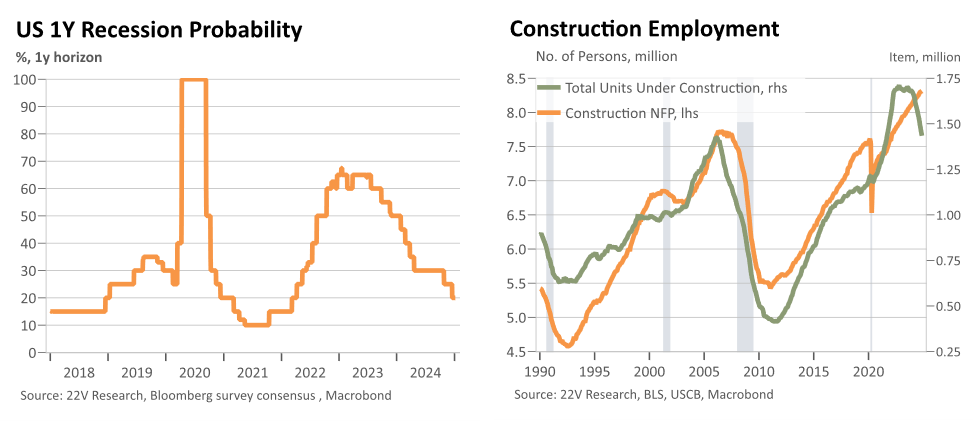
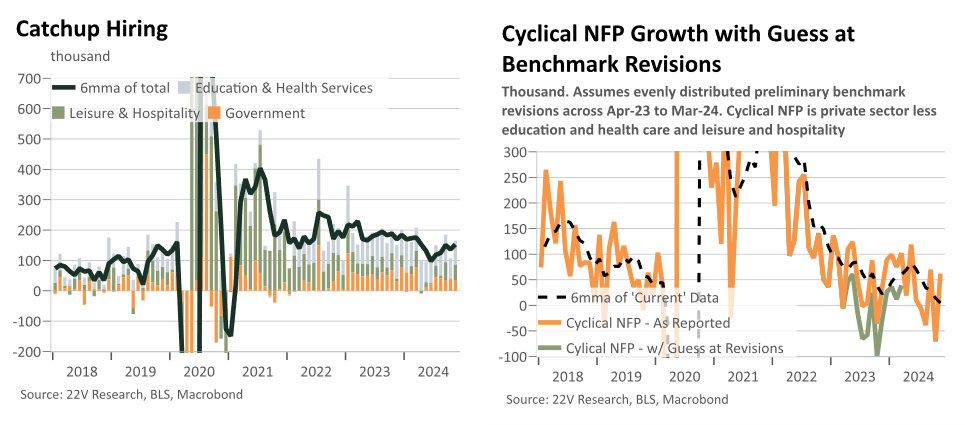
- In the labor market, two main risks stand out. First, there has so far not been an appreciable labor market impact of the decline in housing under construction but the disconnect, and the fading of the infrastructure spending impulse from the CHIPS and IRA bills, points to a clear downside risk which historically leads the broader cycle. Second, cyclical hiring has been notably weak for some years, with catchup hiring insulating the broader labor market from drag from low hiring rates and the supply surge. As catchup hiring continues to slow, there will be less of a buffer preventing keeping hiring positive or above demographic trends in the event of a more notable demand shock.
- Tentatively, the Fed will cut 2x more by June before going on an extended pause. Still a bit too high inflation, growth and labor market outcomes which have so far not ratified recessionary concerns, and policy risks make it more likely the Fed under-delivers on rate cuts than over delivers, with 0x or 1x cuts both distinct possibilities.
- If the economy holds up, possible hikes may become a part of pricing and the more active debate in H2; this would be in line with the 1990s mid-cycle adjustments where risk-management driven cuts met a still healthy economy and ultimately led to a few hikes. However, while far from base case now, the larger skew is to the downside over the longer-term.
- For rates, the base case continues to be a range trading environment where overheating and recessionary concerns periodically dominate price action and push rates towards or past the edges of the recent 10y range (ex ante 4-4.5% still seems broadly right). Procyclical fiscal policy and further evidence of inflation deanchoring too far above target (ratified by not just tariff-impacted data but also wages and inflation expectations) could force rates to break out of this range to the upside while any more notable weakening in the labor market or signs housing is rolling over again could pull rates down.
Labor Market to Steady and Growth to Remain Strong
- The labor market has so far, despite frequent prognostications otherwise, failed to show signs of more acute nonlinear weakening. But the level of slack has eased quite notably.
- Over the course of 2025 payrolls growth should gradually stabilize (stop decelerating) to the mid-100s. Catchup hiring in government, education and health care will continue to slow but a modest rebound in non-rate sensitive sectors should allow overall hiring to eventually stabilize at this fairly normal, by pre-covid standards, pace. Labor market slack should start to steady in H1 before gradually retightening in the back half of the year as on net fairly steady hiring and slower immigration rebalance slack measures, likely starting at the bottom of the labor market.
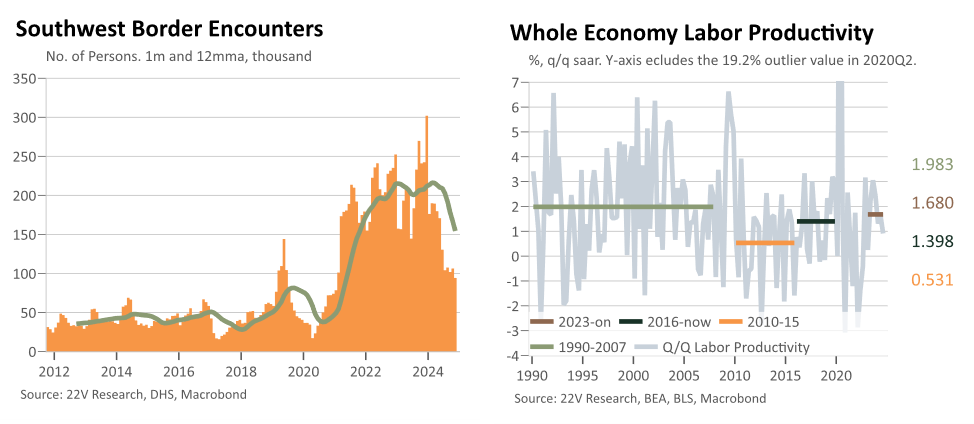
- Immigration has been falling notably since the early summer and will likely continue slowing towards pre-covid pace. Risks here loom large. Maximally aggressive actions at the border would have a less immediately stark impact on the economy than would large scale deportations, and the likely associated reduction in immigrant labor supply for those who fear deportation, which would be a level shock to labor supply, immediately retightening the labor market.
- So long as the business cycle remains healthy, I expect to see positive hysteresis in the labor market with broadly healthy labor markets inducing those on the margins into the labor force. This has been a consistent feature of recent business cycles. As a result, I expect that the prime-age labor force participation rate will slowly move back to new cyclical highs over the course of the year.
- The benchmark revisions to the NFP data and the population adjustments to the household survey (which unhelpfully do not revise the prior data but are rather just levels shifts applied to the January 2025 data) will notably alter the numbers on the screen but given all the attention placed on the labor market’s various internal inconsistencies and generally pessimistic interpretations by market participations over the past few years will not dramatically alter the qualitative understanding of the labor markets recent history. These revisions are likely to show that over much of 2023 and early 2024 hiring in white collar industries, and cyclical industries outside leisure and hospitality, was anemic at best with a number of months with negative cyclical hiring (the benchmark revisions stop in March 2024 but some other revision will apply to the more recent data as well). This level shift down in NFP will partially close the gap between NFP and household surveys. The QCEW source data suggests that NFP seems to be continuing to overcount hiring somewhat into mid-2024. Recently revised Census immigration estimates (here) will substantially raise population and employment estimates in the household survey, closing much more of the gap to the NFP survey from below.
- The ending of the credit tightening cycle, modestly lower rates, healthy household and firm balance sheets, and easy risk asset financial conditions should all be supportive of growth. While housing and AI loom as possible boom-and-bust areas, a look at the overall economy suggests that many classic patterns of potential overinvestment cycles don’t seem to be obviously overheated and present yet (see more from the fall here). AI related investments are of growing macroeconomic consequence but until we get broadly falsified earnings assumptions dragging investment and spending down, an event who’s timing I will not try and predict, this is at least a near-term tailwind for growth.
- The composition of growth is likely to remain somewhat ‘acyclical’, driven by consumer services and non-rate sensitive investment, as housing continues to struggle to reaccelerate given rate levels consistent with roughly stable inflation (more here) and manufacturing remains in its recent doldrums due to high rates, weak overseas demand conditions (either China or Germany inflecting even modestly higher would help sentiment notably), and tariff and trade war related uncertainty keeps firms from ramping up more aggressively.
- The surge in productivity growth over the past few years has been key in enabling relative benign disinflation. While some of the gains seen in recent years likely reflect the settling in of post-reopening hiring surges and decreases in labor market churn which are effectively a one-off gain, the underlying trend pace seems robust. It is often underappreciated that following the economy’s exit from the acute post-financial crisis years (its SAAR was only ~0.50% from 2010-15), productivity growth in the last cycle was notably higher once the economy moved past the acute post-GFC stage.
Inflation: Too High to Be Relaxed, Probably Not Hot Enough to Hike
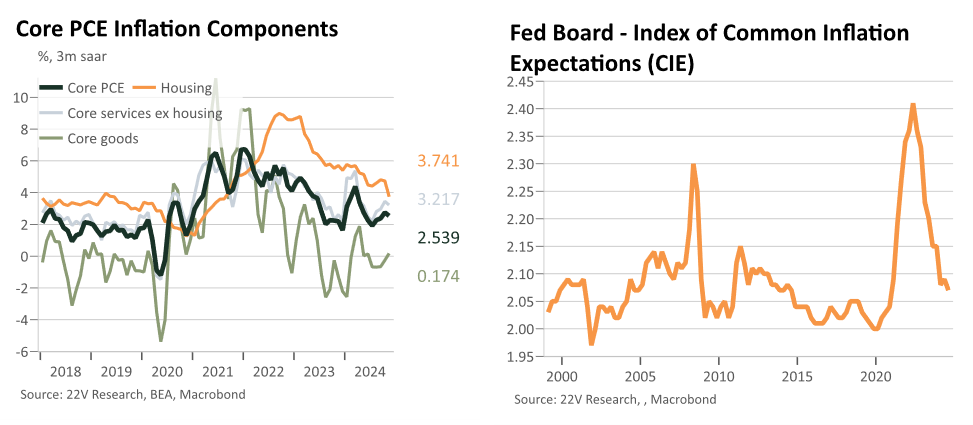
- In a world without tariffs, or broader political policy shifts, I would expect core PCE inflation to run around 2.4% in 2025. While we have seen notable disinflationary progress this has been slower than expected, largely due to episodic bouts of upside volatility with 1.75-2% CPCE serving more as a m/m floor than the ceiling it was before covid. Inflation expectations and wage growth are not obviously so hot as to suggest inflation has massively deanchored but they continue to be hot enough to suggest that we are not returning smoothly to target either.
- Q1 will likely see another, notably smaller than in 2024, bout of excess seasonality. This reflects lagged inflationary resets in relative prices more than strict issues estimating seasonality in the usual sense; given smaller recent price shocks the relative price adjustments should also be smaller.
- Housing inflation will keep gradually decelerating but with robust income growth, marginal rents which are in the 2-4% range, and still heavily rent favoring rent-vs-buy tradeoff, we are unlikely to see housing inflation move to a slower than pre-covid pace. Core goods inflation is largely a story of tariffs but, even without them yet, the pace of level disinflation seems to have slowed notably or even stopped. Ex tariffs, core goods are likely to be a bouncy but roughly 0 contributor to underlying inflation, slightly faster than pre-covid. Core services ex housing is running somewhat too hot for inflation to be durably at target but doesn’t appear to be pulling inflation back above 2.5% or so either.
- Inflation expectations seem to have largely returned towards roughly target consistent, if not pre-covid when they had deanchored to the downside, levels. However, the political and cultural salience of inflation and cost of living challenges are a potent remember that the inflation generating process and attentiveness to price shocks has likely shifted notably compared to the pre-covid period.
- Despite some political prognostications to the contrary, tariffs will not be inflationarily neutral (for more on this see this recent piece from the CBO here). The scope, intensity, and duration of tariffs are all highly uncertain and thus the range of possible outcomes for 2025 are also very wide. This accentuated by the fact that unlike in 2018-19, high inflation is not a distant memory any more and firms have learned how to shift pricing dynamically as input cost shocks happen and consumers are still feeling the negative sentiment and real income effects of the covid-era shocks. For a given tariff shift, I would expect a larger and longer-lived inflation impact now than in 2018-19.
1-2x More Fed Cuts but Rates Are Largely Range Bound
- My base case remains that the Fed will cut 2x more, in March and June, before going on an extended pause. Both 1x or 0x cuts are plausible if the labor market starts to reheat sooner than I expect or Q1’s inflation is hot enough to force another reset higher in their forecasts in March (the Fed likely expects some mild excess seasonality to start the year, but nothing like that seen in 2024).
- Since the September meeting’s 50bp cut the FOMC has been shifting away from concerns of a nonlinear labor market weakening and starting to emphasize the greater persistence of growth and inflation’s upside surprises.
- While many leaned on the supposed hawkishness of the December meeting, the actual reaction function was more or less unchanged given the inflation and unemployment rate forecast revisions. It may be the case that the increased inflationary forecast is itself the hawkish signal but for now the Fed is responding to more than preventing hotter inflation.
- Over the course of the year, I expect the dovish holdouts with a lower neutral rate to largely capitulate, taking central distribution of long-run dots from its current 2.8-3.6% towards 3-4%, with the median moving to roughly 3.5%.
- The response from the Fed to other policy shifts in DC likely depends on their assessment of underlying inflation trends at the time, whether or not the labor market is still easing, FCI and sentiment responses to tariffs, and if there is a notable inflation expectations response. Tariff responses are initial condition dependent and for now those conditions suggest an inflationary and hawkish short-term response. A medium-term growth and sentiment shock could attenuate an anti-inflation impulse from the Fed but they would likely need to see confirmation from the inflation data before allowing themselves to respond to the weakening labor outlook.
- For rates, the base case continues to be a range trading environment where overheating and recessionary concerns periodically dominate price action and push towards or past the edges of the recent 10y range; ex ante 4-4.5% still seems broadly right. Procyclical fiscal policy and further evidence of inflation reanchoring too far above target (ratified by not just tariff-impacted data but also wages and inflation expectations) could force rates to break out of this range to the upside while any more notable weakening in the labor market or signs housing is rolling over again could pull rates down.
- For those able, taking the opportunities to build tail hedge portfolios in rates on a roughly 1y1y horizon whenever spot moves far in the other direction seems a reasonable strategy. On that horizon, the skew in rates seems to favor long positions but the very limited mid-cycle precedents suggest that we may see a modest move higher in policy rates before the cycle’s end.
- When combining the above two points effectively amounts to a vol-selling strategy in the middle of the distribution with a selective purchases of tail hedges and a bias towards adding long-rates positions when the 10y moves to 4.5-4.75%.
Key Risks and Signs to Watch For
- My views of the tails are notably wider than they were a year ago. Unlike over much of the past 2y, consensus recession odds seem much closer to on-sides now. I continue to think that most of the areas of potential cyclical weakness in the short-term could arrested by sufficiently low rates, but it is also unclear if those low rates would ultimately be consistent with inflation staying low-enough near target.
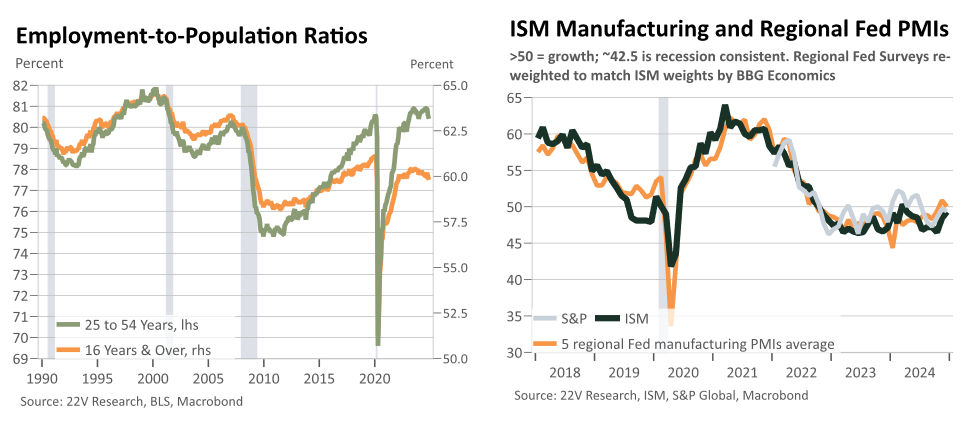
- The labor market has been continuing to gradually ease over the course of the past year and, unlike over the summer, there has been a somewhat concerning decline in the prime-age employment-to-population ratio in recent months. This may simply be an aberration but with hiring slowing and concentrated in catchup industries, there is a risk that eventually growth momentum in cyclical industries slows enough that it starts to more appreciably roll over and accelerate.
- With rates higher for longer, the housing market continues to move roughly sideways after its massive covid-era boom. With construction volumes now falling notably but employment in the sector still moving higher one has to wonder how long it can be before employment starts to flatline or rollover in the sector. If this was to happen it would raise notable alarms.
- Many in markets had seemed overly sanguine on the incoming Trump administrations attitudes towards tariffs and possible immigration restrictions. This has shifted notably in the past month. These two supply shocks are largely inside the administrations control and would be maximally unhelpful for markets and the Fed, but while the directional impacts are clearly the size, likelihood, and duration are not.
- Manufacturing is one of the greater areas of two-sided uncertainty in the economy. Since mid-2022 it has been subject to fits and starts but largely languished in a little-to-no growth high-40s PMIs world. There are some tentative signs of a rebound and the election, possible tax cuts, and the AI boom should all serve to support growth but high rates, weak overseas demand, and tariff risks all point in the other direction. One has to wonder how long the sector can continue to move sideways before firms’ start to lay workers off if/as future growth expectations are not realized.
- Growth has substantially outperformed expectations since inflation peaked and started coming down. Much of this can be chalked up to fading post-pandemic disruptions (the supply shocks reversing), as well as the surge in immigration which helped benignly ease the labor market and supported growth at the same time. Productivity growth also appears to be notably higher than before covid, particularly if one is inclusive of the immediate post-GFC period, but this productivity boomlet could be a downstream effect of the disruptions fading and the more efficient sorting of the labor market which the churn surge in 2021-23 led to. The fading of those one-offs would then endogenously lead to a lower productivity path leading to a worse activity-inflation tradeoff for the Fed.
- A Fed pivot to hikes by the end of 2025 would almost surely come on the back of a reaccelerating goods economy (endogenously) or a pro-cyclical set of tax cuts and tariffs on economy which seems more primed for deanchoring than it was in 2018-19. Aggressive tariffs and trade war risks would be reduce the Fed’s ability to be dovish, likely forcing it to be outright hawkish in many circumstances, while at the same time sharply raising medium-term growth risks.