

The release of the CoreLogic Single Family Rent Index (SFRI) data for October on December 19th was not market moving, because markets were focused on other issues and because the SFRI is not that closely followed. But the report highlighted a further deceleration of (measured) marginal rent inflation, which seems to fit very neatly into an hypothesis I have been pushing. The tightness of the fit is probably a fluke, but it is striking, nonetheless.
The December report shows that the 12-month rate of change of the SFRI slipped to 1.7% during October, down from 2.3% last October. This is slightly below the 2.5% rate of sequential marginal rent inflation that I have subjectively penciled in for the purposes of calculating the Overserved Rent versions of various slices of the PCE Price Index that I regularly highlight. Keep in mind that the SFRI measures only single-family units, where rents are probably rising a bit more quickly than in the multi-family space. So, taken at face value the SFRI rate of 1.7% might imply broader marginal rent inflation of less than 1 ½%.
Another leg lower

Source: CoreLogic as linked above
However, for now I will stick with my 2 ½% guesstimate for “true” marginal rent inflation, for two reasons. First, it is no big deal if I am off by 25 to 50 basis points on my estimate. What matters much more is the idea that marginal rent inflation, whatever it is, will reliably lead the government measures of average rent inflation. I have staked out that it will / must, and will stick with that. Second, there is a somewhat puzzling divergence between the SFRI and Zillow’s Observed Rent Index (ZORI), whose inflation rate is tracking at just under 3 ½%. For now, I will split the difference and hope that this divergence resolves somehow.
Still, the sharply reduced rate of inflation in the SFRI fits very neatly into a template I have been highlighting. I suspect that the experimental rent measures developed by researchers at the Cleveland Fed and BLS, the New Tenant Rent Index (NTRI) and All Tenant Rent Index (ATRI), are getting much less attention than they deserve, because analysts were hoping that the NTRI’s inflation rate would lead the government rent data with a predictable lag. That hope was predictably forlorn, but its failure to be realized has nevertheless put people off.
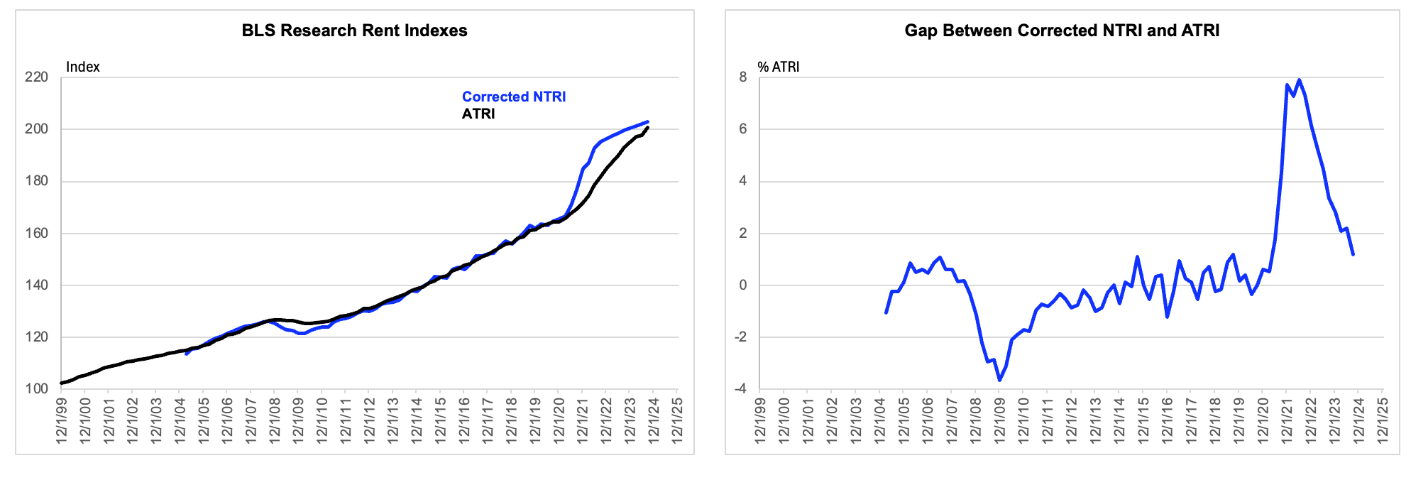
In real time application, the rate of inflation in the NTRI is unreliable because the contemporaneous vintage data are very heavily subject to revision. However, seasoned vintages of the NTRI are reliable and very clearly lead the ATRI, which in turn leads the government measures of average rent inflation by one quarter. That the BLS measures of marginal and average rents are systematically linked is hardly surprising! And it would be unwise to try to beat the BLS at their own game, but that is exactly what you are doing if you ignore these data. Moreover, CoreLogic’s SFRI provides a reasonably decent proxy of what the NTRI will show upon seasoning, roughly two years in. Accordingly, we can use the SFRI to correct recent, say, the last 8 quarters of the NTRI data to get a sense of how the NTRI and ATRI might roughly relate to one another in level terms upon revision. I am skipping over the technical detail here in the interest of brevity and because I have covered all this in gory detail in earlier notes.
The BLS measure of marginal rents leads the BLS measure of average rent, unsurprisingly
Source: BLS, FH calculations and corrections
ATRI data are actual to 2024 Q3. NTRI data are actual to 2022Q3. An inflation rate of 2.3% (ar) sequentially is imposed from 2022 Q3 to 2023 Q3. And a rate of 1.7% is imposed for 2023 Q3 to 2024 Q3.
The chart above compares the level of this “corrected” NTRI with the ATRI. Note that the gap between the NTRI and ATRI – in level terms – now appears to have closed almost fully as of the third quarter of last year. As a result, there is no longer any apparent need for average rents to run ahead of sequential marginal rent growth to close that gap or, in more technical terms, to achieve that “error correction.” Rather, the best guess is that the ATRI should run at roughly the rate of true sequential marginal rent inflation and lead the government measures of average rents by about a quarter, as mentioned, for reasons I have been over in earlier notes.
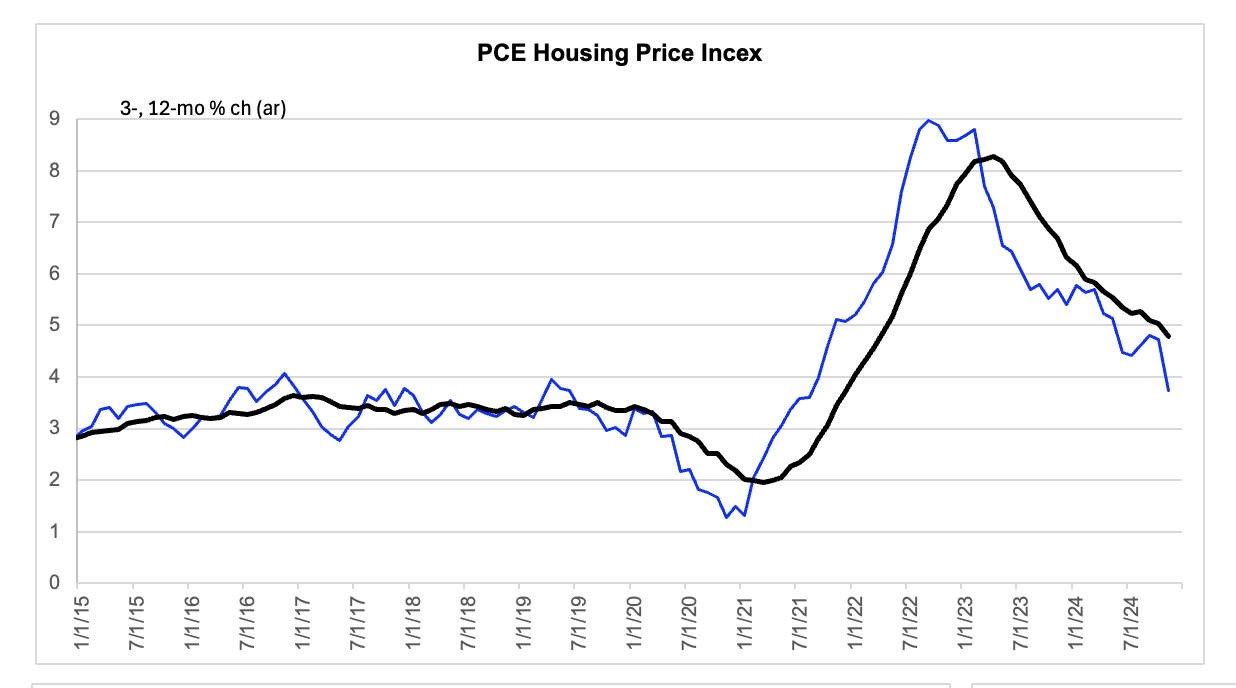
The pause in the disinflation of government average rents was itself probably transitory
Source: BEA
Data are actual to November.
And right on cue, the government measures of average rents showing up in the CPI and PCE Price Index, the latter as above, seem to be making their final deceleration back into the normal range. The PCE Housing Price Index was up 23 basis or at an annualized rate of about 2 ¾% during November. The 3- and especially 12-month rates are higher, but the odds of them continuing to grind lower, the latter steadily, would seem to remain quite high. To repeat, the timing here is a bit too convenient to be more than a fluke. My template here is meant to beat the consensus but there is no way it could work this precisely. It fits is all. And that obviously does not count against it.
Now, let’s conclude with a part of this story that does not fit so well. For the past few months, I had been pushing the view that Fed Chair Powell shared my view that apparently low marginal rent growth meant that the government measures of average rents were also virtually fated to slow, just with a timing that was somewhat uncertain. An implication of this take was that we should put a heavy weight on the apparent trend in marginal rents and not fuss too much about those hugely lagging government measures of average rents, in the CPI and PCE Price Index. And it would follow that the Observed Rent versions of the various slices of the PCE Price Index would be the more relevant ones, when trying to assess the outlook for Fed policy. But at the last Press Conference Jay Powell seems to have changed his story somewhat. In response to a question, he mentioned that he was relieved to see the disinflation highlighted in the chart immediately above, because he was “worried” by the earlier persistent high readings there. But he can’t have it both ways. He can’t be dismissive of the high readings and then later express relief when the data he had earlier dismissed shows disinflation. I am less confident I understand his actual position here than I was. I do wish these guys would be less attracted to the noble lie. It gets a bit irritating after a while. Then again, it won’t matter much practically, if average rent growth continues to decelerate toward a persistently low rate of estimated marginal rent growth.
I should mention as an aside here that I have made no call on the SFRI or ZORI or other measures of marginal rents. My call is that these data matter and can provide a useful lead if used properly, especially (recently) in conjunction with the experimental BLS data, NTRI and ATRI. I have no reason to expect marginal rent growth to seemingly hook higher, but if it were to happen, I would react to that.

