Back Economics

Powell’s “core GDP” trending at 3% in 2024 H2

Published on December 19, 2024

Download the PDF Report

By

Gerard MacDonell

In the Press Conference following the FOMC meeting yesterday, Fed Chair Powell referred to what has recently come to be known as “core” GDP: Final Sales to Private Domestic Purchasers (FSPDP).  He mentioned that its persistent strength justified probing more carefully (i.e., slowly) downward to find the so-called neutral funds rate.  


Whether thinking in terms of the neutral funds rate is appropriate is a separate discussion. But let’s redefine what Powell calls “neutral” as where he thinks the terminal funds rate for this episode might be.  Theoretical neutral does not enter into it, for many reasons, one of which is that the funds rate spends little time at neutral. But we all know what he means.  If he expresses confidence that neutral is lower, then Powell plans on going lower, and vice versa.[1]

 Powell’s Core GDP


Source: BEA, NBER, FH calculations and estimate
Data are actual to Q3 and estimated to Q4.

With this morning’s second revision to the third quarter National Accounts, the rate of growth of FSPDP was revised from 3.2% (ar) to 3.4%.  This upward revision was driven roughly equally by upward revisions to PCE and private investment, inclusive of housing.  Based on my tracking of real PCE and the Atlanta Fed’s current guess for the rest, I figure that FSPDP is on track to be up at a rate of about 2 ½% during the fourth quarter.  That would leave the 2-quarter growth rate just marginally below the 3% pace, around which it has oscillated in a narrow range for the past two years.  


With the supply side of the economy likely now getting slightly less strong, as the earlier immigration surge abates, there should be a natural tendency for realized demand growth to follow potential-demand growth lower, even without any impetus from financial conditions.  But the case for a shift to below-potential growth seems unconvincing, although Powell continues to reference it, primarily by invoking prospective weakness in hiring.  So far, he has been wrong about this, although hiring itself has downshifted and the employment / population ratio has fallen.  If anything, I overstated how these developments would affect Powell’s commentary yesterday. 


Separately, no inventory overhang


Changing subjects now, the data just released suggest that the flow of inventory investment slowed from $ (2017) 72 billion in Q2 to $58 billion in Q3, delivering a negative 20 basis point hit to GDP growth (which is excluded from the FSPDP calculation, by design).  Looking forward, the important point here is that the flow of inventory investment remains very close to the “normal” pace implied by the presumption that the I/S ratio continues its gentle descent and that final sales of goods and structures runs at a normal pace.  My estimate of “normal” here — $62 billion — might be off by $20 billion. But that is peanuts compared to the cyclical variability in the flow of inventory investment.  The far more important point is that it is the inventory flow that is mean reverting around normal and not the I/S ratio.  A spike in the I/S ratio is often followed by a huge impetus from inventories, although I need not get into why here. 


Up-&-down economists often let slip otherwise but you may be confident that they are wrong when they do so.  For whatever it is worth, the I/S ratio looks depressed, so this would not be an issue even if those wrong economists were not wrong.  But looking at it correctly, there is no obvious imbalance on the inventory side, in the Q3 data or as implied by the consensus view that inventory investment quickened marginally in Q4.  From here, the flow of investment seems as likely to quicken as decelerate.[2]

 Not currently an issue either way
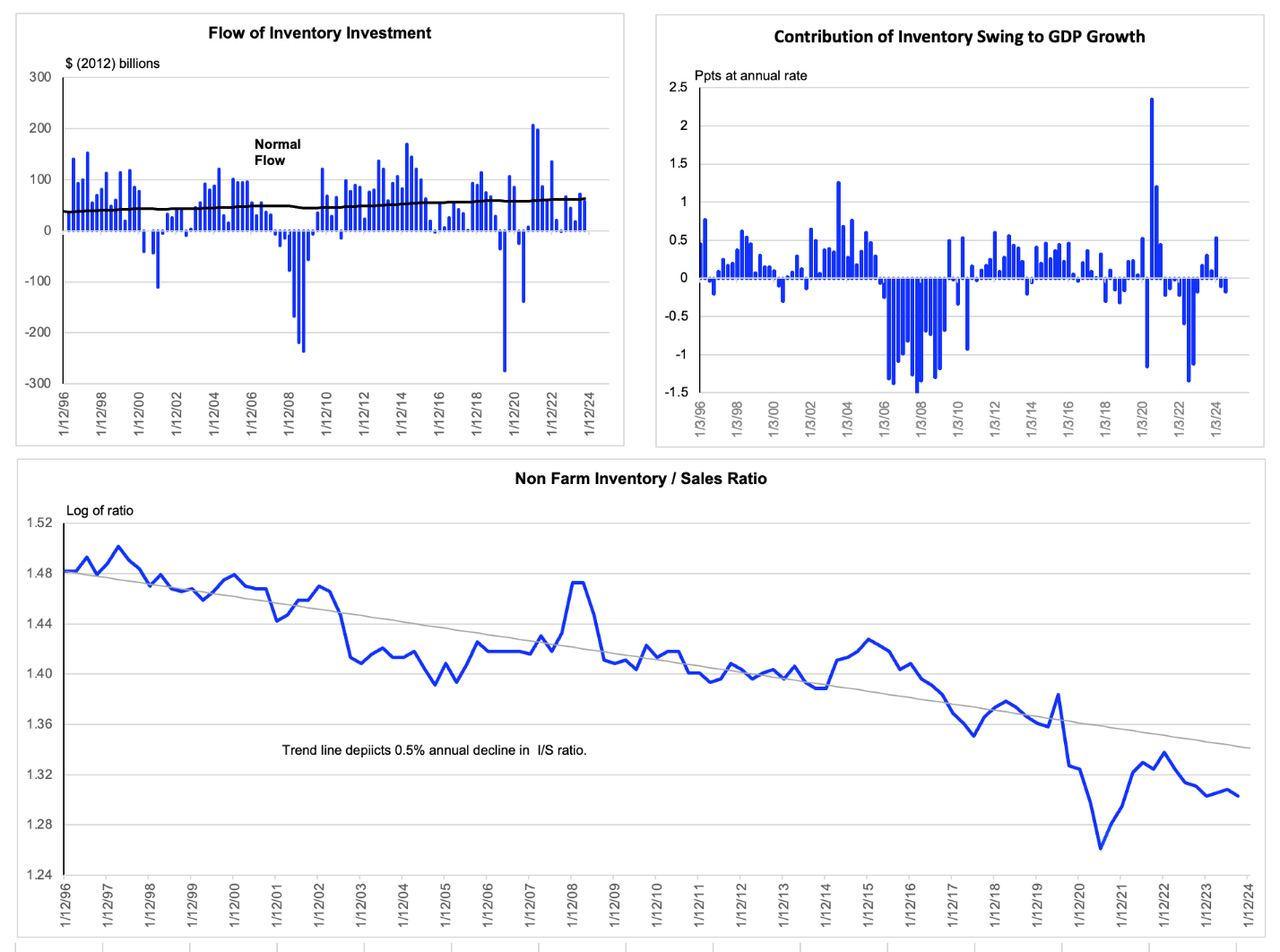

Source: BEA, FH calculations
Data are actual to Q3, although little will have changed during Q4.

[1] We can think of the “short-run” neutral as being a function of the cyclical position of the economy and the mapping of the funds rate to financial conditions.   But in that case, we should just watch the cyclical position of the US economy and financial conditions. And this is what the Fed in fact does, which is why they are backing away from signaling significantly further rate cuts even though the theoretical neutral that they occasionally quantify has not moved much. Neutral cancels out of the algebra here, which is why Ockham would say don’t obsess over it. The bond market needs an estimate of neutral. Indeed, the market is a permanent state of updating that estimate.  But the idea does not guide actual Fed rate decisions. 

[2] Up-&-down economist is a term of derision invented by Paul Krugman.  You call one in to go on the TV to say why the market went up or why it went down. It is aimed at my ilk, but I think the term is wonderful. 

DISCLOSURES AND DISCLAIMERS

Analyst Certification

The analyst, 22V Research Group, primarily responsible for the preparation of this research report attests to the following: (1) that the views and opinions rendered in this research report reflect his or her personal views about the subject companies or issuers; and (2) that no part of the research analyst’s compensation was, is, or will be directly related to the specific recommendations or views in this research report.

Analyst Certifications and Independence of Research.

Each of the 22V Research analysts whose names appear on the front page of this report hereby certify that all the views expressed in this Report accurately reflect our personal views about any and all of the subject securities or issuers and that no part of our compensation was, is, or will be, directly or indirectly, related to the specific recommendations or views of in this Report.

22V Research (the “Company”) is an independent research provider. The Company is not a member of the FINRA or the SIPC and is not a registered broker dealer or investment adviser. 22V Research has no other regulated or unregulated business activities which conflict with its provision of independent research.

22V Research, LLC is a professional services and independent publication organization. 22V Research, LLC is not a securities broker-dealer, not a member of the Financial Industry Regulatory Authority (FINRA), not a registered investment advisor (RIA) and not a member of SIPC.

Securities transactions, when offered, are offered by 22V Securities, LLC through LPS Capital, LLC. Certain employees of 22V Securities, LLC are dually registered as securities representatives of LPS Capital, LLC or Analyst Hub Securities, LLC. 22V Securities, LPS Capital and Analyst Hub Securities are members FINRA, SIPC.

https://brokercheck.finra.org/

Current Ratings Definition.

SECTOR OUTPERFORM: An “outperform” rating anticipates the company will outperform the S&P Regional Banking Index (peer group).

SECTOR PERFORM: A “market perform” rating anticipates the company will perform in line with the S&P Regional Banking Index (peer group).

SECTOR UNDERPERFORM: An “underperform” rating anticipates the company will underperform the S&P Regional Banking Index (peer group).

Limitation Of Research And Information.

This Report has been prepared for distribution to only qualified institutional or professional clients of 22V Research Group. The contents of this Report represent the views, opinions, and analyses of its authors. The information contained herein does not constitute financial, legal, tax or any other advice. All third-party data presented herein were obtained from publicly available sources which are believed to be reliable; however, the Company makes no warranty, express or implied, concerning the accuracy or completeness of such information. In no event shall the Company be responsible or liable for the correctness of, or update to, any such material or for any damage or lost opportunities resulting from use of this data. Nothing contained in this Report or any distribution by the Company should be construed as any offer to sell, or any solicitation of an offer to buy, any security or investment. Any research or other material received should not be construed as individualized investment advice. Investment decisions should be made as part of an overall portfolio strategy and you should consult with a professional financial advisor, legal and tax advisor prior to making any investment decision. 22V Research Group shall not be liable for any direct or indirect, incidental or consequential loss or damage (including loss of profits, revenue or goodwill) arising from any investment decisions based on information or research obtained from 22V Research Group.

Reproduction And Distribution Strictly Prohibited.

No user of this Report may reproduce, modify, copy, distribute, sell, resell, transmit, transfer, license, assign or publish the Report itself or any information contained therein. Notwithstanding the foregoing, clients with access to working models are permitted to alter or modify the information contained therein, provided that it is solely for such client’s own use. This Report is not intended to be available or distributed for any purpose that would be deemed unlawful or otherwise prohibited by any local, state, national or international laws or regulations or would otherwise subject the Company to registration or regulation of any kind within such jurisdiction.

Copyrights, Trademarks, Intellectual Property.

22V Research Group, and any logos or marks included in this Report are proprietary materials. The use of such terms and logos and marks without the express written consent of 22V Research Group is strictly prohibited. The copyright in the pages or in the screens of the Report, and in the information and material therein, is proprietary material owned by 22V Research Group unless otherwise indicated. The unauthorized use of any material on this Report may violate numerous statutes, regulations and laws, including, but not limited to, copyright, trademark, trade secret or patent laws.
