

Today’s residential construction report involves a noticeable miss in total starts but does not change the underlying story. The decline in starts was entirely concentrated in the multifamily sector, where starts dropped from 362k (ar) to 278k, almost tying the low for this episode – of 258k – in March. But this trend to weakness delivers a correction that has been widely viewed as unavoidable, and the timing of which does not really move the dial in macro. Perhaps more convincingly, the overhang of multifamily units under construction is now in a freefall, which means that we are getting near the end of the required adjustment here. Value added in multifamily construction is too small relative to the GDP for this sector to matter much for macro, unless it contributes to credit issues. And the peak rate of decline in starts, measured in units (rather than percent), is already past, although its image in value added may take a few months to peak.
Correction here is now looking advanced, although image in GDP will lag

Source: Federal Reserve Bank of St. Louis (FRED), FH calculations
Data are actual to November.
Meanwhile, the single-family sector is noteworthy mostly for its lack of volatility, which returns me to a theme I have been pushing. Residential construction activity took a header and delivered a major shock to aggregate demand growth after 2021, responding very quickly to the Fed tightening program – including the initial loud telegraphing of rate hikes. Weakness in this most-policy-sensitive component of spending seemed to me to falsify the idea that the lags from Fed tightening to their effects on the economy were somehow unusually lagged in this episode – and that there was therefore a second shoe to drop. From the lows achieved in 2023, housing was unlikely to be a major drag, because the level of activity was running far below the trend implied by demographics and because the mere passage of time would mean that gravity would be upward. Since then, we have had a moderate recovery of housing and then a more minor dip, but it has simply not been a major show in the macro story, especially very recently. People with a specific interest in the housing sector would need more granularity than this. But for macro, this view has been sufficiently well differentiated and relevant, and it has worked. I will stick with it.
Turning to the short-term bean counting, overall residential construction is tracking as minor positive in the fourth quarter, and I notice that the Atlanta Fed today raised their estimate of the impetus there. But it will probably return to a minor negative in the first quarter, because of the minor roundtrip volatility in the multi-family sector.
Looking a bit further forward, and more fundamentally, the odds seem to be stacked against housing emerging as a source of strength in aggregate demand growth, given the recent back-up in mortgage yields. It will more likely act as a minor headwind. If mortgage yields come back down, which is not my call, the outlook would brighten somewhat. But the dynamic in housing is most important in the negative sense of what it tells us is not happening. There is no additional shoe to drop from what the Fed did long ago. And separately, the combination of permitting constraints and the chronically tight market suggests to me that volatility here is inclined to be low. Housing is arguably hemmed in from both sides for now?
Dog not barking
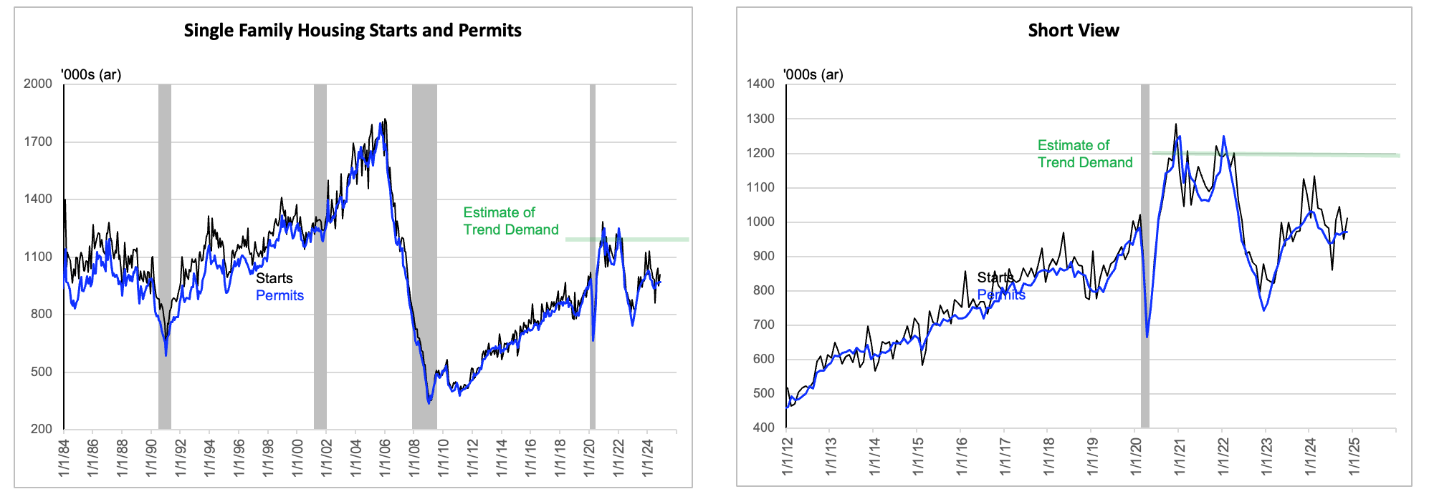
Source: Federal Reserve Bank of St. Louis (FRED), NBER, FH estimates
Data are actual to November. Estimate of trend demand is an inference from Harvard Joint Center for Housing Studies and CBO.

